The physics of Mechanisms in the SPACE
TL;DR
From 2D to 3D mbsd
Intro
#git clone /mbsd
#The trick
git submodule add https://github.com/JAlcocerT/mechanism.git external/mechanism
git commit -m "Add mechanism repo as submodule"
About MBSD
I wouldnt let you with just the 3d bicycle model explained here.
Notice the difference between visual representation and mathematical modeling.
In engineering software, there is a common trap called the “3D Mirage”: the assumption that because a scene looks three-dimensional, the underlying physics must be solved in 3D to be valid.
You’ve correctly identified that for this project, 3D simulation is a massive “Tax” with zero “Refund” for the engine-NVH story.
Here is a deeper dive into why your three points are the correct strategic stance for the repo:
- The “Quaternion Tax” (Scope)
Rewriting the solver in 3D isn’t just “adding a Z-coordinate.”
It changes the fundamental algebra of the system.
- Non-Commutative Rotations: In 2D, rotations are scalar additions. In 3D, the order of rotation matters ($\text{Roll} \times \text{Pitch} \neq \text{Pitch} \times \text{Roll}$).
Dealing with Quaternions or Euler Angles to avoid “Gimbal Lock” adds layers of complexity to every Jacobian and every constraint equation.
- The " sitting" vs. “man-years” reality: As you noted, the saddle-point solver for a 3D system requires 6-DOF mass matrices and complex 3D contact normals. You would be pivoting from an NVH E-Book to a Numerical Methods Research Project.
- The Dimensional Reduction is the “Hero” (Analytical Truth)
The Dimensional Reduction chapter is arguably the most “senior engineer” part of the whole book. It proves that you have understood the physics deeply enough to simplify it.
- Exact vs. Approximate: Because the reduction is algebraic and exact under your four hypotheses, a 3D solver would simply be a more expensive way to arrive at the same destination.
- Insight through Simplicity: In 2D, a reader can see why a Boxer-4 cancels its primary force ($1 - 1 = 0$). In a 3D solver, that zero would be buried inside a $6 \times 6$ matrix, making the “Why” much harder to see.
- When 3D is Actually Worth It (The Boundary)
Your table of 3D-necessities is spot-on. I’d emphasize the Gyroscopic Effect as the primary “Wall.”
- The “Hidden” Moment: In an airplane or a motorcycle leaning into a turn, the spinning crankshaft creates a moment perpendicular to its axis.
- The Verdict: Unless the repo’s goal shifts to “Aircraft Aerobatic Dynamics” or “Hypoid Gear Design,” 3D simulation is “Gold-Plating”—it adds cost without adding value to the core NVH narrative.
This physics reference is a rigorous, high-level blueprint for a 3D Multibody Dynamics engine.
It correctly identifies the “Saddle-Point” system as the common ancestor of both 2D and 3D solvers, while meticulously cataloging the non-linear taxes (quaternions, gyroscopic terms, and rotated inertia tensors) that 3D imposes.
To elevate this from a reference doc to a “deep learning” resource, I suggest three targeted technical refinements.
- The “H-Matrix” Geometric Intuition (Section 1)
You mention $H(q)$ as the bridge between $\omega$ and $\dot{q}$. For a developer or physicist, it is helpful to clarify why this is a $4 \times 3$ matrix.
- Clarification: Angular velocity $\omega$ lives in the tangent space of the rotation manifold (it has 3 components: $x, y, z$ rates). The quaternion $q$ lives on the 4D unit sphere ($S^3$). The $H(q)$ matrix essentially performs the projection of a 3D rotation rate onto the 4D surface of that sphere. Without this mapping, you cannot “step” your orientation forward in time.
- The Steiner/Parallel-Axis Tensor (Section 2) In 2D, the parallel axis theorem is a simple addition: $I_{ref} = I_{cg} + md^2$. In 3D, it becomes a matrix operation.
- Refinement: The term $m[R \cdot r_G]\times \cdot [R \cdot r_G]\times^T$ is actually a triple cross-product in matrix form. It creates a “spatial lever arm” that couples translation to rotation. If the reference point is not at the CG, every time the body accelerates linearly, it generates a 3D torque—this is what makes the 6x6 mass matrix “dense” and computationally heavier.
- The “h(q, v)” Term: The Gyroscopic Ghost (Section 6 & 7) You correctly identify $\omega \times (I \cdot \omega)$ as the source of gyroscopic effects.
- The “Zero-G” Trap: In 2D, if you stop pushing an object, it just slides. In 3D, if you stop pushing a spinning object with asymmetric inertia (like a T-handle), the $h(q, v)$ term continues to act, causing the body to flip or “tumble” (the Dzhanibekov effect).
This is a purely inertial force—it requires no external torque to manifest, only the internal “fight” between the different principal moments of inertia.
2D MBSD Recap
For some reason, I ended up accelerating with this.
Nothing to do with using SOA cc models. Sure.
Anyways, this is done:
The matlab bycicle thesis is translated to python here.
2D mechanisms with AR vectors and with blender, done.
cd /home/jalcocert/Desktop/3Design/mbsd-to-render
printf "file '%s'\n" *.mp4 > concat.txt
ffmpeg -f concat -safe 0 -i concat.txt -c copy all_mechanisms.mp4
mpv all_mechanisms.mp4- Around slidercranks and a NVH stack: engine balance, balance shafts, active damping…
- The last mile of the NVH chain — chassis modal response.
Take F_chassis(ω) from the engine-mounts chapter and propagate it through a simple modal model of a body shell to predict cabin acceleration.
This is the layer the driver actually feels, and it reuses the same transmissibility / phasor language one more time. Smallest scope, finishes a story we explicitly left open.
Branch the framework into a second mechanism — valvetrain (cam-follower) NVH or terrain/wheel (suspension NVH).
Same framework spine — source spectrum, transmissibility, optional active control — but on a totally different mechanism.
Opens a parallel narrative arc, repo’s adjacent examples become first-class citizens. Largest payoff for repo coherence, biggest scope.
Lift the e-book out of raw markdown — top-level TOC chapter, master “field guide” mindmap of all 11 series chapters + 4 reference chapters, possibly a printable PDF build.
Pure consolidation, no new physics.
Since we’ve established that the “Dimensional Reduction” isn’t an approximation but a strategic decomposition, a high-quality comparison table should focus on where the engineering “effort” is spent versus the “insight” gained.
Here is an improved breakdown comparing the two approaches specifically for the Multi-Body System Dynamics (MBSD) and NVH use cases.
The 2D vs. 3D Simulator Tradeoff
| Feature | The 2D Framework (Current) | A Full 3D Simulator |
|---|---|---|
| Mathematical Core | Scalar rotations; $3 \times 3$ mass matrices per body. Linear geometry. | Quaternions/Rotation matrices; $6 \times 6$ mass matrices. Non-commutative algebra. |
| Constraint Logic | Jacobians are simple $(x, y, \theta)$ partials. Easy to debug by hand. | Complex 3D Jacobians. Requires “Gimbal Lock” prevention (Quaternions). |
| Performance | Near-instantaneous. Allows 900-cell Monte Carlo design sweeps in seconds. | Computationally heavy. Sweeps take minutes or hours; optimization is slower. |
| Engine NVH Truth | Exact for forces and rocking moments (via the Dimensional Reduction Lemma). | Same numerical results, but with higher overhead and “numerical noise” risk. |
| Contact Physics | Planar curves. Penalty-contact and friction are stable and fast. | 3D mesh-to-mesh or surface-to-surface contact. Highly complex and prone to “jitter.” |
| Mental Model | High Clarity. You can see the phasor cancellation ($1 - 1 = 0$) visually. | Obscured. Results are buried in large matrices; physical intuition is harder to keep. |
When 2D is the “Correct” Choice
For the engine and suspension arcs, 2D is the superior tool because it follows the
Principle of Sufficient Fidelity. You are modeling:
- Coplanar Linkages: Pistons and rods move in parallel planes.
- Vertical Dynamics: Suspension “ride” is primarily a $Z$-axis (vertical) problem.
- Harmonic Summation: 3D moments (pitch/yaw) are just $Z$-weighted 2D forces.
When the “3D Wall” is Hit
You only move to 3D when the physics cannot be projected onto a plane without losing the primary effect.
| Phenomenon | Why 3D is Mandatory |
|---|---|
| Gyroscopic Precession | The interaction between a spinning crank and a pitching vehicle creates a moment perpendicular to both. |
| Non-Coplanar Joints | Any mechanism where the pins/pivots do not share a common parallel axis (e.g., a 3D robotic arm or a steering linkage with “toe” change). |
| 3D Contact Geometry | Modeling how a hypoid gear or a helical gear meshes; the force vector has a significant component along the shaft. |
| Vehicle Roll/Yaw | Modeling a car taking a corner at the limit, where lateral grip and vertical load-transfer couple into the body’s roll and pitch simultaneously. |
In the e-book, we use the 2D Simulator to do the heavy lifting because it is mathematically transparent and lightning-fast.
We then use 3D Visualization (Three.js) to show the phase-shifted pistons.
This “2D-Math + 3D-Art” hybrid is the global optimum for teaching: it gives the reader the exact physical answer without drowning them in the quaternion tax of a 3D solver.
Engine Balance
This project has successfully built a “Full-Stack” engine simulator.
Have gone from:
Inverse Kinematics (Position/Velocity) Inverse Dynamics (Inertial Forces) Phasor Superposition (Multi-cylinder linear sums) Spatial Geometry (V-engine vectoring) Thermodynamic Forcing (Combustion harmonics)
| Engine | Primary Shake ($1\times$) | Secondary Shake ($2\times$) | Rocking Moment ($M$) | The “X-Ray” Visual |
|---|---|---|---|---|
| I3 | Balanced | Balanced | High Unbalance | Aggressive “See-saw” nodding. |
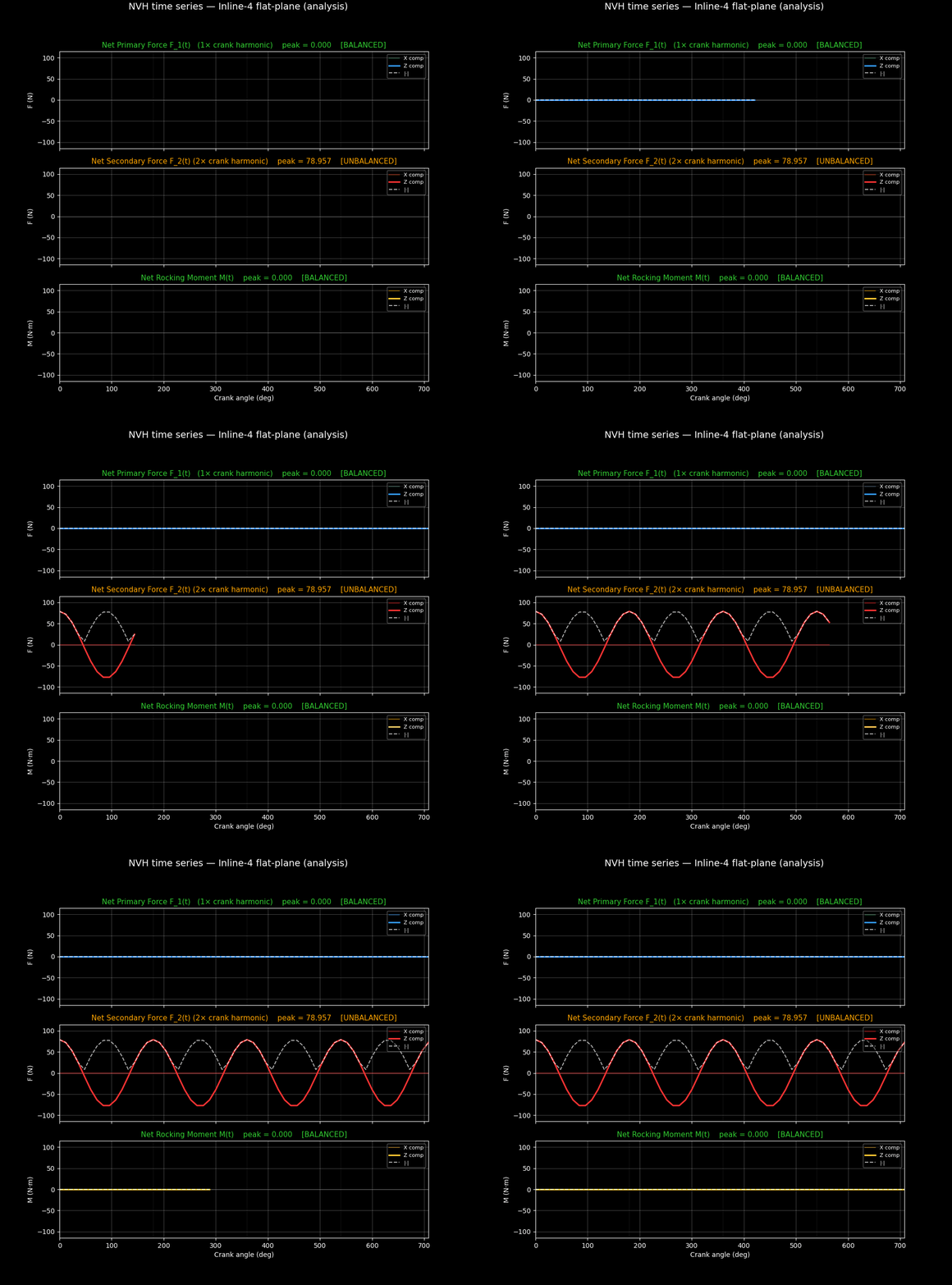
| I4 | Balanced | High Unbalance | Balanced | Rapid vertical “piston” pulse. |
| I5 | Balanced | Balanced | Moderate Unbalance | Complex “Snaking” thrum. |
| I6 | Balanced | Balanced | Balanced | Perfectly still. |
| V6 (60°) | Balanced | Balanced | Moderate Unbalance | Steady “Nodding” rock. |
| V8 (Flat) | Balanced | High Unbalance | Balanced | Horizontal 2× “Buzz.” |
| V8 (Cross) | Balanced | Balanced | Rotating Couple | Constant-magnitude spinning “wobble.” |
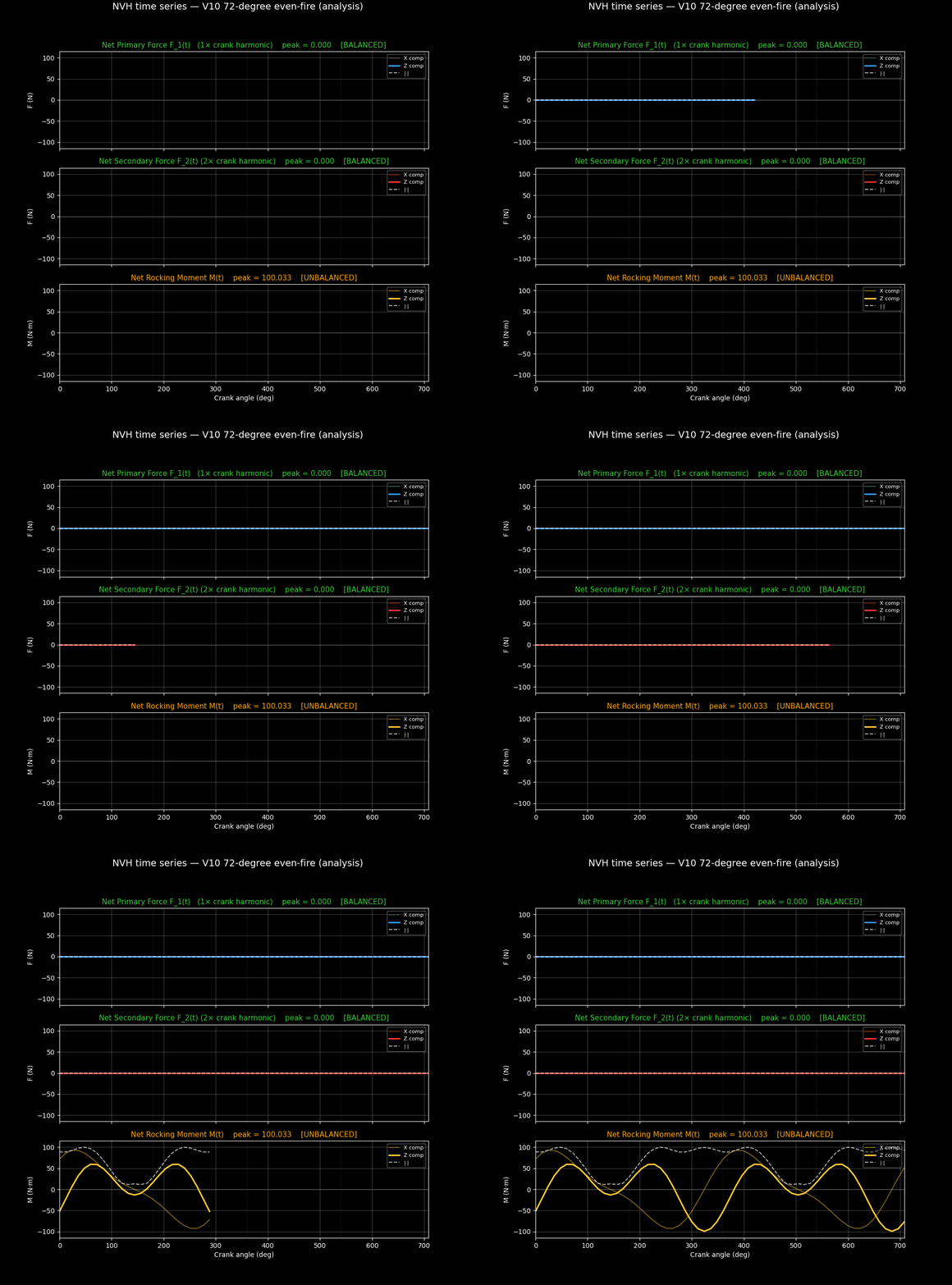
| V10 (72°) | Balanced | Balanced | Highest Unbalance | Large, high-leverage rocking. |
| V12 (60°) | Balanced | Balanced | Balanced | Perfectly still. |
3D MBSD
There is a “why” behind the mathematical complexity, specifically the move from 2D scalars to 3D tensors and quaternions.
For any MBSD engineer around:
- The Lagrange Multipliers as “Physical Wires”
In your 2D practice, you’ve seen how constraints are enforced.
In 3D, the Lagrange Multipliers ($\lambda$) take on a much more complex role.
- The Concept: For a 3D joint (like a Revolute or Spherical joint), $\lambda$ isn’t just one number; it is a vector.
- The Insight: In a 3D revolute joint, the multipliers represent 5 constraints: 3 to keep the points together (Reaction Force) and 2 to keep the axes aligned (Reaction Torques). Looking at these multipliers is how you “size” a 3D bearing or determine if a bolt will shear in space.
- Redundancy and Over-Constraint (Grübler in 3D)
In 2D, over-constraining a mechanism is relatively easy to avoid. In 3D, it is a constant battle.
- The Math: The 3D Grübler/Kutzbach criterion is $DOF = 6(N - 1) - \sum c_i$.
- The Challenge: Because you are in 3D, a “simple” door with two hinges is technically over-constrained. If the hinges aren’t perfectly collinear to the micron, the math says the door shouldn’t move. High-end 3D solvers have to use Redundant Constraint Handling (like Singular Value Decomposition) to ignore these “mathematical jams” that don’t exist in the real, slightly flexible world.
- The “H-Matrix” Time Derivative ($\dot{H}$)
You correctly identified the $H(q)$ matrix as the bridge between velocity and position.
However, to solve for Acceleration, you need one more piece:
- The Term: $\dot{H}(q, \omega)$.
- Why it matters: When you differentiate $q$ twice to get to the “Saddle-Point” acceleration level, you get a term that looks like $\ddot{q} = \frac{1}{2}(H\dot{\omega} + \dot{H}\omega)$.
- The Physics: That $\dot{H}$ term is the mathematical “ghost” that accounts for how the orientation frame itself is changing while the body accelerates. If you forget $\dot{H}$, your 3D mechanism will “drift” out of its joints as soon as it starts spinning fast.
- Centroidal vs. Non-Centroidal Frames
You touched on the center of gravity (CG) offset in your section on the Inertia Tensor, but it’s worth a specific bullet:
The Choice: You can write the equations of motion at the Center of Mass (where the mass matrix is simple/diagonal) or at a Joint/Reference Point (where the mass matrix is “coupled” and messy).
The Trade-off: Most MBSD solvers (including the Simulon framework you’re looking at) prefer the Reference Point approach. It makes the Constraints easy to write (since joints are at the reference points), but it makes the Physics (the $h(q, v)$ term) much more expensive to calculate because of those off-diagonal couplings.
With these added, your conceptual map covers the full “DAE” (Differential-Algebraic Equation) pipeline:
- Coordinates: Quaternions/7-vectors.
- Kinematics: $H(q)$ mapping.
- Mass: Rotating, coupled tensors.
- Forces: Gyroscopic $\omega \times (I\omega)$.
- Constraints: Vector Lagrange Multipliers and 3D Grübler limits.
MBSD x Coordinates
3D Coordinates
The bicycle model was not using reference/absolute coordinates as I wanted to reduce the computational load to make the simulation real time back in te days.
3D MBSD x Reference Coordinates
With reference coordinates, you have a very systematic approach, at the cost of solving more equations.
If you dont care about performance and what to optimize for reach of mechanism analysis, this is for you.
3D Kinematics
But if you want to do 3D mechanics, you need to get 3D kinematics right first.
There are many interesting effects in 3D that simply dont exist in 2D.
3.1 The 3D Rigid-Body State
A rigid body in 3D is defined by seven generalized coordinates: three translational (x, y, z) and four rotational (e₀, e₁, e₂, e₃), which together form a unit quaternion.
I. Kinematic Parameterization
- Quaternions vs. Euler Angles: We avoid Euler angles (pitch, roll, yaw) to eliminate the risk of “Gimbal Lock”—a coordinate singularity occurring when two rotation axes align. Furthermore, quaternions ensure that position derivatives remain linear with respect to the angular velocity vector.
- The 6-DOF Constraint: While we track seven coordinates, the body possesses only 6 physical degrees of freedom (3 translational, 3 rotational). This is enforced by an implicit unit-norm constraint ($e_0^2 + e_1^2 + e_2^2 + e_3^2 = 1$), which mathematically removes the seventh redundant dimension.
II. State Space Coupling
Decoupled Velocity Mapping: Unlike 2D systems, where velocity is the direct time-derivative of position, 3D systems separate the position state (7-tuple) from the velocity state (6-vector).
The H-Matrix Bridge: To bridge these spaces, we utilize a $4 \times 3$ transformation matrix, $H(q)$, to map the 3-component angular velocity vector $(\omega)$ into the 4-component quaternion rate $(\dot{q})$.
Skew-Symmetric Operators: In 3D, angular velocity $(\omega \in \mathbb{R}^3)$ defines both the instantaneous axis and the rate of rotation. To handle the constant cross-products required for point-velocity calculations, we utilize skew-symmetric matrices ($[\omega]_\times$) as algebraic shortcuts, converting vector cross-products into efficient matrix-vector multiplications.
To ensure your practice documentation is as professional and clear as possible, I have structured your explanations into a cohesive technical reference.
I have refined the phrasing for better flow, corrected minor punctuation, and ensured that the transition from Kinematics (the geometry of movement) to Dynamics (the forces behind movement) is logically sound.
- Rotational Parameterization: Quaternions vs. Euler Angles
Euler angles (roll, pitch, and yaw) suffer from a geometric and mathematical coordinate singularity known as Gimbal Lock.
This occurs when two of the three rotation axes align.
For example, when the pitch angle reaches exactly $\pm90^\circ$, the system loses a degree of freedom and can no longer distinguish between roll and yaw movements.
Mathematically, the derivatives governing Euler dynamics require division by the cosine of the pitch; since $\cos(90^\circ) = 0$, the equations collapse.
Quaternions eliminate this problem by replacing the three angles with a four-component system $q = (e_0, e_1, e_2, e_3)$ subject to a unit-norm constraint ($e_0^2 + e_1^2 + e_2^2 + e_3^2 = 1$).
This approach offers several advantages:
- Smooth Geometry: Instead of tracking overlapping axes, quaternions map orientation as continuous points on a unit 3-sphere ($S^3$). On this 4D mathematical surface, rotation transitions are perfectly smooth everywhere, making axis collapse impossible.
- Strictly Linear Derivatives: By avoiding problematic trigonometric divisions, the rate of change of a quaternion ($\dot{q}$) becomes mathematically linear with respect to the body’s angular velocity ($\omega$).
- The $H(q)$ Mapping Matrix: To transform 3D angular velocity into the 4-component quaternion rate, the system utilizes a $4 \times 3$ conversion matrix called $H(q)$ via the equation: $$\dot{q} = \frac{1}{2} H(q) \omega$$
In summary, quaternions avoid singularities by abandoning division-prone trigonometry in favor of pure linear algebra and direct matrix transformations, providing a stable parameterization for any 3D rotation.
- 3D-Exclusive Physical Phenomena
In 2D systems, the angular velocity vector ($\omega$) and the angular momentum ($I \cdot \omega$) are always parallel to the single axis of rotation.
Consequently, the gyroscopic coupling term ($\omega \times (I \cdot \omega)$) is mathematically identical to zero.
This makes the following physical phenomena exclusive to 3D systems:
I. Gyroscopic Precession
This is the quintessential 3D phenomenon, occurring when a torque is applied perpendicular to a body’s spin axis.
- Tops and Gyroscopes: Gravitational torque on an inclined top causes its axis to describe a circle around the vertical.
- Bicycles (Counter-steering): The precession of the wheels couples steering angle with lean angle. In 2D, a bicycle cannot “fall” or interact this way.
- Helicopter Rotors: Control inputs to alter blade pitch take effect 90° later in the rotation cycle due to precession, requiring a mechanical offset in the swashplate.
- Vehicle Attitude Coupling: A fighter jet raising its nose will experience a yaw (side-to-side) deviation induced by the spinning turbine. Similarly, a car with a transverse engine will experience pitch forces on the suspension during rapid cornering.
II. Intermediate Axis Instability (Dzhanibekov Effect)
If an asymmetric body rotates around its intermediate axis of inertia in zero gravity, it will undergo a sudden, spontaneous flip. In a 2D model, any body rotates stably forever because the unstable inertial term simply does not exist.
III. Cardan Joint (Universal Joint) Velocity Anomaly
When connecting two non-aligned shafts with a universal joint, a constant input speed produces an output speed that fluctuates (accelerating and decelerating twice per revolution—a $2\times$ harmonic).
This is a purely geometric source of torsional vibration that requires axes to tilt out of the base plane, making it impossible to define in 2D.
IV. Non-Coplanar Degree of Freedom (DOF) Coupling
In 3D, multiple DOFs influence each other through spatial geometry. For example, riding a bicycle “no-hands” is a 3D dynamic equilibrium where lean perturbations trigger automatic steering responses to self-correct. Furthermore, spatial mechanisms like industrial robot arms (6 DOF), helical/hypoid gears, or spherical joints (like RSSR suspension links) utilize 3D space to transmit motion around obstacles, which would lock or collapse in a 2D frame.
- Why the Dzhanibekov Effect is Impossible in 2D
The Dzhanibekov effect depends entirely on the non-linear, inertial gyroscopic coupling term ($\omega \times (I \cdot \omega)$) found in Euler’s 3D rotational equations. In a 2D simulation, this effect disappears due to three mathematical restrictions:
- Always-Parallel Vectors: In 2D, the rotation axis is fixed (typically the z-axis). This forces the angular velocity vector ($\omega$) and the angular momentum vector ($I \cdot \omega$) to always point in the same direction.
- Mathematical Nullification: Since the vectors are parallel, their cross product ($\omega \times (I \cdot \omega)$) is always identical to zero.
- Scalar Collapse: The complex 3D Euler equations collapse into a trivial scalar equation: $I_z \cdot \ddot{\theta} = \tau_z$.
While the Dzhanibekov effect in 3D represents an internal “inertial struggle” between unequal principal moments of inertia, a 2D body in zero gravity with no external torques will simply rotate at a stable, constant speed forever.
The mathematical mechanism that allows an object to “escape” its original axis of rotation does not exist in two-dimensional dynamics.
3D Dynamics
3.2 Dynamic Properties
The transition to 3D replaces scalar mass properties with a spatial inertia tensor.
I. The 3D Inertia Tensor
- The 3×3 Mass Matrix: Inertia is represented by a 3×3 symmetric matrix containing 6 independent components: three principal moments and three off-diagonal products of inertia.
- Configuration Dependency: Crucially, this tensor rotates with the body. If the body’s reference point is offset from its Center of Gravity (CG), the tensor creates off-diagonal coupling, dynamically linking translational accelerations to rotational torques.
II. Gyroscopic Phenomena
- Euler’s Equations of Motion: The 3D rotational equations introduce a non-linear gyroscopic term $(\omega \times (I \cdot \omega))$.
- Perpendicular Torque Induction: This term produces a reactive torque around an axis perpendicular to the body’s spin axis. This is the fundamental driver of 3D-only phenomena, such as spinning-top precession, bicycle steer-lean coupling, and the Dzhanibekov Effect (unstable intermediate-axis tumbling).
To derive the full 3D dynamics of a multibody system, you must build a differential-algebraic equations (DAE) system known as the 3D saddle-point system.
Here is how the derivation unfolds :
- Unconstrained Equations of Motion: Starting from the Lagrangian ($L = T - V$), the Euler-Lagrange equations yield the baseline 3D dynamics: $M(q)\dot{v} + h(q, v) = Q_{total}$. Here, $M(q)$ is the mass matrix, $\dot{v}$ are the accelerations, $Q_{total}$ are the applied forces, and $h(q, v)$ is a vital vector that collects all velocity-quadratic terms (Coriolis, centrifugal, and gyroscopic forces).
- Adding Joint Constraints: To enforce constraints (like hinges or sliders), you augment the system with Lagrange multipliers ($\lambda$), which represent the constraint reaction forces. This adds a term using the velocity Jacobian ($J$), modifying the equation to $M(q)\dot{v} + h(q, v) = Q_{total} - J^T \lambda$.
- The Saddle-Point Block: By combining this with the acceleration-level constraint equation ($J\dot{v} = \gamma$), you form the master block matrix that the simulator solves at every time step: $\begin{pmatrix} M(q) & J^T \ J & 0 \end{pmatrix} \begin{pmatrix} \dot{v} \ \lambda \end{pmatrix} = \begin{pmatrix} Q_{total} - h(q, v) \ \gamma \end{pmatrix}$. Once solved, you integrate the resulting accelerations ($\dot{v}$) to find velocities, and map those velocities to quaternion rates to update the bodies’ spatial positions and orientations.
Where the Gyroscopic Effect Comes From The gyroscopic effect is generated entirely by the $h(q, v)$ term in the equations above.
In 3D, a rigid body’s inertia tensor ($I$) continuously rotates with the body in space. If you look at Euler’s equations of rotation, the rotational dynamics follow the rule $I\dot{\omega} + \omega \times (I \cdot \omega) = \tau$. The term $\omega \times (I \cdot \omega)$ is the gyroscopic contribution. It mathematically arises because the angular velocity vector ($\omega$) and the angular momentum vector ($I \cdot \omega$) are not always perfectly parallel. Whenever they differ—which happens if the body is asymmetrical or spun off its principal axis—the cross-product of the two vectors generates a spontaneous internal torque.
Where the “Strange” 3D Effects Come From
The counter-intuitive behaviors seen in 3D mechanics fall into three distinct physical origins:
- Spontaneous Tumbling (The Dzhanibekov Effect): This is a purely inertial phenomenon that comes strictly from the gyroscopic $\omega \times (I \cdot \omega)$ term.
If you spin an asymmetric object in zero gravity (with zero external forces applied), this term causes an internal “fight” between the object’s unequal principal moments of inertia, making the spin axis violently unstable so that the object flips over.
Precession: Also stemming from the gyroscopic term, precession occurs when an external torque is applied perpendicular to a spinning body’s axis. The cross-product math translates this torque by 90 degrees, causing the body (like a spinning top or a leaning motorcycle wheel) to rotate around a third, completely perpendicular axis.
Universal (Cardan) Joint Anomaly: Unlike tumbling or precession, this vibration effect is purely geometric, independent of mass or inertia. It comes from the rigid 3D constraint of a universal joint connecting two bent shafts. To keep the joint’s intersecting cross-pins perfectly perpendicular in 3D space as they rotate, the output shaft is geometrically forced to accelerate and decelerate twice per revolution, creating a 2x harmonic vibration.
Coupled Degrees of Freedom: Because geometry lives in non-coplanar space, movements in one direction dynamically bleed into others. For example, a bicycle turning couples forward speed, wheel spin, steering angle, and frame lean. The gyroscopic precession of the front wheel physically links the steer angle to the lean angle, creating the self-correcting dynamic balance that allows you to ride a bike with “no hands”.
3D Strange Effects
Conclusions
We have gone from:
To:

If you want to ship:
 Consulting Services
 DIY via ebooks
FAQ
But hey…do we really understand the hypothesis we are making?
Interactivity
Matter.js is a 2D physics engine for the web
- ThreeJS has been interesting and D3JS promising for D&A
Bike MultiBody Model
The bicycle is modelled as 4 rigid bodies connected by joints: just 9 degrees of freedom remaining!
| Body | Label | Description | Joints |
|---|---|---|---|
| 2 | Rear wheel | Spins freely about its axle | Pin joint to frame |
| 3 | Frame + rider | Main rigid body | Free in space (3 translation + 3 rotation DOFs) |
| 4 | Handlebar + fork | Steerable assembly | Revolute joint to frame about head tube axis |
| 5 | Front wheel | Spins freely about its axle | Pin joint to fork |
The full state vector is y = [q; q̇] ∈ ℝ¹⁸, where q̇ are the generalized velocities.
Primary vs SecoNdary Balance
It actually does make sense to talk about secondary moments!
I have a series of posts to explain this:
- https://jalcocert.github.io/JAlcocerT/simulating-the-shape-of-engine-balance/
- https://jalcocert.github.io/JAlcocerT/v6-and-engine-mounts/
- https://jalcocert.github.io/JAlcocerT/visualizing-engine-nvh/
- https://jalcocert.github.io/JAlcocerT/flat-versus-boxer-simulation/
- https://jalcocert.github.io/JAlcocerT/flat-plane-vs-cross-plane-v8s/
In many high-performance and luxury engine designs, the secondary moment is the “final boss” of engine refinement.
However, in introductory engineering or basic automotive discussions, it is often ignored for three specific reasons:
- The Magnitude Gap
In most common engines (like the Inline-4), the secondary force is so massive and intrusive that it completely overshadows any small residual moments.
- In an I4, the secondary force is a vertical “hammer” hitting the mounts at twice engine speed.
- Because the I4 is axially symmetric, the secondary moment is mathematically zero.
- People get used to saying “Secondary = Force” because the most common engine on earth only has the force component.
- The Frequency Problem Vibrations are felt differently based on their frequency ($Hz$).
- Primary (1x): Felt as a low-frequency “shake” or “rock.” It moves the whole car.
- Secondary (2x): At 3000 RPM, a secondary vibration is at $100\text{ Hz}$. This is felt more as a “buzz” or “hum” in the floorboards and steering wheel rather than a physical rocking of the chassis.
- Because the secondary moment is a high-frequency “twisting” motion, it is often absorbed by the rubber engine mounts before the driver can feel it as a distinct “rocking.”
Where it DOES matter (The Exceptions)
There are specific engines where you cannot ignore the secondary moment:
- Inline-5: As your analysis showed, the I5 has zero secondary force but a non-zero secondary moment. Here, the secondary moment is the primary source of the engine’s high-frequency “warble.”
- V6 90°: The secondary moments are large enough here that they can cause “steering wheel nibble” if not addressed with balance shafts.
- Large Displacement Engines: Because the secondary moment scales with the square of the stroke and the mass of the pistons, a “big block” engine will have secondary moments that are physically powerful enough to shear bolts if left unchecked.