How is my Brand going? x Outbound System
Tl;DR
Hows my brand and outbound email marketing going?
Intro
- Why Im writting this post: bc if you are good, you should not be giving for free your upside
- What Ive learnt with it: Ive ended up being pragmatic and exploring how to help UK businesses
Ive started telling the agents why i need things and there has been some interesting surprises: like having my posts with draft=false into a future date to be effectively scheduled without me having to re-run Ci/Cd.
There will never be better weddings without the mail outbound and to lower the CaC, you can use email DRIP to increase the conversion rate to the people that was attracted, but didnt buy.
https://github.com/JAlcocerT/slubnechwile-chwile-y26-claude https://github.com/JAlcocerT/leads-slubnechwile https://github.com/JAlcocerT/slubne-chwile-y26
Videos
Ive…kinda been doing videos for a while: had this initial flow with OpenAI x OBS x Canva, which i upgraded in late 2024.
I had some thoughts around making data driven videos with streamlit, remotion…
But those had to wait, as I had to get an action cam and get in love with ffmpeg cli first, get gyroflow to brick my linux GUI and brick my pixel8
For automatic chapers see this script
To extract thumbnails from your video see this
I also went crazy and made some simple video edits with kdenlive
https://jalcocert.github.io/JAlcocerT/photo-video-tinkering/#video-editing https://jalcocert.github.io/JAlcocerT/photo-management-tools/
But things accelerated and I had a chat with a youtuber friend about text to video and brainrot shorts
But at the time i tried some animations as a code with python x matplotlib x financial data, then, made some map animations
https://github.com/JAlcocerT/DataInMotion
Later, i bite remotion x yfinance and also made data animations around f1 and its race data
https://github.com/JAlcocerT/eda-f1
Then, i tinkered around repo to post video
How could I not…use remotion for mechanisms videos
https://github.com/JAlcocerT/3Design https://github.com/JAlcocerT/mbsd
Not as a full time thing, not as a…minor thing.
But there has been output:
And in theory, there is nothing stopping you to go viral
VSL
I had to sit and ask myself: what do I do?
Concluded that: I do independent consulting work, driving business outcomes by building enterprise analytics systems
When you dont have a story line for chatting you are far from any sales pitch.
Promo Video
https://jalcocert.github.io/JAlcocerT/poc-101/#from-html-to-promo-video
PAS
Problem - Amplification - Solution
If you watch TV, you should be aware of that already.
Why not just RemotionJS
https://www.remotion.dev/prompts/cinematic-tech-intro
Gold Info for SoloPreneurs
You need to ship/fix/kill (quick).
Ideas Checklist 🚀
For this I dedicated a full post few weeks ago.
The general idea checklist is as follows:
Prospects/Clients Checklist 🚀
Conclusions
Any solar panel with no load has potential (V)
Yet, makes no actual work / provides power / throughput
Dont be an open solar panel, embrace the risk and opportunities:
Have made some upgrades to the site: https://consulting.jalcocertech.com/talks/ superseeding such https://consulting.jalcocertech.com/presentations/opco/slides
 Consulting Services
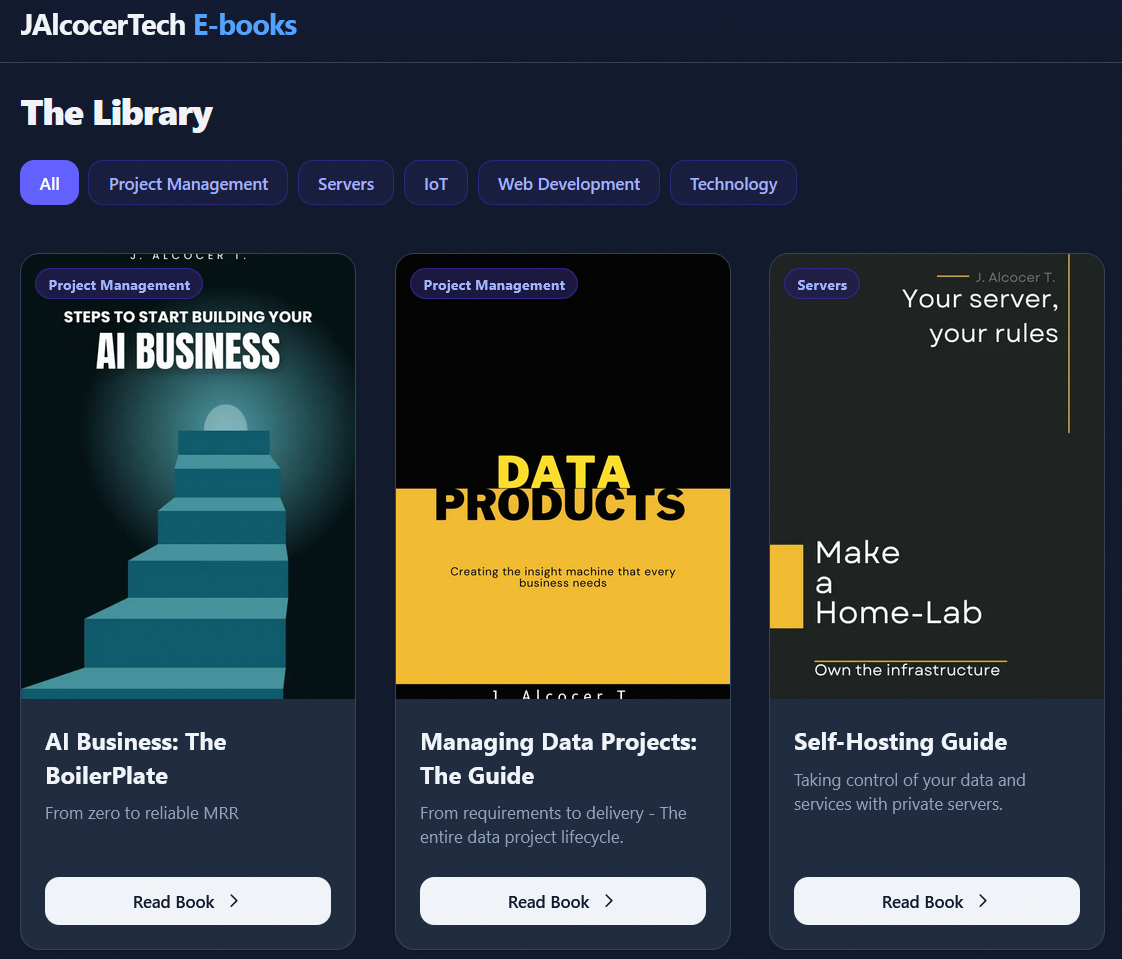 DIY via ebooks
You aren’t doing anything wrong technically. Everything we built works.
The problem is that almost all your effort goes into building and almost none into talking to buyers. Here’s what this session itself shows:
- You build for people who don’t buy.
- Who you write for: about 60 articles in a few weeks, nearly all “how I built X with Cloudflare, Workers, KV”. The readers are developers. Developers don’t hire consultants; they read the ebook and do it themselves.
- Who pays: business owners and team leads, who search for outcomes (“site is slow”, “app keeps breaking in production”), not tools.
- Five audiences, so nobody feels it’s for them.
- Who you speak to today: small-business site owners (audit), real estate agencies (white-label), data engineers and analysts (talks), PMs (coaching), and teams shipping AI (“Ship AI features”).
- What happens: a visitor can’t tell in five seconds that this is for them. Each extra audience makes the message weaker for the rest.
Your only clients came from people, not funnels. The hospital and real estate clients didn’t come through a form; they came from relationships. Meanwhile your biggest asset, 70+ LinkedIn recommendations, sits unused. Funnels convert attention you already have; they don’t create it.
The first step asks strangers for too much. Paying $235 is a fine filter for warm leads, but a cold visitor won’t pay someone they met two minutes ago. The audit is a good free first step, but it targets small-business websites while the paid call sells AI features: two different buyers.
Time is the real constraint. With two full-time jobs, building feels productive, but it’s the comfortable option; outreach and conversations are the uncomfortable ones. Be honest with yourself too: could you even deliver if three clients said yes next week?
What I’d do next: 30 days, almost no new building
Freeze the engine. It’s done. No new features until it has handled 10 real leads.
Pick one buyer and one offer for 90 days. You have the most evidence for one of these two:
- Small teams with a working app that’s painful to ship or run. Your case: the hospital CI/CD story. Offer: a fixed-price “make it shippable” engagement (containers, CI, HTTPS, monitoring), which can be done mostly async in your evenings.
- Real estate agencies. You have a live product, a price and a case study. But the agencies have to be found and contacted, which is the hardest part for someone with two jobs.
I’d pick the first. It’s closer to what you do every day, and it suits async delivery.
Have 10 conversations a week; write fewer articles. No cold email, because of the Polish rules we discussed. Instead:
- Your network: message the people who recommended you on LinkedIn, roughly: “I now help small teams make their apps shippable (versioned releases, CI, HTTPS). Do you know a team that’s struggling with this?” Referrals convert far better than any page.
- LinkedIn posts aimed at buyers: one post a week about an outcome (“A hospital team went from manual deployments to versioned releases”), not the tooling. Link the case study PDF.
- The audit as a conversation opener: when someone engages, offer to run their site and send them the PDF.
Measure conversations, not content. Track one number per week: real conversations with potential buyers. Ten conversations a week will produce a client long before 60 more articles will.
Check your Cloudflare analytics once. If the consulting site gets around 20 human visitors a week, the problem is attention, not conversion. Don’t tweak the site until traffic is there.
Measure the right things, starting now
Right now you can’t tell whether any of this works. I’d set up:
- Google Search Console for the three sites, with the sitemaps submitted. It’s free and shows which searches you appear for, months before clicks arrive. As far as I know it isn’t set up yet.
- Monthly visitors per site in your weekly ntfy digest, from Cloudflare’s analytics API. That’s about an hour of work in the homelab hub.
- The one number that matters for you: confirmed email subscribers. Your list is the asset you can use on launch day.
And prepare the launch for month 9
What I’d stop: building more infrastructure, and articles about how the plumbing was built.
The engine is done; nine months of plumbing articles brings readers who build things, not buyers.
I can do any of these next:
- Search Console for the three sites (needs a DNS TXT record per domain; you click “verify”).
- Visitors per site in the weekly digest.
- A 12-week content plan for the chosen buyer, with titles based on real searches.
- The launch checklist in core.
Google Search API
Google has APIs for almost all of it.
The one step that needs you is creating the Google credentials.
What the APIs cover
┌─────────────────────────────┬─────────────────────────────┬───────────────────────────────────┐ │ Need │ API │ Notes │ ├─────────────────────────────┼─────────────────────────────┼───────────────────────────────────┤ │ Stats: clicks, impressions, │ │ About 16 months of history, with │ │ CTR, average position per │ Search Console API → │ data 2–3 days behind. Once you │ │ search, page, country, │ searchanalytics.query │ verify a site you also see data │ │ device and day │ │ from before verification. │ ├─────────────────────────────┼─────────────────────────────┼───────────────────────────────────┤ │ Submit sitemaps │ Search Console API → │ │ │ │ sitemaps.submit / list │ │ ├─────────────────────────────┼─────────────────────────────┼───────────────────────────────────┤ │ “Is this page indexed?” │ URL Inspection API │ Quota of around 2,000 checks per │ │ │ │ day │ ├─────────────────────────────┼─────────────────────────────┼───────────────────────────────────┤ │ Add a site │ Search Console API → │ │ │ │ sites.add │ │ ├─────────────────────────────┼─────────────────────────────┼───────────────────────────────────┤ │ │ Site Verification API → get │ The TXT record can go into │ │ Verify ownership │ a DNS TXT token, then │ Cloudflare by API too │ │ │ verify │ │ └─────────────────────────────┴─────────────────────────────┴───────────────────────────────────┘
One property can cover all four subdomains. A domain property (sc-domain:jalcocertech.com) includes www, consulting, ebooks and webaudit. fossengineer.com and multibodysystemsdynamics.com would each need their own.
How the setup would split
You (about 10 minutes, once):
- Verify the domain. In Search Console, add
jalcocertech.comas a Domain property. Because your DNS is on Cloudflare, Google offers one-click verification (“Verify with Cloudflare”) and adds the TXT record for you. I could do this by API instead, but my wrangler login probably can’t edit DNS, and the one-click route is quicker anyway. - Create a service account. In a Google Cloud project, enable the Search Console API and create a service account with a JSON key. I’ll give you the exact gcloud commands if you prefer the terminal.
- Give it access. In Search Console, under Settings → Users and permissions, add the service account’s email.
Me:
- Sitemaps: submit all the sitemaps by API and check they’re accepted.
- A seo command in the homelab hub: top searches, top pages, clicks and impressions, compared with the previous period. It also saves weekly snapshots to SQLite, so you can see trends over the nine months.
- One line in your weekly ntfy digest, for example: Search: 1,240 impressions (+18%), 37 clicks, top: “github actions docker versioning”.
- Indexing checks: whether new articles get indexed, so you can tell if Google is picking them up.
One technical note: the hub uses only Python’s standard library by design. Signing in as a service account needs an RSA-signed token, which the standard library can’t produce.
I’d either add Google’s small google-auth package or sign with openssl from the script. I’d go with google-auth; one well-maintained dependency is fine for this.
What it won’t tell you: search data shows what people searched before finding you, not who they are or whether they’d buy. For that you still need the subscriber and lead numbers. Together they show whether the plan is working.
Your cloudflare deploy login’s general account read access includes Web Analytics, so no extra Cloudflare token is needed yet.
Three things stand out:
- Google sends you almost nothing: 1 visit in 7 days, against 108 from Bing and 6 from DuckDuckGo. Either Google isn’t indexing your sites well, or it ranks them low. Search Console will show which, so it’s the right next step.
- fossengineer’s numbers are probably mostly bots. 2,605 views have no referrer, and the top countries are the US (1,170), Singapore (987) and China (497), with only 26 from Poland. Singapore and China at that volume usually means crawlers that run JavaScript, not readers. The human audience is likely a few hundred a week.
- The fossengineer Pages address isn’t redirected to the real domain, so Google sees two copies of every page. It’s a quick fix with a redirect rule; I can do it, the same way we did the www/apex redirects.
About the key you pasted
AIzaSy… is a PageSpeed Insights API key.
It can’t be used for Search Console: Search Console data is private, so it needs a sign-in such as a service account, not a key. I haven’t stored it anywhere.
It’s now in this chat’s history, so in Google Cloud → APIs & Services → Credentials, either restrict it to the PageSpeed Insights API only or regenerate it.
It could be useful later: the audit tool could pull Google’s real-user speed data for a site with it.
Search Console setup, step by step
- Add your sites (search.google.com/search-console):
- Add property → Domain → jalcocertech.com. This one property covers www, consulting, ebooks and webaudit.
- Google detects Cloudflare and offers to verify with Cloudflare; accept, and it adds the DNS record itself.
- Repeat for fossengineer.com and multibodysystemsdynamics.com.
- Create a service account in the same Google Cloud project as your PageSpeed key:
https://console.cloud.google.com/
- APIs & Services → Library → enable “Google Search Console API”.
- IAM & Admin → Service Accounts → Create, named e.g. leads-hub-gsc. It doesn’t need any project roles; skip that step.
- Open it → Keys → Add key → JSON. A file downloads.
- Move it to ~/.config/leads-hub/gsc-service-account.json on this laptop (and later the homelab), then run chmod 600 on it. Don’t paste its contents here.
Give it access to each property: in
Search Console → Settings → Users and permissions → Add user → the service account's email(leads-hub-gsc@.iam.gserviceaccount.com) → Full. Full is needed so it can submit sitemaps; it can’t delete the property or change owners. Tell me “done”. I’ll then:
- check the service account can see all three properties;
- submit all the sitemaps;
- pull the first report: what Google has indexed, which searches you appear for, and why Google sends you so little;
- add a weekly search line to the digest, next to the Cloudflare visits.
- Optional but worth it: at bing.com/webmasters, use Import from Google Search Console. It’s one click once step 1 is done, and Bing already sends you 100 times more visitors than Google.
What the PageSpeed API can do that your web audit can’t
Your audit runs Lighthouse on your homelab: a lab test, one simulated mobile visit from your network. The PageSpeed Insights API adds two things that can’t be done from there:
- Real-user data from Google: the big one.
- What it is: the PSI response includes the Chrome User Experience Report (CrUX), the speed real Chrome users actually experienced on a site over the last 28 days. That covers LCP, INP (responsiveness, which only exists as real-user data), CLS, FCP and TTFB, with Google’s own “Core Web Vitals: passed/failed” verdict.
- Why it matters: this is the data Google uses for ranking, and a lab test can’t produce it.
- For a report: “Google’s data shows 38% of your real mobile visitors wait more than 4 seconds” convinces a site owner far more than a lab score. It’s also what they see themselves at pagespeed.web.dev.
- The limit: CrUX only has data for sites with enough Chrome traffic. Many small-business sites have none. The report would then say “not enough real-user data yet” and fall back to your lab numbers.
- Lighthouse run on Google’s machines.
- More consistent scores: results don’t depend on your homelab’s CPU, its other containers, or its network.
- Lighter homelab: each audit wouldn’t need Chromium and Lighthouse to run locally, which is the heaviest part of the container.
- Desktop as well as mobile, at little extra cost.
The trade-off is that each call takes 10–30 s, and you depend on Google’s quota (about 25,000 requests a day, plenty for you). Your own checks stay as they are: SEO, security headers, HTTPS, broken links, share image. The PSI API doesn’t do those.
What I’d build (about half a day): keep the local Lighthouse run, and add a “Real users (Google data)” block to the audit and the PDF:
- the Core Web Vitals pass/fail verdict;
- each metric’s real-world value, with the share of visitors in good, needs-improvement and poor;
- a sentence in plain language;
- when Google has no data, a clear “not enough real-user data”, never a fake score.
That key would live as a secret on the homelab, never in the repo. Restrict or regenerate it first, since it’s been pasted in this chat. Then put the new key in ~/.config/leads-hub/psi_api_key on the homelab, and I’ll wire it in.
Should I build that after the Search Console setup, or before?
https://console.cloud.google.com/welcome?project=jalcocertech-analytics and https://console.cloud.google.com/marketplace/product/google/searchconsole.googleapis.com?q=search&referrer=search&project=jalcocertech-analytics
What you need is a key for the service account you already created, a JSON file. It’s in a different place:
- On that Credentials page, under Service Accounts, click jalcocertech@jalcocertech-analytics.iam.gserviceaccount.com.
- Open the Keys tab at the top.
- Add key → Create new key.
- Choose JSON → Create.
A file like jalcocertech-analytics-1a2b3c….json downloads. That’s the credential. Then:
mkdir -p ~/.config/leads-hub mv ~/Downloads/jalcocertech-analytics-*.json ~/.config/leads-hub/gsc-service-account.json chmod 600 ~/.config/leads-hub/gsc-service-account.json
Keep it like a password: don’t paste its contents here or commit it. I’ll read the file directly from that path.
┌──────────────────────────┬───────────────────────────────────────────────────────┬─────────────┐ │ Credential │ What it’s for │ Needed │ │ │ │ here? │ ├──────────────────────────┼───────────────────────────────────────────────────────┼─────────────┤ │ API key │ Public Google data (e.g. PageSpeed) │ No │ ├──────────────────────────┼───────────────────────────────────────────────────────┼─────────────┤ │ OAuth client ID │ Apps where a person clicks “Sign in with Google” │ No │ ├──────────────────────────┼───────────────────────────────────────────────────────┼─────────────┤ │ Service account key │ A script reading your private data, such as Search │ Yes │ │ (JSON) │ Console │ │ └──────────────────────────┴───────────────────────────────────────────────────────┴─────────────┘
CF API
it needs a new Cloudflare API token, but there’s a bigger finding first:
Only fossengineer.com sends real-visitor data. www, consulting, ebooks, webaudit and multibodysystemsdynamics.com have no Cloudflare Web Analytics beacon, so for them there are no human-visitor numbers to read, through the API or otherwise. Their privacy pages also say you use Cloudflare’s cookieless analytics. That’s harmless for visitors (less tracking, not more), but the pages and reality don’t match.
What it takes
- Turn on Web Analytics for each site (you, about 5 minutes in the dashboard):
- Cloudflare Pages sites (www, consulting, ebooks, multibodysystemsdynamics): project → Metrics → enable Web Analytics. Pages then inserts the beacon automatically; no code change.
- webaudit (served from your homelab through the tunnel): Analytics & Logs → Web Analytics → Add a site → webaudit.jalcocertech.com, with automatic setup, which injects the beacon through Cloudflare’s proxy.
- Security headers: www and consulting already allow the beacon (I included the two Cloudflare analytics hosts when we wrote them), and ebooks allows any HTTPS script. After you enable it, I’ll check every site for blocked requests.
- Create a read-only analytics token for the homelab (you): My Profile → API Tokens → Create Token, with these permissions:
- Account → Account Analytics → Read. This covers Web Analytics: page views and visits from real browsers. browsers.
- Zone → Analytics → Read, for your zones. This covers all requests, including bots; it’s useful as a second number, but don’t read it as “visitors”.
Save it to ~/.config/leads-hub/cf_analytics_token on the homelab, the same pattern as your other secrets. Keep it separate from the KV token, so each one can do only one thing.
- Then I’ll have the hub query the GraphQL API weekly: visits and page views per site, top pages and referrers. That goes into SQLite for trends and becomes one line in the ntfy digest, next to the Search Console numbers.
Together that gives the full picture each week:
Search (Google): impressions → clicks Visits (Cloudflare): per site, top pages, where they came from List: confirmed subscribers Leads: forms, audits, bookings
Web Analytics only counts from the day you enable it, so the sooner it’s on, the more of the nine months you’ll have data for.
Even a real browser loads no Cloudflare analytics script on any jalcocertech.com subdomain. Only fossengineer.com has one, and it’s the one site set up with “JS Snippet installation” instead of “Automatic setup”.
So “Automatic setup” isn’t injecting the script on your sites. Two likely causes:
- The “exclude EU visitors” option. If it’s on, Cloudflare skips injection for visitors in the EU. You’re in Poland, so you’d never see the script yourself, and only non-EU visits would be counted. That fits the 3 visits a day. Check under jalcocertech.com → Manage site.
- Pages-hosted sites. As far as I know, automatic injection doesn’t reliably reach sites served by Cloudflare Pages, which is all of yours except webaudit.
The reliable fix is the same method fossengineer uses: the snippet in the page itself.
- In the dashboard: jalcocertech.com → Manage site, switch to (or copy) the JS snippet. It looks like .
- Paste the snippet here. The token isn’t secret: it’s public in the HTML of every page that uses it, like fossengineer’s.
- I’ll add it to the shared layout of www, consulting, ebooks and webaudit, deploy them, and check in a browser that the script loads with no security-policy blocks (www, consulting and ebooks already allow it; I’ll check webaudit’s headers).
Do the same for multibodysystemsdynamics.com if you want it measured too. It also shows “Automatic setup” with 0 visits.
Leave out slubnechwile.com unless it’s still yours and live; it’s another site on the list with 0 visits.
Once the snippet is in, the numbers start that same day, and the analytics token for the homelab digest from my previous message becomes worth creating.
So all your properties now report: fossengineer (already did), the four jalcocertech.com sites and the two multibody ones. webaudit follows once you run the git pull and recreate on the homelab.
In a few days, create the read-only analytics token (Account → Account Analytics → Read) and save it on the homelab as ~/.config/leads-hub/cf_analytics_token. I’ll then add weekly visits per site to your ntfy digest. One thing to know: the PWA counts page loads of the app, not solver runs. If you later want “solves started”, that’s a small count the app can send to your own forms Worker, with no third party involved.
The baseline for your nine-month plan: 1 click and 93 impressions on jalcocertech.com, 120 pages unknown to Google, sitemaps submitted on 10 October, the trailing-slash fix, no real-user data anywhere (fossengineer’s traffic is probably bots), and Mermaid’s lazy loading taking www from 81 to 90.
About JAlcocerTech Core
As started here, you can get leads via a serverless architecture around cf kv and workers:
git clone https://github.com/JAlcocerT/jalcocertech-core
#git clone https://github.com/JAlcocerT/jalcocertech-services
cd ~/jalcocertech-core/leads-hub/hub
#docker compose logs --tail 5 hub
sqlite3 data/leads.db "SELECT received_at, site, kind, email FROM leads ORDER BY received_at DESC LIMIT 10;"
# docker compose exec hub python -c 'import sqlite3, json; c = sqlite3.connect("/data/leads.db"); row = c.execute("SELECT raw FROM leads WHERE key LIKE \"fossengineer.com:enquiry:2026-10-06%\"").fetchone(); print(json.dumps(json.loads(row[0]), indent=2)) if row else print("No match found")'
Just see them:
sqlite3 -readonly -json data/leads.db "SELECT received_at, site, kind, email, json(raw) AS raw FROM leads ORDER BY received_at DESC LIMIT 10;"Lead Hub Architecture with Archify
To make things clear, i got to know and applied a new skill: https://github.com/tt-a1i/archify
npx skills add tt-a1i/archify -g
#codex --yolo
claude update
#npm update -g @anthropic-ai/claude-code
##claude --dangerously-skip-permissions

#Get-ChildItem -Path . -Recurse -Force -File -Filter "combine_pbip_model.py" -ErrorAction SilentlyContinue
#uv run .\iac-fwk-test.py sql --fast
# later, off-peak, the heavy ones on their own:
#uv run .\iac-fwk-test.py sql --only SQL-TAG-04 SQL-TAG-07 SQL-TAG-08 SQL-CRT-01
#SQL-REC-01 SQL-TRI-01 --timeout 1800
If you like mermaid diagrams and ever thought to be an architect, this is for you
Outbound mail
https://mxtoolbox.com/SuperTool.aspx?action=mx%3agerleadarchitect.com&run=toolpage#
git clone http://192.168.1.2:3034/jalcocert/leads-slubnechwile/src/commit/c2605d3ded7244d008b17c6ecc310ff36f50ca86/zzz-hormozi-actionplan-leadarchitect.md
#http://192.168.1.2:3034/hermesagent/email-outbound-check
About Leverage
To achieve all what i want to achieve, im always looking for better workflows as my time allocation is maxed out already
Few months ago, using coding agents with long plans.md, skills, plugins…
Agentic cli tools like herdr that wrap codex cli / claude code / hermes agents have helped me ship like never before.
Using the T3 code and https://github.com/ilysenko/codex-desktop-linux for this
https://github.com/generalaction/emdash
But whats next?
How to bring memory for agents?
Will it be hermes, agentmemory
FAQ
Typst
- https://typst.app/
- https://typst.app/universe/package/graceful-genetics
- https://github.com/qjcg/awesome-typst
https://github.com/JAlcocerT/mbsd/tree/master/integrated-engine-lab/typst-report
Gyroflow CLI 101
Risk and Opportunities
The Wheel Strategy
The exact dynamic of the two sides of The Wheel strategy.
Step 1: Selling Cash-Secured Puts (Getting Paid for Downside Risk)
- The Role: You act like an insurance seller against a stock drop.
- What You Give Up: Downside protection. If the stock crashes, you are contractually obligated to buy 100 shares at the agreed strike price, regardless of how far it falls.
- What You Get Paid For: You collect an upfront cash premium for taking on that downside assignment risk. If the stock stays above your strike, you keep the cash free and clear.
Step 2: Selling Covered Calls (Getting Paid to Cap Upside Potential)
- The Role: You act like a seller who sets a firm exit price.
- What You Give Up: Unlimited upside. If the stock rallies significantly past your strike price, you do not participate in any gains beyond that strike because your shares are called away at the agreed price.
- What You Get Paid For: You collect an upfront cash premium in exchange for surrendering that potential runaway profit.
| Strategy Step | What You Are Selling | What You Give Away | Optimal Market Condition |
|---|---|---|---|
| Step 1 (Cash-Secured Put) | Downside obligation | Protection against a severe decline below the strike | Neutral to moderately bullish |
| Step 2 (Covered Call) | Upside obligation | Capital appreciation above the strike price | Neutral to moderately bullish |
In both phases, you monetize market uncertainty and time decay (theta) in exchange for setting fixed boundaries on your price outcomes.
Employment vs The Wheel
That is a sharp philosophical analogy—an employment contract structurally mirrors a permanent covered straddle / collar, exchanging volatility and unlimited upside for capped, predictable cash flow.
The Parallels: Employment vs. The Wheel
| Dimension | In “The Wheel” (Covered Call + Cash-Secured Put) | In a Standard Employment Contract |
|---|---|---|
| The “Premium” | Regular cash credit (option premium) deposited into your account. | Your bi-weekly or monthly fixed salary/paycheck. |
| The Upside Cap | Step 2 (Covered Call): If the company/stock does a 10x, your shares are called away at the strike. You capture zero percent of the runaway upside. | If your department invents a billion-dollar product, you still receive your agreed baseline wage (perhaps plus a modest capped bonus). The equity shareholders capture the exponential upside. |
| Downside Buffer | Step 1 (Cash-Secured Put): You absorb gradual dips, buffered by the upfront premiums you collect. | If company revenue dips 15% in a quarter, your paycheck doesn’t automatically drop by 15%. The business absorbs normal fluctuations. |
| Catastrophic Tail Risk | If the underlying company goes bankrupt to $0, you hold the bag on the assigned shares. | If the business faces systemic failure or insolvency, you face layoffs or restructuring (your human capital is “unassigned” from the income stream). |
Why the Analogy Fits
Monetizing Human Capital Theta: In options, you sell options to capture Theta (time decay). In employment, you literally sell blocks of your finite time (hours/weeks) for an agreed cash yield.
The Implied Volatility Trade-off: Entrepreneurs and equity owners take on unlimited downside and retain unlimited upside (long volatility). Salaried employees effectively write a derivative contract against their labor: high win rate, steady small payouts, strictly bounded boundaries.
Where the analogy breaks down is assignment: when an option trader gets assigned, they own an equity asset; when an employee gets laid off, they hold uncompensated spare time rather than retained company shares.
My Fav Diagrams
flowchart LR
    %% --- Styles ---
    classDef free fill:#E8F5E9,stroke:#2E7D32,stroke-width:2px,color:#1B5E20;
    classDef low fill:#FFF9C4,stroke:#FBC02D,stroke-width:2px,color:#F57F17;
    classDef mid fill:#FFE0B2,stroke:#F57C00,stroke-width:2px,color:#E65100;
    classDef high fill:#FFCDD2,stroke:#C62828,stroke-width:2px,color:#B71C1C;

    %% --- Nodes ---
    L1("Free Content
(Blog/YT $0)"):::free
    L2("DIY
(Templates / Platform) $"):::low
    L3("Done With You
(Consulting) $$"):::mid
    L4("Done For You
(Services) $$$"):::high

    %% --- Connections ---
    L1 --> L2
    L2 --> L3
    L3 --> L4
flowchart LR
%% --- Styles ---
classDef free fill:#E8F5E9,stroke:#2E7D32,stroke-width:2px,color:#1B5E20;
classDef low fill:#FFF9C4,stroke:#FBC02D,stroke-width:2px,color:#FBC02D;
classDef mid fill:#FFE0B2,stroke:#F57C00,stroke-width:2px,color:#F57C00;
classDef high fill:#FFCDD2,stroke:#C62828,stroke-width:2px,color:#C62828;
classDef bridge fill:#E3F2FD,stroke:#1565C0,stroke-width:3px,color:#0D47A1;
%% --- Nodes ---
L0("Free Content
( DIY = $0)"):::free
L1("Web Audits 🛡️
(Reveals Problem )"):::free
L11("Tech Blog/Youtube"):::free
L12("ebooks"):::free
L13("mbsd framework OSS"):::free
L14("OSS guides"):::free
L3("Done With You
(Trade $$ for knowledge)"):::mid
L4("Done For You
(Trade $$$ for outcomes)"):::high
L44("GenBI
Shopify PoC"):::bridge
L45("Real Estate
Funnel Bot"):::bridge
L46("Energy Solutions
HVAC"):::bridge
L47("IoT Solutions
Crops"):::bridge
L48("Weddings
Photo QR"):::bridge
%% --- Connections ---
L0 --> L1
L1 --> L3
L12 --> L3
L13 -->|MultiBodySystemsDynamicscom| L3
L14 -->|FOSS Engineer| L3
L0 --> L11
L0 --> L12
L0 --> L13
L0 --> L14
L3 --> L4
L4 -->|Productized Service| L44
L4 -->|Productized Service| L45
L4 -->|Productized Service| L46
L4 -->|Productized Service| L47
L4 -->|Productized Service| L48graph LR
%% Main Flow
A[Business System
Focus] -- "5x Life Expenses" --> B{Allocation Hub}
%% Distribution Branches
B -- "x2.5 (50%)" --> C["Keep & Grow Wealth
(Diversify)"]
B -- "x1.5 (30%)" --> D[Tax]
B -- "x1.0 (20%)" --> E[Lifestyle]
%% Styling
style A fill:#f9f,stroke:#333,stroke-width:2px
style B fill:#fff,stroke:#333,stroke-dasharray: 5 5
style C fill:#d4edda,stroke:#28a745,stroke-width:2px
style D fill:#f8d7da,stroke:#dc3545,stroke-width:1px
style E fill:#fff3cd,stroke:#ffc107,stroke-width:1pxSkills Im using
Coming from here
- Archify
- Zettel blog notes, weekly work summarizer
- huashu design
- blog post editor, image gen
Web audits x checks
There are no excuses to have a website A+ for the planet: https://www.websitecarbon.com/website/fossengineer-com/
cd ~/poc_webs_magnet && git pull && docker compose -f docker-compose.prod.yml up -d --force-recreateou can confirm the first scheduled run published the Cloudflare post with:
npx wrangler pages deployment list --project-name jalcocertAnd with links+notifications in place: https://github.com/linkchecker/linkchecker https://ntfy.jalcocertech.com/
🕵️♂️ All-in-one OSINT tool for analysing any website
localhost:6160 or via curl to your local endpoint (you wont be able to do curl to the hosted we-check.xyz)
Lissy93 have a lot other interesting OSS tools!
https://github.com/lissy93/awesome-privacy https://awesome-privacy.xyz/all/#media-photo-management https://privacytools.io/trending/today https://www.bitdoze.com/self-hosted/#level-up https://www.bitdoze.com/self-hosted-apps-cloudflare-workers/ https://selfh.st/apps/
Mailpit and mailjet (SMTP API) were really helpful to get this going:
On the homelab: run git pull in jalcocertech-core to pick up the hub’s new fallback.
cd ./jalcocertech-core && git pull
cd leads-hub/hub && docker compose up -d --build
docker compose exec hub python -c "import leadshub; print(leadshub.__version__)"   # should print 0.4.3
It isn’t urgent, since your .env sets the sender.
To see the new email, request an emailed full report from the audit tool; the “ready” email will include the PDF link.
jalcocertech-core: pull, then rebuild the hub. The hub’s code is copied into its Docker image when the image is built (only sequences/ is mounted), so git pull alone doesn’t change what’s running:
poc_webs_magnet: pull once more. The Node 18 fix for make report came after your last pull:
cd ~/poc_webs_magnet && git pull
docker exec auditmagnet-prod node scripts/audit-cli.mjs https://jalcocertech.com --links --html=data/example.html
#docker exec auditmagnet-prod make -s reports  # valid reports only
No rebuild or recreate is needed: the repo is mounted into the container, and nothing the server runs has changed since your last deploy.
That report didn’t show up in make reports because the CLI doesn’t store reports on the server. Itonly writes the files you ask for, with no link or token, so the list never includes it. Two ways to get PDFs:
- For a CLI audit, ask for the PDF too:
docker exec auditmagnet-prod node scripts/audit-cli.mjs https://jalcocertech.com --links --html=data/example.html --pdf=data/example.pdfdata/ inside the container is ~/poc_webs_magnet/data/ on the host, so the file lands at ~/poc_webs_magnet/data/example.pdf.
Copy it to your laptop with:
scp homelab:~/poc_webs_magnet/data/example.pdf .
#Plain --pdf without a filename writes to reports/<host>-<date>.pdf instead.- For reports created on the site (the ones make reports lists), open the .pdf link in a browser, for example:
https://webaudit.jalcocertech.com/r/fcdc291f-1d55-4c62-bdf7-5bd63e5000c3.pdf
The first open prints the PDF, which takes a second. After that, make reports shows “PDF printed” for it.
The two box2overtake “full” reports were created before your update, so their pages have no button, but the .pdf link works for them too.
Why the apex scored 60 on security: you audited jalcocertech.com, the apex, which only redirects to www. The CLI checked the headers on that redirect response, and Cloudflare’s redirect doesn’t carry the _headers from the site. www.jalcocertech.com scores 100. The web app doesn’t have this problem because it follows redirects before auditing; the CLI doesn’t yet.
There’s also a real point in it: HSTS is worth having on the apex itself, so browsers never try http://jalcocertech.com. That’s a Cloudflare setting (SSL/TLS → Edge Certificates → HSTS), not a _headers change. Only switch it on if every subdomain serves HTTPS, which yours do.
Web Best practices
The ones I captured this year so far… 🚀
I scanned all 145 non-draft blog files dated 2026. I found 14 strong matches.
Posts containing the guidance itself
| Date | Post | Relevant material |
|---|---|---|
| Jan 2 | A boilerplate to create Landings for lead generation | Landing-page anatomy, ATF, social proof, components, conversion, Astro and the DIY boilerplate. |
| Jan 31 | How to analyze Business Opportunities | Reusable “cool and modern UI” prompt, development plan, content files and technical stack. |
| Feb 8 | How to (Dis)qualify Business Opportunities | AI-assisted website creation prompt plus architecture, UX/UI and review templates. |
| Feb 23 | Are agents and DAOs the inevitable future? | Full Cinematic Landing Page Builder prompt and fixed design system. |
| Mar 17 | If I would have known - Web Apps edition | “Collecting cool prompts for BluePrints”; points toward the PBi/PoC collections. |
| Mar 30 | From Idea to Resolution | “My favourite prompts,” base landing prompt, full cinematic prompt and landing-page essentials. |
| May 1 | How to PoC around Brands | Embedded landing-page/agentic-engineering starter prompt. |
| May 3 | How to PoC - Arbitrage with AI | Another copy of the same reusable website-building prompt. |
Posts linking directly to stored GitHub guidance
| Date | Post | GitHub material |
|---|---|---|
| Jan 21 | Improving a micro-SaaS Conversion | poc_shopify/landing/z-atf-changes.md for effective above-the-fold design. |
| Feb 2 | The insights for a profitable Shopify | Landing tech stack, UI forms, form psychology, ATF changes and business strategy. |
| Mar 7 | Learning with/from agents | Links to the PBi/z-prompt-collection-md; broader UI/prompt collection. |
| Mar 27 | OSS-AI Generated Videos with Remotion | Links directly to btc-powerlaw/tech-stack.md and GEMINI.md. |
| Apr 2 | OOP 101 for Engineers | References the btc-powerlaw UI prompt and using GEMINI.md for a cinematic educational site. |
| May 2 | Launching a MBSD framework? | Links directly to Slider-Crank/prompt-blueprint.md. |
Additional backlinks to the central guidance
These do not contain or directly link to the GitHub prompt files, but they point readers back to the central prompt or landing-practices sections:
- Closing the code to impact gap
- Improving a HomeLab Privacy with OSS DNS
- F1 Data Animations
- Just Data Animations x Kilo Code
- From PoC to OutReach
The most natural canonical source is currently Are agents and DAOs the inevitable future? for visual design and DIY Landing Boilerplate for conversion/architecture.
Several later posts duplicate the full prompt, so centralizing it in one repository file would reduce drift.
The GitHub source material
These are the practical files referenced across the posts, gathered in one place:
- PBi prompt collection
- Slider-Crank cinematic UI blueprint
- BTC Power Law
GEMINI.md - BTC Power Law tech stack and design system
- Shopify landing tech stack
- Qualification form implementation
- Qualification form psychology
- Above-the-fold changes
- Landing-page business strategy
- DIY Landing Boilerplate
The combined web best practices
This is the consolidated version of what I wrote and tested across those posts and repositories.
Start with the job of the website
Before choosing colors or a framework, define four things: the brand and its one-line purpose, the audience, three concrete value propositions, and the primary action visitors should take. A landing page without one dominant action is just a brochure.
The website should also have a place in the value ladder. Free content attracts attention; an audit, calculator or useful interaction proves value; the CTA moves the right visitor toward DIY, DWY or DFY help.
Commit to one aesthetic direction
Pick a deliberate identity such as editorial luxury, organic technology, raw brutalism or industrial precision. Turn it into design tokens: palette, typography, spacing, radii, borders, imagery and motion rules. Keep these consistent instead of improvising each component.
Avoid the usual AI-generated look: generic typography, purple gradients, interchangeable cards and decoration without context. The page should have one memorable visual idea, not ten unrelated effects.
Make the above-the-fold area earn the click
The first viewport should explain what this is, who it helps, what outcome it creates and what to do next. Use a clear headline, supporting sentence and one high-contrast CTA.
Proof should appear early: a product preview, useful statistic, customer evidence, risk reversal or three short trust points. When appropriate, replace a passive CTA with a low-friction interaction such as entering a URL, running a check or previewing the product. Reduce time to value before asking the visitor to scroll.
Use a dependable page hierarchy
A practical sequence is:
- Navigation with one visible CTA.
- Hero with the promise, action and immediate proof.
- Social proof or trust strip.
- Three outcome-oriented benefits, preferably demonstrated through functional micro-interfaces rather than static cards.
- A short explanation of how the process works.
- A contrast section explaining the old way versus your approach.
- Offer, pricing or one strong get-started section.
- FAQ, legal links and a final CTA.
Every section should either explain, prove, qualify or convert. If it does none of those, it is probably noise.
Treat forms as progressive commitment
Start with easy click-based questions and delay high-friction fields until the visitor understands the value. A useful qualification flow is: opportunity size, compatibility, website or problem context, name and business email, then the result.
Capture enough information before showing the scheduler so an abandoned booking can still be followed up. Branch the result: qualified visitors can book immediately; others can join a waitlist or receive a more suitable offer. For high-ticket work, fewer well-qualified leads are more useful than many anonymous submissions.
Show functionality, not decorative motion
Interactions should make the product easier to understand. A chart should reveal an insight, a scheduler should demonstrate the flow, and a card animation should communicate state—not merely move because GSAP is installed.
Use one coherent motion language: consistent easing, restrained stagger values and a small number of high-impact sequences. Clean up animation contexts, respect reduced-motion preferences and confirm that every interaction remains usable without waiting for animation.
Keep the fast parts static and isolate interactivity
Astro works well when the hero, proof, copy, FAQs and most layout ship as static HTML. Hydrate only interactive islands such as a qualification modal, chatbot, calculator or scheduler. Load below-the-fold widgets when visible or idle rather than making them part of the initial payload.
Start with the simplest architecture that preserves the product truth:
- Use browser-side logic for light, stable calculations.
- Precompute data into JSON when Python is useful but a runtime backend is not.
- Add FastAPI or another backend only for heavy, dynamic or authoritative computation.
Separate content, design and business logic
Marketing copy, features, testimonials, pricing and FAQs should live in Markdown or structured content rather than being scattered through components. Qualification rules belong in their own function or configuration. Secrets belong in environment variables.
This makes copy changes safe, lets one design serve multiple brands, and prevents a redesign from silently changing the funnel logic.
Make the development workflow reproducible
Begin with a BRD and ask the agent whether the requirements are clear. Then create an explicit technical stack, independent development phases and a definition of done. Keep a
Makefilewith obvious setup, development, test and production commands.Record significant iterations as change requests. Finish with a walkthrough explaining how to run, deploy and modify the project. A beautiful result that nobody can reproduce or maintain is still a weak deliverable.
Design mobile-first and verify the boring parts
Stack complex layouts cleanly, reduce oversized hero text, simplify navigation and make every tap target comfortable. Use semantic HTML, visible focus states, descriptive labels, sufficient contrast and useful alternative text.
Validate performance, accessibility, SEO and responsive behavior. Confirm that forms reach the real destination, analytics record the important funnel events, booking works, emails arrive, legal pages exist and users can unsubscribe where required.
Measure the complete funnel
Track meaningful steps: CTA click, form start, step completion, submission, qualification, booking and follow-up. Measure where people stop rather than celebrating page views.
The actual definition of done is not “the landing page looks nice.” It is: the right visitor understands the offer, sees proof, completes the intended action, enters a working follow-up loop and can be measured without sacrificing privacy.
Compact definition of done
- The audience, promise and primary CTA are obvious within the first viewport.
- One coherent design system governs typography, color, spacing, imagery and motion.
- The page contains proof, not only claims.
- Static content stays fast; interactive code is loaded deliberately.
- The layout, forms and animations work on mobile, keyboard and reduced-motion setups.
- Copy and FAQs are editable without rewriting components.
- Forms, scheduling, analytics, email and follow-up work end to end.
- Privacy, terms, consent and unsubscribe behavior match what the system actually does.
- The repository contains requirements, development phases, repeatable commands and a deployment walkthrough.
Improved RE and GenBI
I found 12 source posts dated 2026 mentioning one or both domains.
Six contain substantial discussion; the rest are roadmap, portfolio, or monitoring references.
realestate.jalcocertech.com
Your story evolved through three stages: https://consulting.jalcocertech.com/talks/real-estate-agency-ai-website/
- Custom full-stack Real Estate product
In A SaaS for Real Estate Agencies (content/blog/entrep-saas-re-rag.md:1), you described:
- Real-estate agencies as the target avatar
- A conversion-ready website and property catalogue
- Mortgage calculator with Chart.js
- Markdown-based property storage and editing
- Astro hybrid rendering
- OpenAI chatbot and FastAPI scraper
- Basic authentication, CORS and rate limiting
- Docker deployment through your homelab
Your conclusion was blunt: the product worked; client acquisition did not.
- Pivot into a white-label DFY offer
In White-Labelling the Real Estate solution (content/blog/entrep-saas-re-whitelabel.md:1), you reframed the existing software as a reusable service:
- Landing adapted from the Shopify/GenBI project
- Cal.com booking for qualified prospects
- Manual 1:1 onboarding
- $1,000–$3,000 setup
- $100–$300/month maintenance
- Targeted prospecting toward B2B real-estate agencies
The site became a funnel for selling the existing technical capability, rather than another speculative SaaS.
- Original roadmap item cancelled, reusable asset retained
By March–May, you repeatedly described the original “Custom RAG and WebApp via DecapCMS” idea as cancelled and white-labelled, including in From Idea to Resolution (content/blog/z-idea-2-resolution.md:247), PoC 102 (content/blog/poc-102.md:179), and PoC 104 (content/blog/poc-104.md:168).
So, realestate.jalcocertech.com became a high-ticket white-label Real Estate funnel, calculator, chatbot and managed implementation offer—not a conventional self-serve SaaS.
genbi.jalcocertech.com
The main concept was a Shopify-focused agentic COO / profit-leak detector.
In The insights for a profitable Shopify (content/blog/entrep-saas-pnpshopify.md:1), you wrote that:
- Shopify stores share sufficiently similar data structures to support repeatable analytics.
- Store owners may ignore generic website audits but care about increasing profit.
- Every project should begin with a landing page and lead capture.
- The landing should qualify stores before admitting them to your calendar.
- AuditPro was intended for Shopify businesses doing more than $10k revenue.
- The offer could support high-ticket DFY analytics and potentially a success-fee model.
The technical model had four layers:
- PostgreSQL data
- BAML semantic definitions
- FastAPI/Python agentic logic
- React/Recharts representation
The landing used Astro/React, Tailwind, Framer Motion, Docker and a Cloudflare Tunnel. Its stronger ATF combined a headline, interactive URL input and video proof in the first viewport (example(content/blog/entrep-saas-slub-product-dev.md:74)).
In From Shopify to Profit (content/blog/entrep-saas-pnpshopify-be.md:1), you acknowledged that the landing existed before the complete product. The next work was:
- Shopify GraphQL integration
- Completing the analytics backend
- Manual onboarding
- Finding prospects
- Monitoring the public service with Uptime Kuma
So, genbi.jalcocertech.com was less a finished SaaS and more a productized demonstration and qualification funnel for your Generative BI/DFY analytics capability.
Shared conclusion
Both domains became proof assets inside your value ladder:
- realestate: industry-specific white-label software
- genbi: industry-specific analytics and profit discovery
- Both: high-ticket DFY lead magnets with manual onboarding
- Shared constraint: distribution and prospecting, not software construction
- Shared operational obligation: uptime, analytics, security and working follow-up
By April, you presented them together as portfolio PoCs in How to PoC (content/blog/poc-101.md:350): demonstrations of what your consulting/full-service tier could deliver.
The live domains, repository files and all 12 related 2026 posts are indexed in the expandable section below.
Real Estate and GenBI repositories 📌
The clearest domain-to-repository mapping is:
Some implementation repositories are private working repos. These links remain useful as my project inventory, but readers without access will see a GitHub 404.
Data-Chatis public; the live sites and related blog posts are public.
| Domain | Primary repository | Role |
|---|---|---|
realestate.jalcocertech.com | moi-realestate-pro-astro-bot | Astro website, property editor, chatbot/RAG, mortgage calculator and FastAPI scraper. |
genbi.jalcocertech.com | poc_shopify | Shopify AuditPro landing, qualification funnel and product-facing application. |
| GenBI analytics engine | langchain-db-ui/Z_PGSQL-GenBI | PostgreSQL, FastAPI, BAML and React/Recharts experiments behind the Generative BI concept. |
Real Estate repository
The deployed service is primarily documented in moi-realestate-pro-astro-bot:
- Sales notes
- Sales automation
- B2B positioning
- API security
- CORS and rate-limiting change request
- Chatbot architecture
- Mortgage calculator
- FastAPI scraper service
- Scraper migration change request
Earlier experiments that fed the final solution:
ScrewFastMoiRealEstate- earlier Astro real-estate website.Data-Chat- database chat and RAG experiments.Data-Chat/LLamaIndex/With_Mem0- real-estate assistant experiment with memory.moi-realestate-pb- previous Streamlit/PocketBase scraper logic.py_stocks/EDA_Mortage- original mortgage-calculator experiment.
GenBI repositories
poc_shopify contains the domain-facing landing and qualification experience:
- Business requirements
- Requirement clarifications
- Development phases
- Landing technical stack
- Qualification-form implementation
- Qualification-form psychology
- Above-the-fold changes
- Landing-page business strategy
langchain-db-ui contains the earlier and shared analytics foundation:
Z_PGSQL-GenBI- the four-layer GenBI experiment.- GenBI technical stack
- GenBI sales notes
Data-Chat- the earlier chat-with-data foundation referenced by both project histories.
Related 2026 posts
The repositories explain the implementation. These posts preserve the decisions, experiments and commercial pivots around them.
Real Estate story
- A SaaS for Real Estate Agencies: Custom RAG Solution - the full Astro, RAG/chatbot, editor, calculator, scraper and security build.
- White-Labelling the Real Estate Solution - the pivot from an underpriced custom project to a repeatable DFY offer.
- From Idea to Resolution - records the original custom RAG/CMS roadmap item as cancelled and retained as a white-label asset.
- How to PoC 102 - April roadmap checkpoint for the white-labelled Real Estate project.
- How to PoC: Arbitrage with AI - May checkpoint placing the original idea in the ideas cemetery while keeping the deployed solution.
GenBI story
- Improving a micro-SaaS Conversion: Email Automation - uses the GenBI landing as the example for a stronger ATF with an interactive input and video proof.
- How to Analyze Business Opportunities - places GenBI inside the wider business-opportunity and service-offer thinking.
- The Insights for a Profitable Shopify - defines AuditPro, the Shopify-facing landing, qualification logic and four-layer GenBI architecture.
- From Shopify to Profit - continues from the landing toward Shopify integration, delivery, prospecting and service monitoring.
- The RevOps You Always Dreamt About - positions GenBI as part of the broader RevOps and consulting offer.
Shared portfolio and operations context
- How to PoC - presents GenBI and Real Estate together as proof assets in the JAlcocerTech portfolio.
- Spring Is Here (and So Are Weddings) - references the operational need to monitor deployed services such as
realestate.jalcocertech.comrather than checking them manually.
The practical boundary is: poc_shopify owns the Shopify-specific offer and conversion layer, while langchain-db-ui/Z_PGSQL-GenBI records the reusable analytics architecture behind it.
BaJ
I converted all the pushed images to CF pages to .webp:
git clone https://github.com/JAlcocerT/BeyondAJourney #https://beyondajourney.pages.dev/
codex --yolo #have a look to BeyondAJourney and make websites UI/X improvements for SEO, while respecting my content, also have a look to ./poc_webs_magnets and the make CLIs you can run to get audits and get the score as close to 100% as possible with no broken links. The page is deployed at cloudflares pages at beyondajourney.pages.dev
#I had CI/CD configured to avoid manual builds
cd astro-news
#npm run build
#npx wrangler pages deploy dist
Also used my own dog food web audit:
cd /home/jalcocert/poc_webs_magnet

AUDIT_REPORT_ROOT="$(mktemp -d /tmp/baj-audit-XXXXXX)" \
LINK_CHECK_TIMEOUT_SECONDS=600 \
make audit-full-fast URL=https://beyondajourney.pages.dev
The temporary report directory avoids permission problems from previously root-owned report folders.
The shorter standard command is:
make audit-full-fast URL=https://beyondajourney.pages.devEayP v4 x EmDash x Monolith
Coming from eayp v3 here and here
git clone https://github.com/JAlcocerT/EntreAgujayPunto #decapCMS- Interesting Recipes
How could I not offer something very special to entreagujaypunto: to capture all those recipes
#git clone https://github.com/JAlcocerT/foldergram
#For Docker Compose, add to .env:  DEFAULT_LOCALE=es
docker compose up -d --force-recreate

#For Docker Compose, add to .env:  DEFAULT_LOCALE=es
docker compose up -d --force-recreate #this pulls upstream img #192.168.1.2:4141

docker compose \
  -f docker-compose.yml \
  -f docker-compose.local.yml \
  up -d --build --force-recreate

#This creates foldergram:local from your current files while preserving the existing gallery/database volumes.
docker network connect --alias foldergram \
    cloudflared_tunnel foldergram-foldergram-1

#For Spanish by default, put this in .env first:
#DEFAULT_LOCALE=esI compared both projects. They serve different purposes rather than being direct alternatives.
Area Foldergram EntreAgujayPunto ━━━━━━━━━━━━ ━━━━━━━━━━━━━━━━━━━━━━━━━━━━━━━━━━━━━━━━━━━━━━━━━━━ ━━━━━━━━━━━━━━━━━━━━━━━━━━━━━━━━━━━━━━━━━━━━━━━━━━━━━ Purpose Private/self-hosted Instagram-style media browser Public portfolio/gallery website ──────────── ─────────────────────────────────────────────────── ───────────────────────────────────────────────────── Stack Vue 3, Express, TypeScript, SQLite, Sharp Hugo, Gallery theme, Decap CMS ──────────── ─────────────────────────────────────────────────── ───────────────────────────────────────────────────── Content Automatically indexes folders Hugo page bundles with Markdown frontmatter ──────────── ─────────────────────────────────────────────────── ───────────────────────────────────────────────────── Publishing Persistent Node server/Docker Static Cloudflare Pages site ──────────── ─────────────────────────────────────────────────── ───────────────────────────────────────────────────── Editing Filesystem changes, scanning, deletion, trash Git, Decap CMS, Flask uploader, Telegram bot ──────────── ─────────────────────────────────────────────────── ───────────────────────────────────────────────────── Features Feed, Explore, Likes, Moments, search, video, PWA SEO pages, descriptions, menus, public presentation ──────────── ─────────────────────────────────────────────────── ───────────────────────────────────────────────────── Tests 23 backend test files and CI workflows No substantive automated test suite found
Important findings:
- Foldergram already has a complete local copy of EntreAgujayPunto’s media: 123 files, 113 unique hashes, with no missing or additional media.
- Its SQLite database has indexed all 123 images across 12 folders.
- The migrated media under foldergram/data/ is ignored by Git. EntreAgujayPunto keeps its content in Git. Backups therefore need separate handling.
- Foldergram imports Hugo description and per-image resources[].title, but ignores broader Hugo data such as page title, date, keywords, featured image, menus, About and Imprint pages.
- Foldergram has no upload interface. EntreAgujayPunto provides Decap CMS and a Flask uploader.
- EntreAgujayPunto builds successfully: 18 pages, 123 media resources and 244 processed images.
- Foldergram’s tests could not run locally because the machine has Node 18 while Foldergram requires Node 22.
There is one urgent issue: EntreAgujayPunto/docker-compose.yml:38 contains a committed, real-looking uploader password and uses a placeholder Flask secret. Those credentials should be rotated and moved into an untracked .env. The uploader also runs Flask debug mode in EntreAgujayPunto/uploader/app.py:259.
My conclusion: Foldergram is the stronger browsing experience and works well as a private companion gallery. EntreAgujayPunto remains the better public website because it has static hosting, SEO/content pages, editorial metadata and upload workflows. Foldergram is not yet a complete replacement unless public publishing, uploads and Hugo metadata are added. No files were changed.
the project’s evolution.
EntreAgujayPunto originally gave you:
- Hugo for the public gallery.
- Decap CMS for managing galleries and text.
- Git-based publishing.
But Decap CMS made simple photo management awkward: authentication, Git commits, page-bundle paths, and media placement all had to work correctly.
Foldergram solved the viewing side beautifully:
- It discovers folders automatically.
- It creates thumbnails and an Instagram-like feed.
- It reads existing Hugo descriptions and image captions.
But it deliberately lacks:
- Photo uploads.
- Folder creation.
- Caption/description editing.
- General content pages.
So Filebrowser—or your Flask uploader—became necessary to put photos into the correct directories.
That solves file management, but still leaves text editing unresolved because Foldergram only reads index.md; it does not write it.
The missing workflow is essentially:
Upload/create folder → add photos → edit gallery description/captions → Foldergram rescans
The cleanest solution would be to extend Foldergram with a small authenticated management screen that can:
- Create gallery folders.
- Upload multiple photos.
- Edit the folder description.
- Edit individual photo captions.
- Save metadata into index.md.
- Trigger a rescan.
That would remove the need for both Decap CMS and Filebrowser while preserving compatibility with your existing Hugo content.
Foldergram already contains much of the reading side for this—the main missing piece is the upload and metadata-writing interface.
cd ~/foldergram
docker compose stop foldergram

sudo chown -R "$USER:$(id -gn)" \
    data/db data/thumbnails data/previews

npx -y node@22 --run dev

#For future use, install Node 22 as your default runtime. Then the normal command will work:
#npm run dev
cd ~/foldergram && npx -y node@22 --run dev #http://192.168.1.2:4141/settings #http://192.168.1.2:4141/manageKeep that terminal open, then visit: http://192.168.1.2:4141/
Using npx does not permanently replace /usr/bin/node; therefore plain npm run dev will keep failing until Node 22 is installed as your default.
- One shared password protects the entire Foldergram app.
- Anyone logged in with that password can browse and manage content.
- There are no usernames, public users, or separate administrator accounts.
To use it:
Open http://192.168.1.2:4141/settings
Enable password protection.
Open More → Manage content, or: http://192.168.1.2:4141/manage
From there you can:
- Create gallery folders
- Upload multiple photos/videos
- Edit gallery titles and descriptions
- Edit individual captions
- Save metadata into index.md
- Trigger a library scan
For LAN access, add this to .env and restart:
CSRF_TRUSTED_ORIGINS=http://192.168.1.2:4141
If you want a public gallery plus a private administrator login, that would be the next change—the current password protects both viewing and editing.
Outbound
The US and UK are opt-out markets for B2B email, so Apify, lead enrichment and Smartlead can be done legally there.
There are a few hard rules, and the US fines for ignoring them are steep.
United States: legal under CAN-SPAM, with no consent needed, if every email:
- Says honestly who it’s from: your brand, e.g. JAlcocerTech, is fine; correct “From” and reply addresses.
- Has a subject line that isn’t misleading. No fake “Re:” or invented urgency.
- Is clearly a commercial message. Saying “I’m offering…” is enough; no tricks.
- Includes a valid physical postal address. A US virtual mailbox (roughly $10–20 a month) or a P.O. box works, so your home address stays private.
- Has a working opt-out, honoured within 10 business days and permanently, across every domain you send from.
Fines: the FTC can charge up to about $50,000 per non-compliant email. That’s why the checklist isn’t optional, even though enforcement against small, compliant senders is rare.
Scraping: pulling addresses with automated tools is an aggravating factor if the emails also break the rules above. Fully compliant emails avoid that problem.
Skip Canada (CASL requires opt-in) and Australia.
United Kingdom: legal to companies only (PECR)
- OK without consent: limited companies, PLCs, LLPs and their corporate addresses, with your identity and an opt-out in every email.
- Consent required: sole traders and partnerships. Your enrichment step must filter those out; many small UK sites are run by sole traders.
- UK GDPR applies: a legitimate-interest basis, a note on where you got the data, and honouring objections.
What the EU still asks of you, even for US/UK targets
You’re based in Poland, so GDPR covers your own processing of these contacts. The practical burden is light:
- A one-page legitimate-interest note, written once, kept on file.
- One sentence in the first email: “I found your business on Google Maps; reply STOP and I’ll delete your details.”
- Data you keep: only what you need, and delete non-responders after a set time, e.g. 90 days.
Complaints from US businesses to EU regulators are very unlikely, but this keeps you clean.
Setup that protects your existing engine and your anonymity
- Domain: a separate sending domain, never jalcocertech.com.
- Sender: Smartlead, never the Mailjet account behind your lead engine.
- Names: your brand name as sender, with the virtual mailbox address. There’s no need for your personal name, which also keeps it away from your employers.
- Volume: small batches of 30–50 a week. Read the replies and adjust before scaling.
- The pitch: one concrete finding from the audit (“your homepage takes 7.8 s on mobile; here’s the report”), a link to the full report, and one question. Don’t attach the PDF; links get past spam filters better.
Using getleadarchitect.com as a separate brand for outbound, while you learn the craft, is a sound plan. Lots of agencies send cold outreach from a separate domain to protect their main one. Three things to get right:
It shields your brand, but it doesn’t hide who sends. US law requires every cold email to identify the sender truthfully and include a postal address. The LeadArchitect name can carry the outreach, but it must be a real, honest brand: a real site, real client stories, a real address. So: no invented testimonials, and no fake “team”.
Lead with the evidence, not “your website sucks”. “Your homepage takes 7.8 s on mobile; here’s the report” makes the same point and gets better replies. Insulting openers mostly get “mark as spam”, which damages the domain you’re warming up.
Treat it as an experiment and measure it. Per weekly batch, track:
- deliverability: bounces and spam rate;
- reply rate and positive replies;
- calls booked.
After 4–6 batches you’ll know whether outbound works for you. That’s what you wanted to learn.
The DNS fix
Right now getleadarchitect.com has mail records only and no web record, which is why it doesn’t load.
Here’s the snag. To serve the apex domain (getleadarchitect.com with no www) from Cloudflare Pages, Cloudflare must manage the domain’s DNS; an external DNS provider like Porkbun only works for subdomains. So the clean fix is to move the DNS to Cloudflare, like your other domains, without breaking email:
Add the domain to Cloudflare (free plan): Add a site → getleadarchitect.com → Free. Cloudflare imports the existing records.
Before changing anything, check the import includes all four email records, exactly as they are now:
┌──────┬───────────────────┬──────────────────────────────────────────────────────────────────────┐ │ Type │ Name │ Value │ ├──────┼───────────────────┼──────────────────────────────────────────────────────────────────────┤ │ MX │ @ │ smtp.google.com, priority 1 │ ├──────┼───────────────────┼──────────────────────────────────────────────────────────────────────┤ │ TXT │ @ │ v=spf1 include:_spf.google.com ~all │ ├──────┼───────────────────┼──────────────────────────────────────────────────────────────────────┤ │ TXT │ google._domainkey │ the long v=DKIM1;k=rsa;p=MIIB… key (copy it from Porkbun if missing) │ ├──────┼───────────────────┼──────────────────────────────────────────────────────────────────────┤ │ TXT │ _dmarc │ v=DMARC1; p=quarantine; rua=mailto:dmarc@getleadarchitect.com; │ │ │ │ pct=100; adkim=s; aspf=s │ └──────┴───────────────────┴──────────────────────────────────────────────────────────────────────┘
If any is missing, add it in Cloudflare before step 3; otherwise Smartlead’s warm-up emails start failing. Leave any Smartlead or Google verification TXT records exactly as they are.
Switch the nameservers at Porkbun: Domain → Authoritative nameservers → replace the four *.ns.porkbun.com with the two Cloudflare gives you. This usually takes minutes, occasionally a few hours.
Tell me once Cloudflare shows the domain as “Active”. I’ll then:
- check the records with dig against what’s live now;
- build the English one-pager and attach getleadarchitect.com to it (Cloudflare creates the web record itself), with www redirecting to the apex.
Want something online in five minutes instead? At Porkbun, set URL forwarding for getleadarchitect.com to https://leadarchitect.org. I wouldn’t use that for this campaign, though: US prospects would land on a Polish site with the placeholder-looking testimonials, which undermines the very first click.
Send me the offer line and whether you have a US mailing address yet, and I’ll prepare the one-pager while the DNS moves.
● Fair. No new site. Let’s go straight to the emails, with the minimum that’s still legal and works:
- No website for now. At Porkbun, forward getleadarchitect.com to leadarchitect.org (URL forwarding, one minute), so anyone who checks the domain lands somewhere. Swap out those testimonials when you can, since that’s where prospects will land.
- No links in the first email. That’s best practice for cold email anyway: plain text gets past spam filters better. The email states one concrete finding and asks if they want the full report. When someone replies, you send them the PDF your audit tool already makes. No hosting needed.
- The legal minimum lives inside the email (US): your real brand name, an unsubscribe line (Smartlead adds it), and a postal address in the signature.
So the only thing to build is the bridge from the Apify CSV to the Smartlead CSV. I’m writing it now in the audit tool’s repo. It reuses the CLI you already have:
You can focus on the emails now: the outreach batch is built, tested and pushed. Nothing new to host.
What you run each week (on the homelab, or on this laptop): make outreach CSV=~/Downloads/apify-leads.csv ARGS="–limit=30" It reads your Apify or enrichment export (column names are detected automatically) and runs each site through the audit tool. It saves:
- smartlead.csv: one row per lead with company, first_name and two custom fields, finding (a plain sentence) and finding_short (for the subject line);
- audits/
.pdf: the report to send when someone replies; - skipped.csv and no-finding.csv: who was left out and why.
It protects you automatically:
- keeps US businesses and UK companies only;
- drops UK rows that look like sole traders (no Ltd/LLP/PLC, or a free-mail address), Canada, EU countries, social pages, missing emails and duplicates;
- doesn’t email sites that are fine. A good site gets no pitch; a weak “2.9 s on a 97/100 site” doesn’t count.
Tested with a fake 8-row CSV: all 5 filter cases were caught, and three of your own sites took about 18 s each to audit, each with a PDF. The lead data folder (outreach/) is excluded from git, and your readme.md wasn’t touched.
The email, in docs/outreach.md, is plain text with no links:
▎ Subject: {{company}}: {{finding_short}} ▎ Hi {{first_name}}, I ran a quick check of {{company}}’s website and noticed that {{finding}}. I put ▎ the details in a one-page report… Want me to send it over? No charge. ▎ — LeadArchitect · postal address · reply “no” and I won’t write again.
The same file has the compliance checklist, the Smartlead settings (warm-up, tracking off, 20–30 emails a day) and a table of the numbers to watch per batch.
What’s left for you:
- Postal address:
a US virtual mailbox or P.O. box. It’s legally required in every US email. - Porkbun: URL forwarding getleadarchitect.com → leadarchitect.org, and swap those placeholder testimonials when you can.
- Smartlead: let the warm-up run, then import the first smartlead.csv as a 20–30 lead campaign.
- Apify: export one niche in the US (e.g. dentists or plumbers in one city), with website and email columns.
Send me the first real batch’s numbers after a week (bounces, replies, positive replies), and we’ll adjust the niche or the findings from there.
5. Analytics
- 5a0259e Cloudflare Web Analytics script added; the server’s security policy now allows it.
- Outreach (last)
- 247817d scripts/outreach-batch.mjs + make outreach: lead CSV → audits → Smartlead CSV, with one finding per site and a PDF each. Plus docs/outreach.md (email template, compliance checklist, Smartlead settings, metrics), and outreach/ added to .gitignore.
Homelab state: you’ve pulled and recreated up to the report restyle (8c9e0c2). Since then, two commits affect the running server: 5a0259e (the analytics script and the security-policy change for it) and 247817d (the outreach script, used through the CLI only). One git pull plus docker compose -f docker-compose.prod.yml up -d –force-recreate picks them up.
The roadmap is updated, the ADR is written, and outbound has its own folder, all in jalcocertech-core(commit 61d5193, pushed).
ADR 0005: outbound prospecting, kept separate from inbound. Every axis is kept apart from the inbound engine:
┌────────┬───────────────────────┬───────────────────────────────────────────────────────────────┐
│ │ Inbound │ Outbound │
├────────┼───────────────────────┼───────────────────────────────────────────────────────────────┤
│ Brand │ JAlcocerTech │ LeadArchitect │
├────────┼───────────────────────┼───────────────────────────────────────────────────────────────┤
│ Domain │ jalcocertech.com etc. │ getleadarchitect.com (sending) + leadarchitect.org (site) │
├────────┼───────────────────────┼───────────────────────────────────────────────────────────────┤
│ Sender │ Mailjet │ Smartlead │
├────────┼───────────────────────┼───────────────────────────────────────────────────────────────┤
│ Who │ people who opted in │ UK companies from public listings │
├────────┼───────────────────────┼───────────────────────────────────────────────────────────────┤
│ Data │ lead hub (KV → │ outreach/
It also records the eight rules:
- UK companies only, confirmed through Companies House when unclear;
- the lead hub stays opt-in only;
- plain text with no links or tracking, at most one follow-up;
- only sites with a real problem;
- data kept to a minimum and deleted;
- the legitimate-interest assessment on file;
- small, measured batches, with stop conditions;
- truthful landing pages, so the testimonials go first.
It also lists the alternatives rejected (EU email, the US for now, Mailjet, prospects in the hub) and why.
Folders:
- outbound/ (new, in core) holds the policy side:
- legitimate-interest-assessment.md, the GDPR basis written out;
- batches.md, a per-batch log with numbers only;
- a README with the flow diagram and which folder holds what.
- The tooling and the data stay in poc_webs_magnet, next to the audit CLI they reuse: the batch script, docs/outreach.md and outreach/ (excluded from git).
Roadmap (architecture/roadmap-leads.md):
- Ticked today’s work: the talks and client-story pages (4A.10–4A.12), the audit fixes, report PDF, site (5.4).
- New §6, visibility for the nine months. It opens with the baseline (1 Google click, 120 pages
unknown to Google). Done: Search Console, the sitemaps, the trailing-slash fix, Mermaid. Open:
- the weekly digest line;
- Bing import;
- re-checking the index around 7 November;
- past-client messages, Reddit by hand, the marketplace profile;
- the month-9 launch list;
- restricting the PageSpeed key.
- New §7, outbound. Done: domain authentication and the batch script. Open:
- Smartlead warm-up;
- the Porkbun forward;
- removing the testimonials;
- 7.6: review your Apify test tomorrow, with 7.7, the Companies House step, if Google Maps names lack “Ltd”;
- the first batch, the batch log, the 90-day clean-up;
- the US and the paper-letter pilot, both deferred.
- “Not doing” now also lists: EU cold email, prospects in the hub, automated social posting, and LinkedIn until month 9.
- Also updated: the ADR index and core’s README folder table, which now shows inbound, outbound, brand/ and templates/.
Still open on your side from earlier (4C.19): a git pull and recreate of webaudit on the homelab, which picks up the analytics script and the outreach script. For tomorrow, bring the Apify CSV (a few rows are enough), the actor(s) you used and the niche/area.
git clone https://github.com/JAlcocerT/slubne-chwile-y26
#git clone https://github.com/JAlcocerT/leads-slubnechwile
I’ve been through both folders.
They’re more developed than I expected, and they change the picture from yesterday in three ways.
What’s there
slubne-chwile-y26: Ślubne Chwile, the wedding product. It’s a built proof of concept: QR code, guest uploads, R2, Stripe at 299 PLN, Firebase, an email drip. It has a careful B2C vs B2B analysis. The B2B idea was wedding photographers as recurring distribution, about 20–60 weddings a year each. Julita’s cold calls on 15 May tested it, and the transcripts mostly answer the question: several photographers no longer do weddings, and the rest said “I deliver photos fast, I don’t have that problem”. The pain wasn’t felt.
leads-slubnechwile: the scraping experiments plus a full LeadArchitect plan.
- The scrape: 372 Warsaw wedding photographers from Google Maps via Apify (compass/crawler-google-places). 298 have a website and 343 a phone, but none has an email; the enrichment field is empty. The JSON also holds 4,044 Google reviews with reviewers’ names. The repos are private, but I’d delete that JSON if you don’t need it, since it’s personal data with no use.
- The plan: a complete “Hormozi” action plan for LeadArchitect as a done-for-you outbound agency. That’s $5,000 setup + $3,500/month, “30 qualified meetings in 90 days or I work free”, aimed at Polish/CEE B2B firms (accountants, fractional CFOs, law firms). There’s already a pipeline in 04-pipeline/ (SQLite, email verification, Firecrawl enrichment, AI openers, push to Smartlead, reply webhook).
Three conflicts to resolve
- The plan’s market is the one you can’t cold-email. z-setup.md says cold email is “Legal (US/UK/EU)” with legitimate interest. GDPR is only half of it: Poland’s PKE requires prior consent for B2B commercial email, and since November 2024 that covers phone marketing too. So the Polish accountants in the plan, and the Warsaw photographers in the scrape, can’t legally be emailed (or cold-called) without consent. That also applies to the May calls, for what it’s worth.
- getleadarchitect.com is doing two jobs. In your plan it sells outbound as a service to B2B firms. In what we built yesterday it sends website-audit findings to sell web fixes. Those are different offers, buyers and proof. Cold email works best with one offer per domain.
- Two pipelines. Your 04-pipeline/ (SQLite → verify → Firecrawl → AI opener → Smartlead) and my outreach-batch (CSV → filter → audit → finding → Smartlead) overlap. The audit finding is a stronger, provable opener than an AI-written line, but your version has the SQLite deduplication and the reply webhook mine lacks.
What I’d do
Decide what LeadArchitect sells first. Either way, the target is UK (or US once you have an address):
┌────────────┬─────────────────────────────┬────────────────────────────────────────────────────┐ │ │ A. Website fixes (audit │ B. Outbound as a service (your plan) │ │ │ hook) │ │ ├────────────┼─────────────────────────────┼────────────────────────────────────────────────────┤ │ Hook │ “Your site takes 7.8 s on │ “We book qualified meetings for firms like yours” │ │ │ mobile; here’s the report” │ │ ├────────────┼─────────────────────────────┼────────────────────────────────────────────────────┤ │ Proof you │ The audit tool, 2 client │ None yet (no client results, placeholder │ │ have now │ stories │ testimonials) │ ├────────────┼─────────────────────────────┼────────────────────────────────────────────────────┤ │ Price │ Hundreds to low thousands │ $3.5k/month │ ├────────────┼─────────────────────────────┼────────────────────────────────────────────────────┤ │ Risk │ Low; easy to test this │ High. The guarantee means working for free if it │ │ │ month │ doesn’t deliver, and you have no track record yet │ └────────────┴─────────────────────────────┴────────────────────────────────────────────────────┘
My recommendation: A first. It’s your audit tool’s real advantage and fits your evening capacity. Every reply also teaches you outbound itself: deliverability, copy, enrichment. That experience is what would later make B credible.
Then make the “Apify test” a UK test. The Warsaw photographers can’t go through this flow. Concretely:
- Reuse your scrape_photographers.py with a UK query, e.g. “accountants” / “Manchester, UK” or “dentist” / “Leeds, UK”, about 100 results.
- Add the two enrichment steps your data shows are missing:
- emails from each website, using Firecrawl (which you already use) or Apify’s contact-details scraper;
- company type from Companies House, to keep only Ltd/LLP/PLC.
- Feed that into make outreach and look at how many rows survive and how good the findings are, before sending anything.
For Ślubne Chwile, the calls already gave a clear answer: photographers aren’t the channel. Since outbound in Poland is closed, I’d leave its growth to the B2C ads funnel. The zzz-nextsteps.md list of security items (Firestore rules, upload rate limit) should come before spending more on ads.
Which way for LeadArchitect, A (website fixes) or B (outbound agency)? If A, I’ll adapt your Apify script for a UK niche and add the email and Companies House steps.
● LeadArchitect is set up as option A, website fixes for UK businesses, with its own repo and site.
Live site: https://www.getleadarchitect.com. It uses the web audit’s design and has:
- the offer: “Your website is costing you customers”;
- how it works and what you check;
- Fix pack £390 / Rebuild from £1,500;
- your two real client stories;
- an FAQ, including “Why did you email me?”;
- a free-report call to action;
- a sample report PDF made from example data for a fictional dental practice, never a real prospect;
- a privacy notice written for the outreach data.
The bare domain redirects to www. The site sets no cookies, loads nothing from third parties, and has strict security headers. Moving the domain to Cloudflare didn’t touch email: MX, SPF, DKIM and DMARC are unchanged.
New private repo JAlcocerT/leadarchitect-uk, with three steps:
  make scrape Q="dentist" L="Leeds, UK" MAX=100   # Apify, business fields only (no reviews)
  make enrich RUN=data/<run>                       # email from their own site + Companies House check
make batch RUN=data/<run> ARGS="--limit=30" # audit → smartlead.csv + LeadArchitect-branded PDFs- Enrichment: it finds addresses like info@company.co.uk on the business’s own site, including the Cloudflare-hidden ones, and rejects free-mail and other-domain addresses. Companies House confirms active Ltd/LLP/PLC companies, and their registered name becomes the company name in the email.
- Branding: reports now carry the LeadArchitect logo and the “Fix pack from £390 →” offer. In the audit engine this is a –brand option; the web audit itself is unchanged.
- Tested: email discovery and decoding, all the filters, branded PDFs end to end, and the site in a browser on desktop and mobile. Lead data (data/) is excluded from git, and make clean-old deletes runs after 90 days.
Two surprises from Cloudflare’s tooling, both handled:
- Projects are Workers now. “Pages” projects are now created as Workers serving static files, which is why the domain had to be on Cloudflare.
- It edited the site. The create command quietly added a server adapter to the site; I reverted it, since the site is static.
About your existing material: the Warsaw photographer scrape can’t feed this flow, because they’re Polish and the scrape has no emails. The “outbound agency” plan is recorded as not pursued for now (ADR 0005 amendment), with the reasons. Its Polish/CEE market needs prior consent, and there’s no track record yet to sell meetings with.
What you need to do before the first run:
- Keys: in leadarchitect-uk/.env, add APIFY_TOKEN and CH_API_KEY. The Companies House key is free at
developer.company-information.service.gov.uk - Mailbox: create hello@getleadarchitect.com as a mailbox or alias in Google Workspace. The site and privacy notice use it; without it, replies from the site bounce. Also check that dmarc@ exists for the DMARC reports.
- Review the copy:
- the prices;
- “report within two working days” and “Fix pack done within 7 days”;
- the two client-story summaries;
- the privacy page, which names you as the data controller. The law requires it; no NIP or address is shown.
- First real run: one UK niche and city, MAX=100. Send me the three counts it prints (places, emails found, companies confirmed) and we’ll judge the yield before anything goes to
- Who can register: anyone, from anywhere. The register is public data, and the API is free.
- Which email: whatever you like. I’d use a project address, e.g. julita@ or hello@getleadarchitect.com, or your own, so the account isn’t tied to a random personal inbox.
- Identity verification: the UK’s new identity checks apply to company directors and people filing at Companies House, not to developers reading the public register. If it asks you to sign in with a GOV.UK account, that’s just email plus a code for two-factor sign-in, not proof of identity. As far as I know, that holds; if it ever asks for passport-style verification, stop and tell me.
- Limits: about 600 requests per 5 minutes, far more than a batch of 100 businesses needs.
Steps:
- Go to developer.company-information.service.gov.uk → sign in or register.
- Your
applications → Create an application. Name it e.g. “LeadArchitect lead check”, environment Live. - In the application: Create new key → REST. You can leave the restricted IPs and JavaScript domains empty; the key is only used from your machine or homelab.
- Put the key in leadarchitect-uk/.env as CH_API_KEY=…. Don’t paste it here.
Checks whether UK businesses are active limited companies llps or plcs before contacting them, using the public company search
You’re signed in and on the right form. Fill it in like this:
┌──────────────────┬─────────────────────────────────────────────────────────────────────────────┐ │ Field │ Enter │ ├──────────────────┼─────────────────────────────────────────────────────────────────────────────┤ │ Application name │ LeadArchitect lead check │ ├──────────────────┼─────────────────────────────────────────────────────────────────────────────┤ │ Description of │ Checks whether UK businesses are active limited companies, LLPs or PLCs │ │ application │ before contacting them, using the public company search. │ ├──────────────────┼─────────────────────────────────────────────────────────────────────────────┤ │ Environment │ Live. Test only works against Companies House’s sandbox, with fake data. │ ├──────────────────┼─────────────────────────────────────────────────────────────────────────────┤ │ Terms & │ leave empty │ │ Conditions URL │ │ ├──────────────────┼─────────────────────────────────────────────────────────────────────────────┤ │ Privacy Policy │ https://www.getleadarchitect.com/privacy/ (optional, but it’s real and │ │ URL │ matches what you do) │ └──────────────────┴─────────────────────────────────────────────────────────────────────────────┘
Then Create application → open it → Create new key → choose REST. You can leave the restricted IPs and JavaScript domains empty.
Copy the key into ~/Desktop/mbsd-framework/leadarchitect-uk/.env: CH_API_KEY=your-key-here
Don’t paste it here. Once it’s in, tell me, and I’ll run a quick check that the key works with one well-known company search, without printing the key.
Signing up with a Proton passmail.net alias is fine; Companies House doesn’t care which email you use.
https://www.getleadarchitect.com/privacy/
Go to console.apify.com → Settings → API & Integrations, and copy your Personal API token (it starts with apify_api_…). If it’s Julita’s account, as the APIFY_julita name in your old script suggests, use the token from that account. 2. Replace the APIFY_TOKEN= line in leadarchitect-uk/.env with it.
APIFY_TOKEN=apify_api_
CH_API_KEY=
Both keys work, and I ran the whole pipeline once on real UK data: 30 dentists in Leeds. ┌─────────────────────────┬──────────────────────────────────────────────────────────────────────┐ │ Step │ Result │ ├─────────────────────────┼──────────────────────────────────────────────────────────────────────┤ │ Apify scrape (cents of │ 30 places, all UK, 26 with a website │ │ your free $5/month) │ │ ├─────────────────────────┼──────────────────────────────────────────────────────────────────────┤ │ Emails from their own │ 16 found, half of them info@/reception@-style │ │ sites │ │ ├─────────────────────────┼──────────────────────────────────────────────────────────────────────┤ │ Companies House │ 6 confirmed active Ltd/LLP companies (4 by postcode, 2 by identical │ │ │ name), plus 1 with “Ltd” in its Google name │ ├─────────────────────────┼──────────────────────────────────────────────────────────────────────┤ │ Audits │ 7 ready to email, every one with a strong finding: 6 sites take │ │ │ 11–17 seconds to show content on a phone, 1 has a 13 MB homepage │ └─────────────────────────┴──────────────────────────────────────────────────────────────────────┘
Google’s own PageSpeed test agrees with the numbers: Meliora 12.9 s vs Google’s 12.3 s, Indigo 16.3 s vs 16.2 s. A dentist who checks will see what the email says.
What the real data exposed, now fixed:
- The Apify library changed format. The scrape ran but the script couldn’t read the result. I fixed it and recovered the finished run instead of paying twice.
- Wrong company matches. “Jem Dental Care - Leeds” had been matched to LEEDS DENTAL CARE LIMITED, a different business. Matching now ignores trade and street words and the city, and accepts only a matching postcode, or an identical name once “Ltd” etc. is removed. A missed lead is better than a wrong name.
- Robotic names. Emails now say “Clarendon Dental Spa”, not “CLARENDON DENTAL SPA LLP”. The registered name is kept in a company_evidence column, which records why each row qualifies.
- Lighthouse varies between runs (one site measured 4.5 s, then 12–13 s). Speed findings are now measured twice and the faster run is kept, and the email rounds down: “over 12 seconds… you can check it yourself at pagespeed.web.dev”.
What an email from this batch would say:
▎ Subject: Meliora Dental: 12s+ load time ▎ Hi there, I ran a quick check of Meliora Dental’s website and noticed that your homepage takes over ▎ 12 seconds to show its main content on a phone (Google’s target is under 2.5); you can check it ▎ yourself at pagespeed.web.dev. … — Julita, LeadArchitect
About the pagespeed.web.dev mention: it’s plain text, but some mail clients turn it into a link, and spam filters notice URLs. If you’d rather keep the first email strictly link-free, I’ll drop that clause.
Logged and committed: the run is in outbound/batches.md (numbers only, marked “test, not sent”), and roadmap items 7.7b and 7.7d are ticked. The lead data stays in leadarchitect-uk/data/ (excluded from git, deleted after 90 days).
Next:
- Let warm-up run 2–3 weeks on both inboxes, and set up the hello@ and dmarc@ aliases.
- Then a bigger run (MAX=100) in one niche, and import the first smartlead.csv as a small campaign.
ou have seven ready-to-send leads from the Leeds dentists run. The next step is sending them by hand, not integrating Smartlead.
What’s in leadarchitect-uk/data/2026-10-11-dentist-leeds-uk/
┌─────────────────────────────┬──────────────────────────────────────────────────────────────────┐ │ File │ What it is │ ├─────────────────────────────┼──────────────────────────────────────────────────────────────────┤ │ raw.json │ The 30 Maps listings │ ├─────────────────────────────┼──────────────────────────────────────────────────────────────────┤ │ leads.csv │ The listings enriched with website email and Companies House │ │ │ match │ ├─────────────────────────────┼──────────────────────────────────────────────────────────────────┤ │ batch/smartlead.csv │ 7 send-ready rows: email, company, the evidence it’s a company, │ │ │ the finding, subject line, path to the PDF │ ├─────────────────────────────┼──────────────────────────────────────────────────────────────────┤ │ batch/audits/ │ One branded PDF report per company, ready to send when someone │ │ │ replies │ ├─────────────────────────────┼──────────────────────────────────────────────────────────────────┤ │ batch/skipped.csv, │ Who was dropped and why │ │ no-finding.csv │ │ └─────────────────────────────┴──────────────────────────────────────────────────────────────────┘
All seven have a strong finding (11–17 s load time on mobile, or a heavy homepage). One thing to check: Rodericks Dental Partners is a large chain with its own marketing team. It will almost never reply to a £390 offer, so I’d drop it and send six.
What I’d do next
Send this batch by hand from Workspace. Smartlead is built for volume and saves nothing at six emails. Sending by hand also lets you see how each email reads and what comes back. Send from julita@ as “Julita | LeadArchitect”, plain text, no links. Spread them over a day or two, not all at once.
- Before each one, open pagespeed.web.dev for that site (about 30 seconds) and confirm the number still holds.
- Send soon: findings go stale. If it’s more than about two weeks, re-run the audit.
- Log what you sent in outbound/batches.md, and log any opt-out permanently.
Reply to responses by hand too: a yes gets the PDF from batch/audits/. This is the step where you What I’d do next
Send this batch by hand from Workspace. Smartlead is built for volume and saves nothing at six emails. Sending by hand also lets you see how each email reads and what comes back. Send from julita@ as “Julita | LeadArchitect”, plain text, no links. Spread them over a day or two, not all at once.
- Before each one, open pagespeed.web.dev for that site (about 30 seconds) and confirm the number still holds.
- Send soon: findings go stale. If it’s more than about two weeks, re-run the audit.
Reply to responses by hand too: a yes gets the PDF from batch/audits/. This is the step where you learn the most.
Keep Smartlead warming up in the background. If warm-up isn’t running on both inboxes yet, start it now. It needs 2–3 weeks.
Scale only after warm-up. Run larger scrapes (make scrape MAX=100) across a few trades and towns. Going by this run (30 → 7), expect about 20–25 eligible per 100. At that volume, import the CSV into Smartlead with the first email plus one follow-up 4–5 days later. That’s a CSV upload with column mapping, no code needed.
How many per day
- About 30 a day per inbox is the usual ceiling, and only once the inbox is warmed up. Two inboxes gives at most about 60 a day.
- New or cold inboxes: start at 5–10 a day and increase over 2–3 weeks.
- Google Workspace’s own limit (about 2,000 a day) doesn’t matter here. What matters is spam complaints and the domain’s reputation, because one burst can hurt the domain for weeks.
- At your volume you’ll stay well below this anyway: about 25 new leads per 100 scraped is a few dozen emails a week, which suits learning the process.
So for now: drop Rodericks, send six by hand this week, and keep warm-up running.
https://www.getleadarchitect.com/#packages
Smartlead. But the CSV is only the list of who to email.
A campaign has three parts:
- Leads: upload send-1.csv from
leadarchitect-uk/data/2026-10-11-dentist-leeds-uk/batch/. When Smartlead asks you to map columns:- email → Email;
- company, finding_short and finding → keep them as custom fields (the email text uses them);
- you can ignore the other columns.
- Sequence: paste the two emails from my last message. Step 1 has {{company}}, {{finding_short}} and {{finding}}; step 2 goes 4 days later as a reply in the same thread.
- Settings:
- Accounts: tick all three inboxes.
- Schedule: Monday to Friday, 9:00–16:00, London time.
- Tracking: open and click tracking off, send as plain text, no unsubscribe link.
- Stop on reply: on.
Then send yourself a test email (there’s a “send test” option in the sequence or review screen). Check that the company name and the finding filled in, and that there are no links in it. Then launch. It will start Monday morning on its own.
If any screen doesn’t match what I’ve described, send me a screenshot and I’ll tell you what to click.
Medallion
Dentists are a poor trade for UK company-only outreach, because most practices aren’t limited companies. Trades where limited companies are the norm should give 3–5 times more leads per scrape. Good candidates are trades with high-value jobs and a “website = trust” problem:
- architects;
- solicitors and accountants (businesses, not individuals);
- building contractors, kitchen and bathroom fitters;
- letting agents;
- private clinics (physio, aesthetics).
An outbound data pipeline in bronze, silver and gold layers (a “medallion” layout)
Your inbound side is: forms → Cloudflare KV inbox → the homelab hub pulls into SQLite. The outbound equivalent fits in leadarchitect-uk, as one DuckDB file. That’s the natural tool for layered data: it reads the JSON and CSV files you already produce directly, everything is SQL, and you already use it. Keeping it in its own repository, separate from the inbound leads hub, follows ADR 0005.
BRONZE raw, append-only, as received
apify/
SILVER cleaned, one row per thing, keys joined businesses (place_id, trading name, domain, trade, city, category) companies (company_no, status, type, match method: postcode / name / footer number) contacts (email, domain, found on which page, role address y/n) findings (domain, date, finding type, value, PDF path) sends (email, campaign, step, sent_at, bounced) outcomes (email, replied, positive, call, won, opted out)
GOLD aggregates only, no personal data, kept forever funnel by batch / trade / city: scraped → website → email → company → finding → sent → replied → positive → call → won reply rate by finding type (speed vs HTTPS vs heavy page) cost per positive reply (Apify spend + Smartlead + your time)
How Smartlead data gets in without the API: each campaign has a lead CSV export in the UI that includes status (sent, replied, bounced) and Smartlead’s reply categories (Interested, Not interested). You download it once a week into data/bronze/smartlead/, and make ingest loads it. Calls and won work go in events.csv, one line each.
Retention, consistent with your legitimate-interest assessment:
- Bronze and silver hold personal data, so they’re deleted after 90 days, as now.
- Gold holds aggregate numbers only, so it’s kept forever. That’s where the learning lives.
- Kept beyond 90 days:
- the suppression list (opt-outs and bounces), which you must keep to honour them;
- a business-domain contact log, so no business is emailed twice. These are business domains, not personal data.
Commands:
- make ingest: bronze → silver → gold.
- make funnel: prints the gold tables.
- make send: the filters from earlier, reading the suppression list and contact log from silver.
The weekly view would look like:
batch trade scraped email company sent replies positive calls b1 dentist 30 16 6 4 ? ? ? b2 dentist 210 93 18 11 ? ? ?
It’s about half a day of work: DuckDB SQL for the layers, a small Python loader, and the Make targets. Today’s two batches would be loaded as the first rows.
Do you want me to write it up as ADR 0006 in jalcocertech-core and then build it in leadarchitect-uk?
The outbound funnel data pipeline is built, tested on today’s two batches, and committed: ADR 0006 is in jalcocertech-core (bf0311a), the code is in leadarchitect-uk (92cf7b7).
What you have now
- Bronze is the files the pipeline already writes (Maps listings, enrichment, audit results), plus:
- the sent batches in data/sends/;
- Smartlead exports in data/bronze/smartlead/;
- the outcomes you log in data/bronze/events.csv.
- Silver is one DuckDB file, data/lake.duckdb, with one cleaned table per stage. It’s rebuilt from bronze every time, written in plain SQL in lake/silver.sql.
- Gold is counts only, in gold/*.csv. These files are committed and kept after the 90-day deletion, so the lessons stay without the people.
- Keep lists in data/keep/ (git-ignored) are never deleted: opt-outs and bounces, business domains already contacted, and the list of batches.
Batches 1 and 2 are loaded as b1 and b2:
run scraped site email company finding sent sent per 100 Leeds 30 26 16 6 7 4 13.3 Sheffield 70 64 32 5 6 3 4.3 Bristol 70 59 34 7 8 3 4.3 Manchester 70 52 24 6 7 5 7.1
What I tested:
- Re-runs don’t duplicate gold rows.
- Logging an outcome by email or by domain lands on the right batch, and opt-outs are suppressed for good.
- A sample Smartlead export loads. I made it up, then deleted it.
- make send reproduces every decision I made by hand today. On the same four cities, all 15 sent businesses are held back as already contacted, and the 3 dissolved companies, the 3 registered offices in other towns and the chain are all dropped.
Two bugs fixed on the way:
- An opt-out logged by email address didn’t match its business domain.
- The old make clean-old deleted any folder under data/ older than 90 days. That would have wiped the opt-out list once it was old enough. It now deletes only run folders and dated files.
To test it:
cd ~/Desktop/mbsd-framework/leadarchitect-uk
make funnel                    # the four views: per run, per trade, per batch, per finding type
make send RUNS=2026-10-11-dentist-leeds-uk,2026-10-11-dentist-bristol-uk BATCH=t1
cat data/sends/t1.dropped.csv  # why each lead was held back
rm data/sends/t1.*             # it's a draft; nothing is recorded until mark-sent
That send picks only Beyu Dental (6 s). Everything else is already contacted or fails a rule. Earlier I held Beyu back by hand because one run measured 3.9 s; the code can’t know that, so check a borderline pick on pagespeed.web.dev before sending it.
From here, a batch goes:
- scrape, enrich and batch as before;
- make send RUNS=… BATCH=b3, then upload b3.draft.csv and launch;
- make mark-sent BATCH=b3 CAMPAIGN=“UK test 3”;
- log each reply with make event WHO=… E=positive (or optout, call, …).
Smartlead exports: Smartlead’s export columns are a guess until we see a real one. Once there are replies (end of the week), export a campaign’s leads into data/bronze/smartlead/ and run make funnel. It lists any column it doesn’t recognise, and I’ll adapt the loader.
The roadmap has two new open items: that first export (7.8b), and trying a trade where limited companies are common (7.8c). Dentists yield only about 6 sends per 100 listings.
7.3 Volume (October–November):
- The goal: about 30 sends a week, so about 100 by mid-November. That’s the first point where reply rates mean anything.
- Dentists can’t get you there: at about 6 sends per 100 listings, that’s about 500 listings a week. So the first step is a trade experiment: 3 trades with mostly limited companies, one city each, compared on sends per 100 listings. Keep the ones at 15 or more.
- Also in this section:
- the weekly Monday-to-Friday rhythm;
- connecting the third inbox, with at most 15 real sends per inbox a day;
- staying on Smartlead’s free tier while it sends;
- Apify credit;
- the monthly make clean-old.
7.4 Decision points. This table turns the numbers into actions:
┌─────────────┬──────────────────────────────┬───────────────────────────────────────────────────┐ │ At │ If │ Then │ ├─────────────┼──────────────────────────────┼───────────────────────────────────────────────────┤ │ ~50 sends │ bounces > 3% or any │ stop and fix │ │ │ complaint │ │ ├─────────────┼──────────────────────────────┼───────────────────────────────────────────────────┤ │ ~100 sends │ replies ≥ 3% and at least 1 │ scale the best trade │ │ │ positive │ │ ├─────────────┼──────────────────────────────┼───────────────────────────────────────────────────┤ │ ~100 sends │ replies < 1% │ change one thing at a time: subject, then finding │ │ │ │ type, then trade │ ├─────────────┼──────────────────────────────┼───────────────────────────────────────────────────┤ │ ~200 sends │ calls but no paid work │ look at the offer and price, not volume │ ├─────────────┼──────────────────────────────┼───────────────────────────────────────────────────┤ │ ~200 sends │ no positive replies at all │ rethink the offer │ ├─────────────┼──────────────────────────────┼───────────────────────────────────────────────────┤ │ first paid │ delivery took more than a │ reprice the fix pack │ │ job │ day │ │ └─────────────┴──────────────────────────────┴───────────────────────────────────────────────────┘
7.5 Tooling backlog, built only when a phase needs it:
- strip taglines from trading names during enrichment;
- flag borderline speed picks like Beyu;
- grow the chains list for each new trade;
- a helper that finds the right PDF for a reply;
- plus the hello@ alias and the leadarchitect.org testimonials.
7.6 Deferred: US prospects, paper letters for the EU, the Smartlead API, and moving the lake to the homelab.
The most useful thing to do before Monday is 7.2.7. If you want, I can draft the reply templates and the fix-pack quote now.