The hidden Mechanism behind Cyclying
Tl;DR
Is the 4 bar mechanism everywhere?
Or is it just my head deployed at this CSR?
Intro
Some math, some physics, some mechanics.
And some personal journey for starters before going all in with MBSD.
Some economist say that time does not matter.
In this post, times does matter for the model.
Otherwise…how could we describe reality?
In fact, this can be simulated in real-time without problems: https://link.springer.com/book/10.1007/978-1-4612-2600-0
4 bars: leg-leg-biela bicicleta
Its all about 4 bars and… being a 100% Rigid Solid.
 Flask Intro
 Data Chat Repo
About MBSD
How…have I arrived here?
Its a long story.
I got sold on been a good student.
Wanted to have a career on sth solid, so went for engineering instead of physics.
Decisions taken on verbal information - like a pro, w/o validating / cross-checking
Some Math Wont Hurt
Spent time understanding calculus and algebra.
Again: understanding, not operating.
Love for physics
When it became something morethan vomiting non-sense formulas
Bike Dynamics Thesis
How could i not go all in on real time 3d motion simulation for bicycles?
They are crazy efficient in $/km terms
D&A has real demand
And thats why I pivoted to D&A career.
The dev part was just to sell at scale
Found Mechanism Project
Forked it and created a personal PoC from scratch:
and put together some 101 with the equations with python sympy
Today
Fast-forward until today.
Because from 2023 it has all been learn/do/learn/do around AI.
Suspension
Long ago I was reading the book:
Among the suspension types, you can understand Double Wishbone Suspension System with the 4B:
Another fantastic rendering of the suspension:
Which is much cooler than mcpherson, isnt it?
Conclusions
Some time ago, I was wondering if: Julia: optimization, eq solver, symbolic algebra, jump library would be the way to go.
Would Python be the best approach to find the math behind mechanism that cant block along their movement?
Some kind of automated mechanism synthesis….
Matlab —> a python – programa sintesis mec generalizado.
The passion of your live is to create such systems?
Stay with me for the series about MBSD.
Because this is no longer about wondering.
Just about shipping and sharing:
git clone https://github.com/JAlcocerT/mbsd
cd mbsd/2D-Kinematics
#python examples/slider_crank.py
python examples/four_bar.py
python examples/four_bar_bicycle.pye. The new four_bar_bicycle.py models a cyclist’s right leg as a four-bar linkage with realistic dimensions:
Link Part Length Crank Pedal arm 170 mm Coupler Lower leg (ankle → knee) 440 mm Rocker Upper leg (knee → hip) 400 mm Ground Frame (BB → hip) 618 mm Grashof check passes (0.788 ≤ 0.840) so the crank makes full rotations 60 RPM cadence (comfortable pedaling speed) Tracks pedal, knee, and shin midpoint for velocity/acceleration analysis Generates all 7 outputs (2 PNGs + 5 MP4s) including the combined video
I know, its cycling reversed.
Imagine its the same vectors…just going back in time.
You get the idea :)
Another idea that you should get is: stay, because renders are coming:
All Those 2D Moving
In mechanical engineering, a 2D (planar) mechanism is a collection of rigid bodies (links) connected by joints that constrain their motion to a single plane.
These are the fundamental “building blocks” of machines, from car engines to window wipers.
Here are the top 10 most popular 2D mechanisms based on their prevalence in industrial design and daily life:
- The Four-Bar Linkage
The “king” of mechanisms. It consists of four links connected in a loop by four pin joints. By varying the lengths of the links, it can perform a massive variety of tasks, from opening a car hood to stabilizing a camera.
- Slider-Crank Mechanism
This is the heart of the internal combustion engine.
It converts rotary motion (the crankshaft) into reciprocating linear motion (the piston) or vice versa.
You’ll find it in air compressors, pumps, and steam engines.
- Geneva Drive (Maltese Cross)
This mechanism converts continuous rotation into intermittent rotary motion.
It’s famously used in movie projectors to advance the film frame-by-frame and in automated assembly lines for indexing parts.
python examples/geneva_drive.py- Scotch Yoke
Similar to the slider-crank but produces a purely sinusoidal motion.
It’s often used in control valve actuators and high-pressure gas compressors where smooth, harmonic motion is required.
python examples/four_bar_bicycle.py- Pantograph
Based on a parallelogram linkage, the pantograph is used to scale motion.
If you move one point, another point follows the exact same path but larger or smaller.
It’s used in engraving machines and for power collection on electric trains.
python examples/pantograph.py- Quick-Return Mechanism (Whitworth)
Designed for machines like shapers or grinders, this mechanism allows a tool to move slowly during a “working stroke” and then snap back quickly during the “return stroke” to save time and increase efficiency.
- Bell Crank
A simple but vital three-link mechanism that changes the direction of a force, usually by 90°.
You see these in bicycle brake systems, aircraft flight controls, and throttle linkages.
- Ratchet and Pawl
This mechanism allows motion in only one direction while preventing it in the other.
It is the core of every socket wrench, zip tie, and heavy-duty winch.
Comparison Table: Motion Types
| Mechanism | Input | Output | Common Use |
|---|---|---|---|
| Four-Bar | Rotation | Oscillation/Path | Windshield wipers |
| Slider-Crank | Rotation | Linear | Car pistons |
| Cam & Follower | Rotation | Custom Linear | Engine valves |
| Geneva Drive | Rotation | Intermittent | Watchmaking |
| Rack & Pinion | Rotation | Linear | Steering |
FAQ
Maximum piston speed with formula
You can demonstrate it step by step:
Or…simulate it: under the hood its just same hypothesis and equations
From Concepts to Equations
I extracted knowledge from pdf to txt so that models can play with it:
cd ./mbsd/jalon-theory
# Extract text from any file to text format
#uvx kreuzberg extract Chapter01.pdf > output.txt
#uvx 'kreuzberg[cli]' extract jira-estimation.pdf > output.txt
for f in Chapter*.pdf; do
  uvx kreuzberg extract "$f" > "${f%.pdf}.txt"
done

###with container even better!
#docker run -p 8027:8000 goldziher/kreuzberg
#curl -X POST -F "file=@jira-estimation.pdf" http://localhost:8027/extract
Yep, using claude:
#curl -fsSL https://claude.ai/install.sh | bash
claude --help
The work I put in the prompts: not huge, i know
see the bicycle simulator inside the matlab folder, do you understand how it works?
could you make an equivalent of that in python on the other folder of the repository?
Quote again: AI does not apply to me / my industry
Yea…sure :)
cd ~/Desktop/Bike_dynamic_simulator/Python_version #migrated from matlab in 2 prompts
python3 -m venv venv
source venv/bin/activate
pip install -r requirements.txt
python3 main.py --keyboardThis is also…REAL TIME!
Only that this time, than with python, not with Matlab:
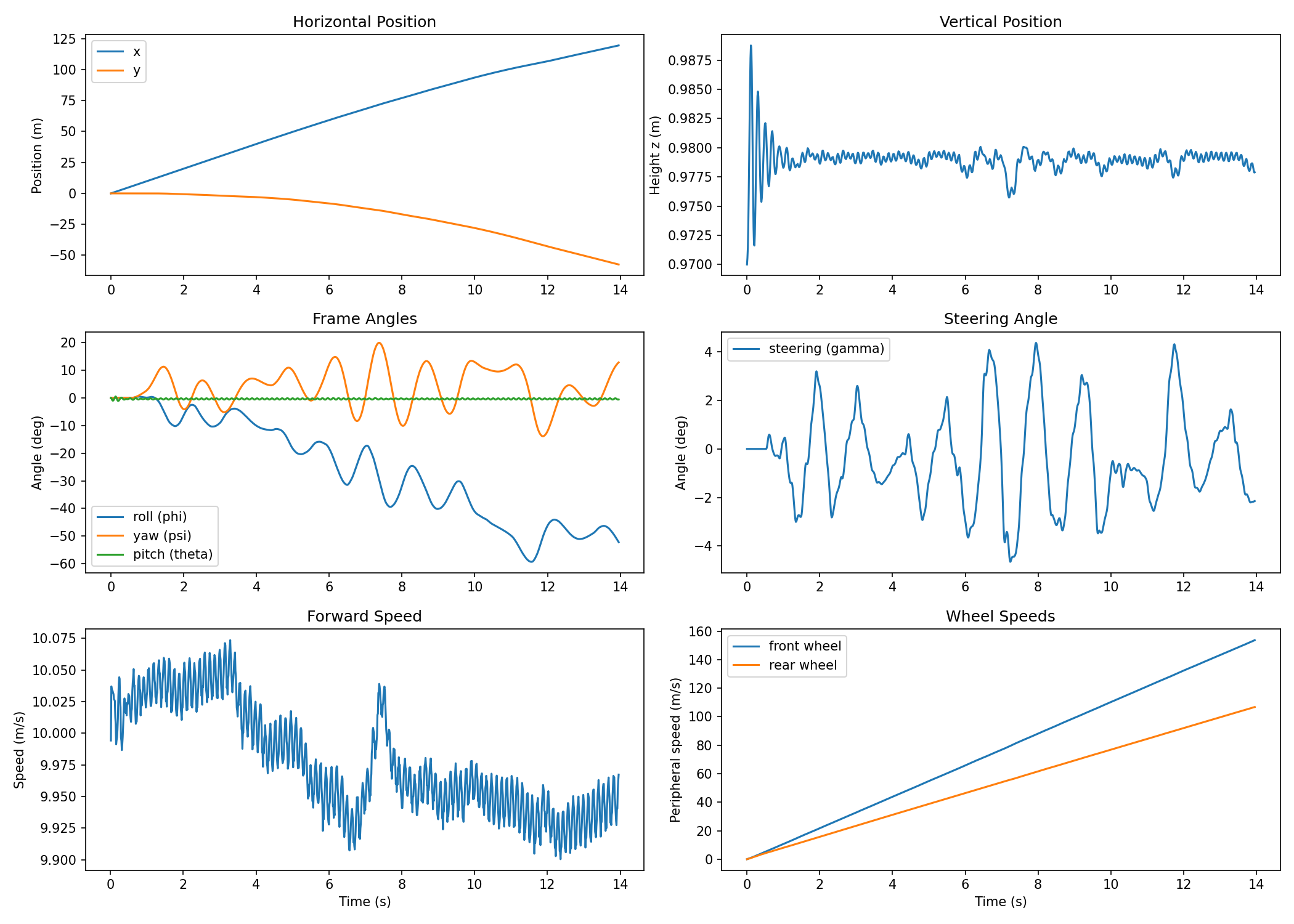
When you are done, it generates this historical data of the path you followed:
About python SymPy
When I was using matlab back in the days, their simbolic extension was a killer feature.
Now, we have it in python for free:
#rm -rf .git
#git init && git add . && git commit -m "Initial commit: MultiBody" && gh repo create mbsd --private --source=. --remote=origin --push
#make install && make dev #requires .env.local