Engineering 101
TL;DR
What if I’d had to study engineering again?
Intro
Those years were crazy: calculus with the Taylor Polynomials , phase diagrams
Now, some of my colleagues are married.
How have I ended up writing about heat transfer and electrical engineering?
Who knows :)
Modelling 101
Before jumping to details…
Be aware of what you will be building on top of.
It helps if you use open physics models
Mech
You might have heard about the 3 body problem:
git clone /ThreeBodies
cd ./ThreeBodies/ThePoincareLab

make deploy #https://the-poincare-lab.pages.dev/But 3D mechanics has its unique magic.
The 3 body problem has sth to say about that:
$$\ddot{\vec{r}}_1 = -G m_2 \frac{\vec{r}_1 - \vec{r}_2}{|\vec{r}_1 - \vec{r}_2|^3} - G m_3 \frac{\vec{r}_1 - \vec{r}_3}{|\vec{r}_1 - \vec{r}_3|^3}$$
Just with some math, you form equations of motion:
1st order: $\frac{dx}{dt} = f(x, t)$ (velocity defined by position)
2nd order: $\frac{d^2x}{dt^2} = f(x, \dot{x}, t)$ (acceleration defined by position and velocity)
For mechanical systems, Newton’s 2nd law gives us 2nd-order differential equations:
$$m\ddot{x} = F(x, \dot{x}, t)$$
The Lagrangian approach gives us these same equations, but derived automatically from energy rather than force:
$$\frac{d}{dt}\left(\frac{\partial L}{\partial \dot{q}}\right) - \frac{\partial L}{\partial q} = 0$$
- Kinetic Energy T: Always comes from the center of mass velocity of each body, plus rotational motion
$$T = \sum_i \left(\frac{1}{2}m_i v_{cm,i}^2 + \frac{1}{2}I_i \omega_i^2\right)$$
- Potential Energy V: Comes from the center of mass height in gravity field, plus any other potential fields
$$V = \sum_i m_i g h_{cm,i} + V_{springs}$$
MBSD
Luckily Ive had a come back to this topic: https://github.com/JAlcocerT/mbsd-core
Tire Modelling has some interesting assumptions
At least with the honesty unlike other disciplines to call it magic formula

git clone https://github.com/JAlcocerT/mbsdFluids
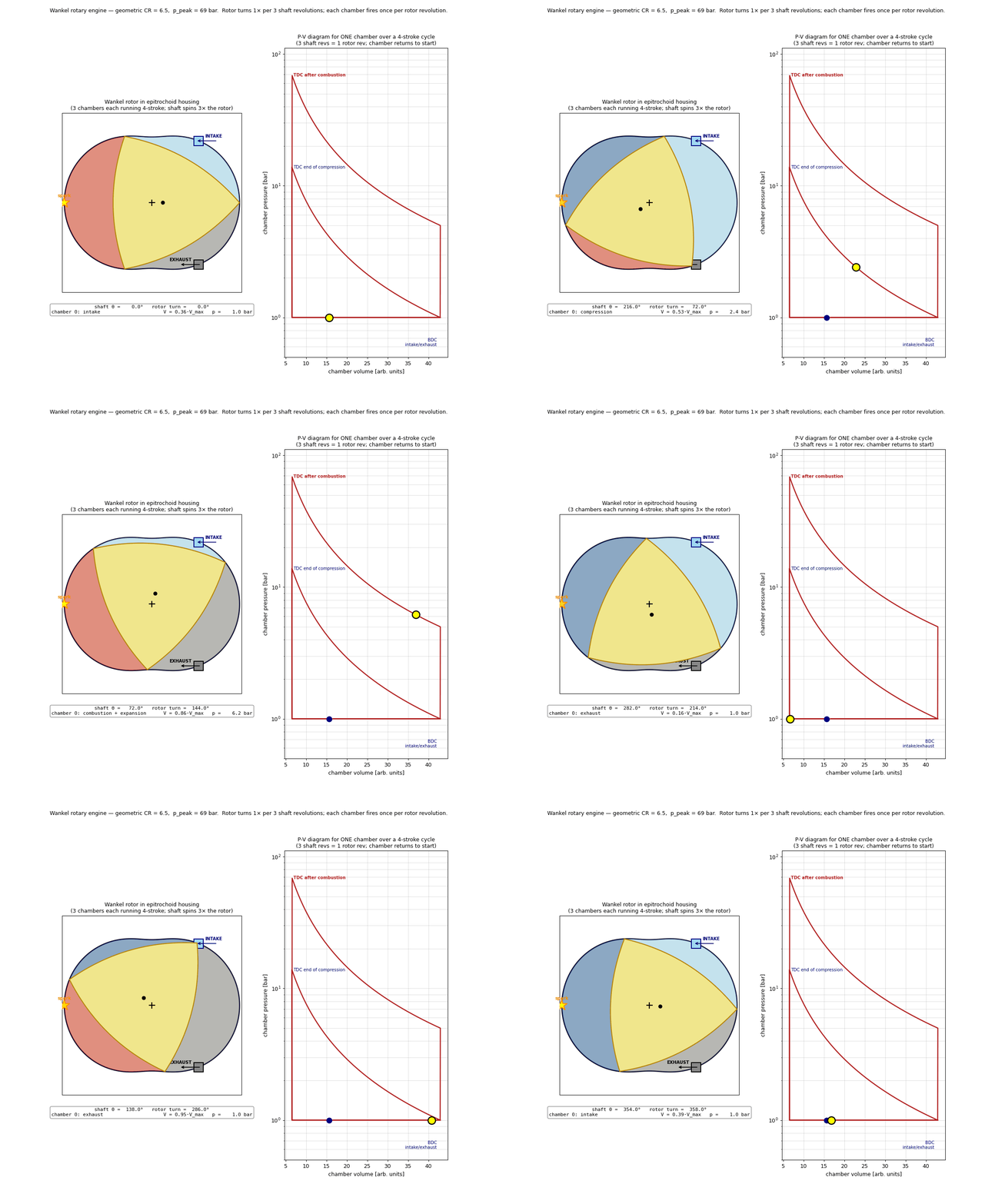
Got a 101 here
Aerodynamics
I was covering some aero101 here
Ive been wondering whats different between multirotors (drones) to fixed-wing aircraft like ULMs (Ultralights/Microlights) and Gliders (Sailplanes).
The efficiency numbers jump into a completely different tier.
Multirotors must spend 100% of their power pushing air straight down to fight gravity.
Fixed-wing aircraft use wings to generate lift from forward movement, so the engine only has to produce enough thrust to overcome aerodynamic drag.
The primary aerodynamic KPI for fixed-wing aircraft is the Lift-to-Drag Ratio ($L/D$).
When translated into the same $\text{g/W}$ (grams of supported mass per Watt of power) metric used for drones, the comparison is striking:
[ FPV Drone ] ----> [ Camera Drone ] ----> [ ULM / Ultralight ] ----> [ Motorized Glider ] ----> [ Human-Powered Aircraft ]
~2.8 g/W ~6.5 g/W ~25–40 g/W ~120–160 g/W ~400 g/W- ULMs / Ultralight Aircraft
- Lift-to-Drag Ratio ($L/D$): $10:1 \text{ to } 15:1$
- Equivalent Efficiency: $25 \text{ to } 40 \text{ g/W}$
For every 10–15 kg of weight, an ultralight only needs about 1 kg of forward thrust to maintain level flight.
- Real-World Example (Pipistrel Alpha Electro):
- All-Up Weight: $400\text{ kg } (400,000\text{ g})$
- Level Cruise Power: $\sim 14\text{ kW } (14,000\text{ W})$ at $120\text{ km/h}$
- Efficiency: $\frac{400,000\text{ g}}{14,000\text{ W}} \approx \mathbf{28.5\text{ g/W}}$
- Gliders / Sailplanes
- Lift-to-Drag Ratio ($L/D$): $35:1 \text{ to } 60:1$
- Equivalent Efficiency: $120 \text{ to } 160+\text{ g/W}$
Modern composite sailplanes are the most aerodynamically refined machines on the planet.
With $L/D$ ratios around 45:1 or higher, a glider dropping at a rate of just 0.5 m/s travels 45 meters forward for every 1 meter it descends.
- Real-World Example (Pipistrel Taurus Electro - Electric Motorized Glider):
- All-Up Weight: $470\text{ kg } (470,000\text{ g})$
- Sustaining Power Needed for Level Flight: $\sim 3.2\text{ kW } (3,200\text{ W})$ at $85\text{ km/h}$
- Efficiency: $\frac{470,000\text{ g}}{3,200\text{ W}} \approx \mathbf{146.8\text{ g/W}}$
- The Absolute Physics Ceiling: Human-Powered Planes
To see how high this metric can go, look at human-powered aircraft like the MIT Daedalus 88, which flew 115 km across the Mediterranean Sea:
- All-Up Weight (Pilot + Aircraft): $104\text{ kg } (104,000\text{ g})$
- Power Output (Pilot pedaling): $\sim 250\text{ W}$ continuous
- Efficiency: $\frac{104,000\text{ g}}{250\text{ W}} \approx \mathbf{416\text{ g/W}}$
| Aircraft Type | Primary Flight Metric | Power to Maintain Flight | Efficiency ($\text{g/W}$) |
|---|---|---|---|
| Heavy FPV Drone | Hover Thrust | $160\text{ W}$ for $0.45\text{ kg}$ | $2.8\text{ g/W}$ |
| DJI Mini 4 Pro | Hover Thrust | $38\text{ W}$ for $0.25\text{ kg}$ | $6.5\text{ g/W}$ |
| Electric ULM | $12:1 \text{ L/D}$ | $14,000\text{ W}$ for $400\text{ kg}$ | $28.5\text{ g/W}$ |
| Electric Glider | $45:1 \text{ L/D}$ | $3,200\text{ W}$ for $470\text{ kg}$ | $146.8\text{ g/W}$ |
There are really cool tinkerers out there:
https://www.youtube.com/@OpenSourceFPV
https://www.youtube.com/@rctestflight
https://www.youtube.com/@NicholasRehm/videos https://www.youtube.com/watch?v=gZQEOjyjwhc
https://www.youtube.com/@thinkflight https://www.youtube.com/watch?v=VCgpRQXFEaU
https://www.youtube.com/watch?v=gZQEOjyjwhc
https://www.youtube.com/@RcLifeOn https://www.youtube.com/watch?v=zP1nS3sIu2U
https://www.youtube.com/@NicholasRehm/videos who created https://github.com/nickrehm/dRehmFlight
FPV Design
If you have seen these awsome video series:
How about putting together a checklist with features and expected dron build behaviour?
cd ./poc/pwa-fpv-buildCame here for engines
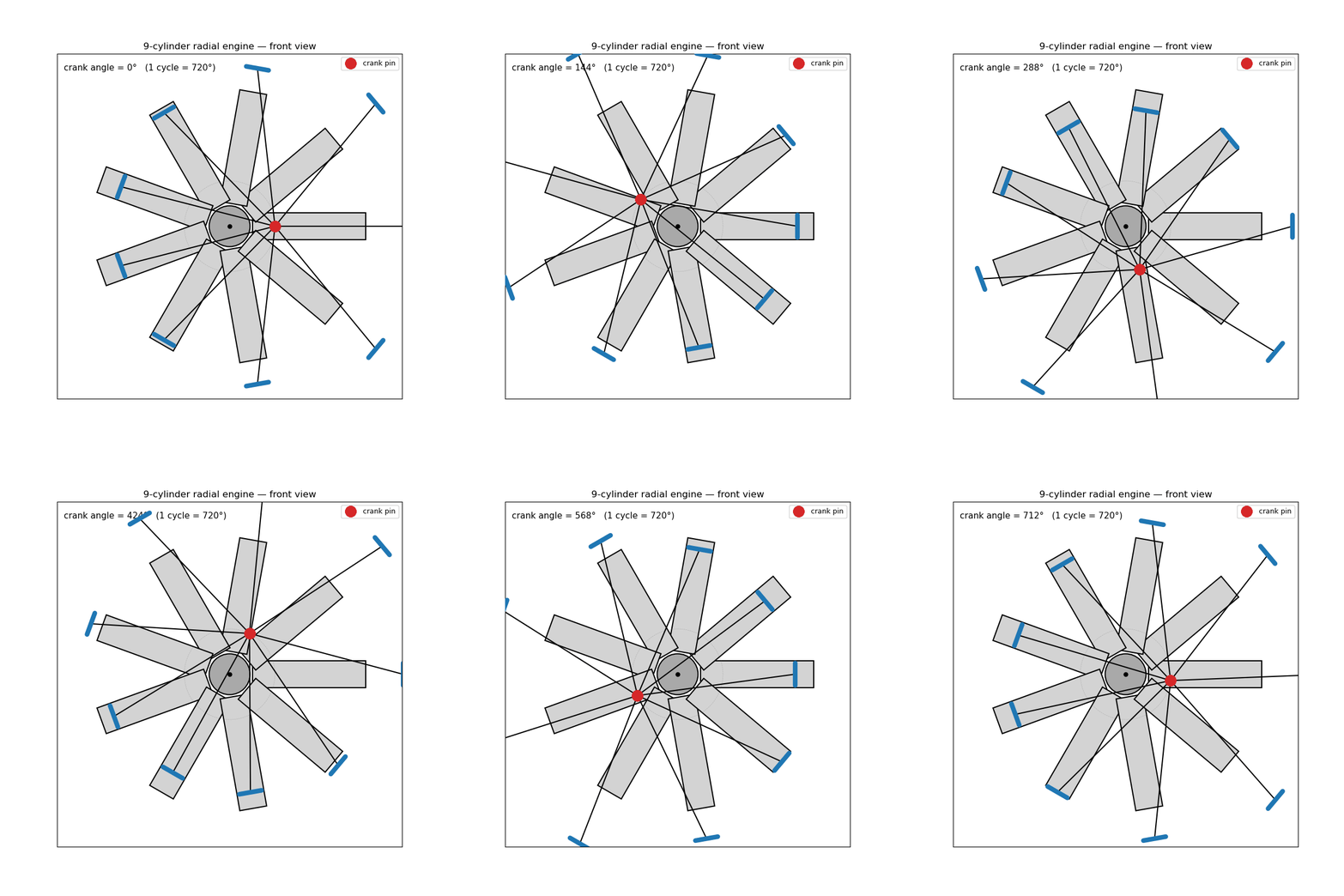
For the PISTON engines (ICE) i mean.
Aint no replacement for displacement some say
https://www.youtube.com/watch?v=bWvv8Y4qhOA
https://www.youtube.com/watch?v=XctfCw4fKUg
https://www.youtube.com/watch?v=ZvdsGlxg2Bs
https://www.youtube.com/watch?v=1HqXs301_K8
https://www.youtube.com/watch?v=CJNhoSXvxYs
Solar
When my x300 server disconnected and the emqx went down, my picoW got blocked and DHT22 info got stucked like so, until I fixed this script:
# make flash-picow    #you can always go with Thonny portable!
sqlite3 /home/jalcocert/poc/iot-rpi-dht-insulation/ingester/data/readings.sqlite "SELECT date(received_at) AS day, COUNT(*) AS rows, AVG(value) AS avg_value FROM readings WHERE metric = 'temperature' GROUP BY day ORDER BY day;"
flowchart TD
A[Wake] --> B[WiFi connect, max 15s]
B -->|OK| C[MQTT connect, max 8s]
B -->|Timeout| S[LED off, sleep 300s]
C -->|OK| D[Read Pico internal temp]
C -->|Timeout| S
D --> E[Read DHT22]
E --> F[Publish available readings]
F --> S
S --> AApplied similar fix to the esp32 deepsleep script
Electro Magn
Electromagnetism is a must have in your engineering toolbox.
Signals and Telemetry
After mastering electro magnetism, you can derive interesting fenomena like Friis
To go from that to throughput (mbps) you will need to plug also couple additional models
LoRa and ELRS are a thing
This is a great video around: RF, Modulation, noise and Lora constrasting with WIFI connectivity!
ELRS x LoRa 📌
ExpressLRS receivers utilize LoRa technology to achieve long-range communication, even in challenging environments like forests.
By employing unique signal modulation techniques, these receivers can decode signals below the noise floor, allowing for impressive range capabilities compared to traditional systems.
Key points:
- ExpressLRS receivers can maintain connections over distances of up to 100 kilometers, even with obstacles like forests.
- Traditional Wi-Fi struggles with range due to higher frequency signals being easily blocked, while lower frequencies like 2.4 GHz used by ExpressLRS have longer wavelengths that penetrate obstacles better.
- Digital modulation techniques like FSK and QAM allow for higher data rates, but LoRa focuses on maximizing range by decoding signals below the noise floor.
- LoRa uses a “chirp” signal and Fast Fourier Transform (FFT) to extract frequency content, enabling it to filter out noise effectively.
- The video discusses four different ExpressLRS receivers, highlighting one that violates typical RF design rules by using a via for the antenna connection.
- The importance of impedance matching in RF design is emphasized, explaining how reflections can impact signal quality.
Notable quotes:
- “LoRa can decode signals below the noise floor. Even if you cannot see the LoRa signal, the receiver can still decode it.”
- “Current flows in circles. The current that flows in the top trace to the antenna, well, an equal and opposite current must flow on the ground plane directly beneath it.”
Circuits
More interesting effects around here.
Specially when you can simulate circuits and see that EMR kickback happen before you order and mount your components.
Thats the beauty of non-toy models: you can bet
Others
Programming
Some say thats not pure engineering
I dont care at this point
If you are able to make a machine make something repeatable for you - you’ve won
Embedded Systems
IoT is usually a subset or application area of embedded systems, but not all embedded systems are IoT.
A practical distinction:
- Embedded systems = computers built into devices to control hardware.
- IoT = embedded/networked devices that communicate with services, other devices, or the internet.
Embedded is a broader parent category, with IoT, Drone, FPV, Firmware, MQTT, and Home Automation as more specific angles.
IoT
How is your energy/walls/sun or tomatoes experiment going?
- pico/temperature/dht22
- pico/humidity/dht22
- pico/temperature/internal
- esp32/temperature/dht11
- esp32/humidity/dht11
#curl -fsSL https://opencode.ai/install | bash
mosquitto_sub -h 127.0.0.1 -p 1883 -t 'pico/temperature/dht22' -v
mosquitto_sub -h 127.0.0.1 -p 1883 -t 'esp32/temperature/dht11' -v
when the setup is ready:
cd ./poc/iot-rpi-dht-insulation/ingester
#configure the mqtt host properly and
docker compose up -d && docker compose logs --tail 10
http://192.168.1.2:3011/
You can check the latest readings at: poc/iot-rpi-dht-insulation/ingester/data/readings.sqlite
#mosquitto_sub -h 127.0.0.1 -p 1883 -t 'esp32/temperature/dht11' -v
sqlite3 -header -column /home/...readings.sqlite "SELECT * FROM readings ORDER BY received_ms DESC LIMIT 10;"
And this got me several (11) days without solar connection with the ESP32 having deep sleep and coming back every 60s:
sqlite3 /home/jalcocert/poc/iot-rpi-dht-insulation/ingester/data/readings.sqlite "SELECT date(received_at) AS day, COUNT(*) AS rows, AVG(value) AS avg_value FROM readings WHERE metric = 'temperature' GROUP BY day ORDER BY day;"

# sqlite3 /home/jalcocert/poc/iot-rpi-dht-insulation/ingester/data/readings.sqlite "SELECT MAX(received_at), MAX(received_ms), │ datetime(MAX(received_ms)/1000, 'unixepoch') FROM readings;"
Drones/FPVs
ISDT 608AC charger
After 7min flight, i got 16.5mb of the flash with telemetry in the iflight with 1/4 1khz gyro scaled
Key findings from this log: 10 flight segments with the iFlight F722 TwinG. Coasting power ranges 50-174W depending on segment. Motor model fit: RMSE 6.6A,
Coasting power is nearly identical (~166W) suggesting the same battery/motor setup (with vs w/o cam)
By contrast the meteor needs 10w with ~50g
Wanna experience pure Power/Weight?
Get…
I mean BUILD a drone
Ive experimented around:
- Meteor 75 pro with up to ~100w with ~50g
- Eachine with up to ~400w
- iFlight F722 with up to ~1kw (crazy, >1hp)
There is a lot of OSS around drones: https://github.com/betaflight/betaflight-configurator which is a PWA https://app.betaflight.com/
From the welcome sound to edgeTX
A drone setup is not “one firmware”
It is usually: EdgeTX for RC -> ExpressLRS for TX and RX -> Betaflight / dRehmFlight for FC -> ESC firmware -> motors/servos
So a bad behavior can come from the radio model, RF link, receiver protocol, UART setup, flight-controller modes, mixer, failsafe, ESC config, or physical build.
Dron BOM
Wanna get into drons?
let me give you the bom and the price (going up, so that you dont get dissapointed with prices)
- radiomaster pocket - 100$
- 18650 (x2) batteries for the RC - 10$
- meteor 75 pro - 150$ which brings to LiPo batteries
With those 2, you can fly as the dron pack comes with couple of batteries and a charger :)
The RC can charge the 18650 batteries, so no worries there.
Getting the right throtle levels is tricky
After you get that right, you’ll have fun and probably consider a bigger project…
like I did with the other 2 mentioned FPVs
You can get interesting second hand deals and test them properly with telemetry when they arrive:
Like an used Cidora for 150$ or a for 130$
Then…you will need some batteries and proper charger:
I got a NOVA 608AC which apparently waited 2 years from production to be in my hands
And some 4s batteries:
To go all in, you’ll also need some gogles, deciding beween analog and digital.
For now, i just mounted my oa5 into a dron:
DRON Telemetry RCA
Get ready to break some parts!
This is what happened to my iflight f722 propeller as per the 19/32mb logs from the half battery ovonic packs and the one that accidentally died after 2/7min of expected flight
make telemetry TELEMETRY_DECODED=BTFL_BLACKBOX_LOG_20260727_082759_IFLIGHT_F722_TWING_decoded.json LOG_INDEX=2
TELEMETRY_LONGEST=0 DURATION=0 FPS=30
#make imu-video │ IMU_DECODED=BTFL_BLACKBOX_LOG_20260727_082759_IFLIGHT_F722_TWING_decoded.json LOG_INDEX=2 │ DURATION=0 FPS=30 IMU_SIZE=1280x720
Get the best offset that matches the action cam with the acelerometer:
 python sync_offset_estimator.py `
    --decoded BTFL_BLACKBOX_LOG_20260727_082759_IFLIGHT_F722_TWING_decoded.json `
    --video iflight-26jul/DJI_20260726095445_0040_D.MP4 `
    --log-index 2 `
    --min-offset-s 0 `
    --max-offset-s 30 `
    --compare-s 105 `
    --video-fps 8 `
    --step-s 0.125
Then just:
make telemetry-overlay VIDEO=iflight-26jul/DJI_20260726095445_0040_D.MP4 TELEMETRY_MP4=BTFL_BLACKBOX_LOG_20260727_082759_IFLIGHT_F722_TWING_imu_video_s2_101s.mp4
VIDEO_OFFSET=9 COMPOSITE_OUT=DJI_20260726095445_0040_D_with_imu.mp4

make telemetry-overlay VIDEO=iflight-26jul/DJI_20260726095445_0040_D.MP4
TELEMETRY_MP4=BTFL_BLACKBOX_LOG_20260727_082759_IFLIGHT_F722_TWING_telemetry_s2_101s.mp4
VIDEO_OFFSET=9 COMPOSITE_OUT=DJI_20260726095445_0040_D_with_telemetry.mp4
T-Shape Engineering
Wanna build end to end?
Product Mindset
Experiments, self-funded R&D and just building is great
Unless you have the expectations that somebody will care and buy the thing that only matters to you
Plot twist: there does not seem to be an unified/deterministic value of things.
World experience and pricing is subjective
But dont panic, you can A/B test to see what people wants you to build
Wants as in: wanna pay for
Aka: revealed preferences
Believe it or not, marketing matters to fund your R&D:
Yep, im assuming you got the Unit Economics in your radar.
Also: Attract -> Convert -> Deliver
After mastering step 3, how about 1 and 2?
Conclusions
So all of this to be able to dedicate your work life to be an engineer?
Maybe, think first about your Ikigai
If you want a money/effort focused career, there are definitely better ways.
Specially when you understand that engineering / R&D is part of Opex:
$$ P \times V \times GM \times OM \times IF \times T $$
Yes, all your greatness is a expense without a certain ROI for someone.
In the meantime, you can measure instead of model, prepare the ULM exam or upskill with:
 Consulting Services
 DIY via ebooks
FAQ
Which engineering is for me?
Are you aware on how priviledge we are to be able to choose our hard?
About ULM and flights
ULM (Ultralight Pilot License): A national recreational license for flying small sport aircraft (up to 600 kg) under day visual conditions.
CPL (Commercial Pilot License): A professional EASA/ICAO license allowing you to get paid to fly as a pilot-in-command of single-pilot aircraft or first officer on commercial flights.
ATPL (Airline Transport Pilot License): The highest tier of pilot certification, legally authorizing you to act as Captain (Pilot-in-Command) on multi-crew commercial airliners.
PPL (Private Pilot License): An internationally recognized EASA/ICAO license that allows you to fly certified aircraft (like a Cessna, Piper, or Cirrus) and carry non-paying passengers anywhere in the world non-commercially.