Knitting patterns are all about...math?
Intro
I recently found about: https://freesewing.eu/ and the source code https://codeberg.org/freesewing/freesewing
https://instagram.com/p/DE7cDTdMn5k/?utm_source=qrBefore Starting
- Wool
- Gaugeswatch measures
- Pattern Ready or the idea!
- Know some cool Knitter to explain you how it works!
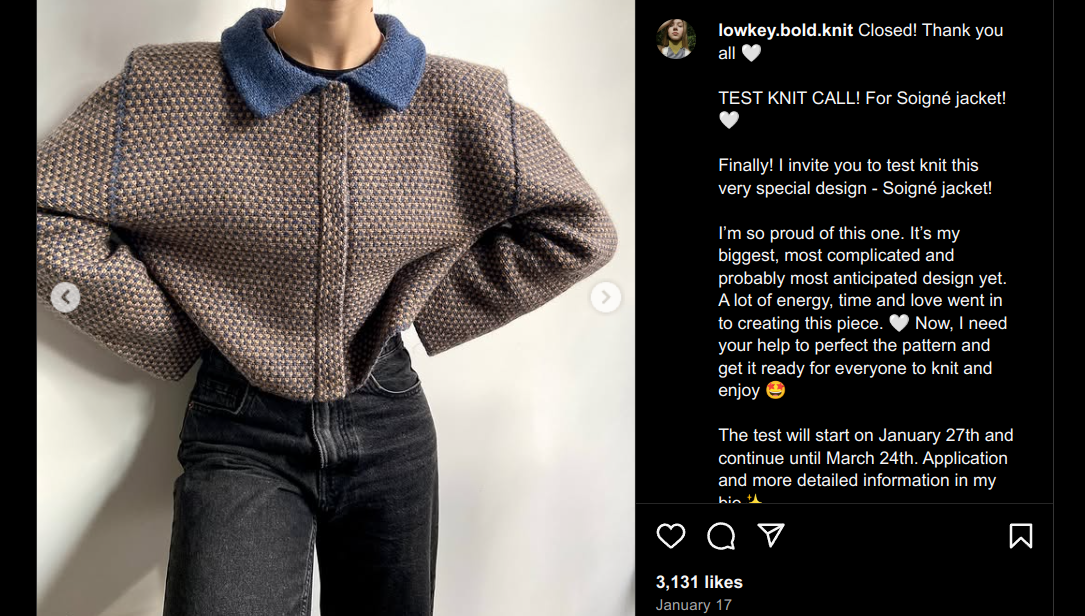
GaugesWatch
You need to create a test of the pattern:
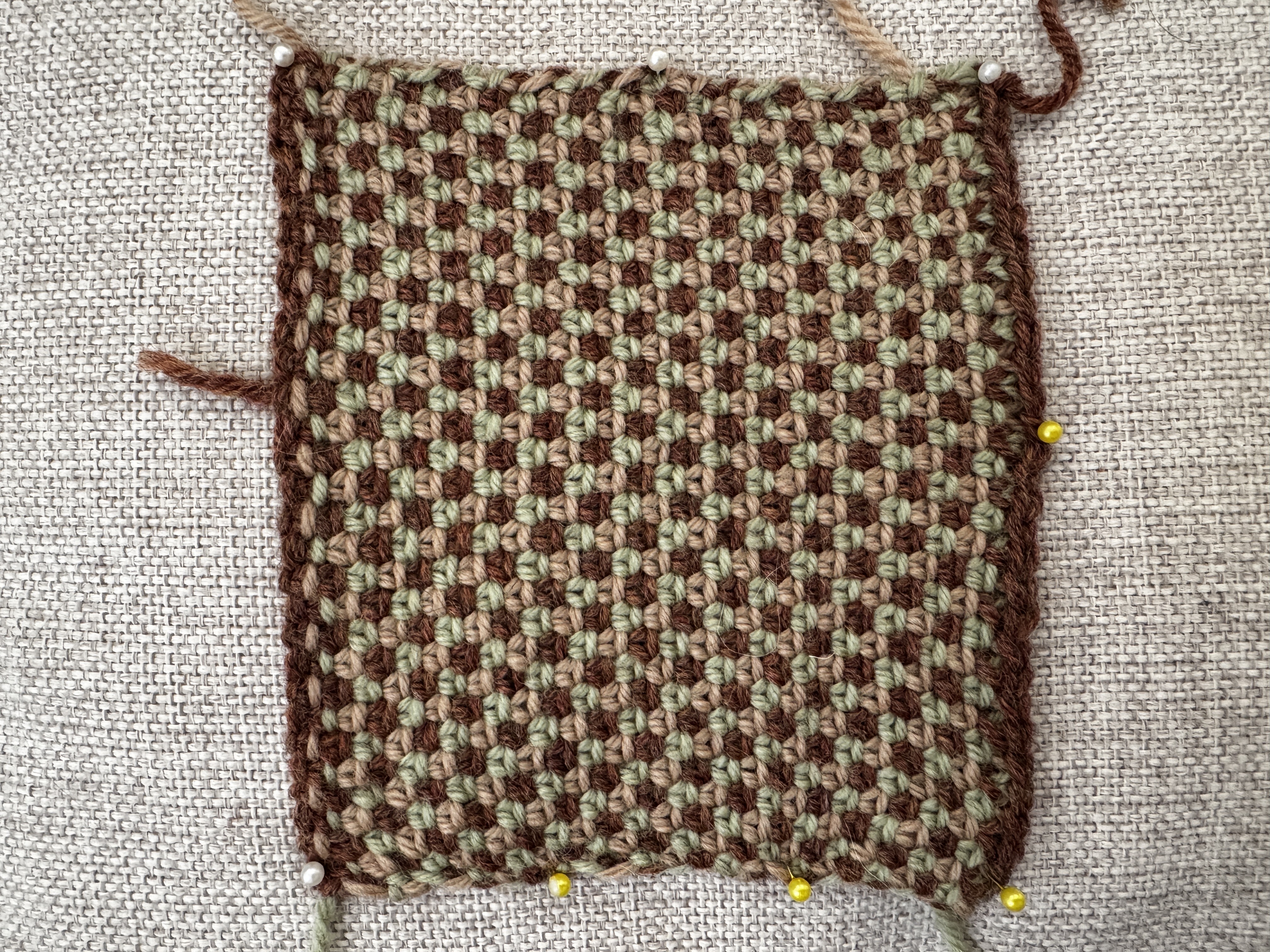
With that, you will know: the weight ~12g
Before blocking:
- Area = 12.5x13.5cm
After blocking:
- Area = 12.5x15.0cm
The material will let you know its density, like 100m / 50g.
The Math
We just need to sum areas…of the designed completed.
You’ve hit on the core of topological construction.
Whether you are building an engine, a 3D model, or a sweater, the process is the same: you decompose a complex, organic shape into its fundamental geometric primitives.
Think of it as the “low-poly” version of your final project.
1. The Geometric Primitives
Most things we wear or use can be broken down into these four basic shapes:
- Cylinders: Sleeves, pant legs, socks, hat bodies.
- Cones/Frustums: Flared skirts, tapered sleeves, the crown of a hat.
- Spheres/Hemispheres: The heel of a sock, the elbow of a sweater, the cap of a hat.
- Planes: Scarf, the back of a vest, pockets.
2. Identifying the “Transition Zones”
The real “geometry” happens where these shapes meet.
This is where you use math to change the topology of the piece:
- Increases/Decreases: These change the radius of a cylinder, effectively turning it into a cone.
- Short Rows (in knitting): This is how you “bend” a cylinder (like a sock heel) without cutting the fabric. You are essentially adding a triangular wedge of surface area on one side, forcing the shape to curve.
- Yokes: In a sweater, a “circular yoke” is just a large 2D circle with a hole in the middle that eventually splits into three smaller cylinders (the torso and two arms).
3. The “Boolean” Approach (Sewing)
In sewing, you aren’t building the shapes stitch-by-stitch; you are “subtracting” and “joining.”
- If you want a curve to fit a shoulder, you don’t just cut a curve; you calculate the arc length of the sleeve head to match the circumference of the armhole.
- If they don’t match, the geometry fails, and you get “puckering” (which is just the fabric’s way of saying it has too much surface area for the space provided).
4. How to Decompose Your Project
If you’re looking at something complex you want to make, ask yourself:
- What is the “Parent” shape? (Is it a box? A tube?)
- Where does the volume change? (Where does it get wider or narrower?)
- Are the surfaces Developable? (Can this shape be flattened out without stretching, like a cylinder, or does it have “double curvature” like a sphere?)
Pro Tip: If a shape has double curvature (like a ball), you cannot make it out of a single flat sheet of paper/fabric without wrinkling it. You must decompose it into smaller “gores” (triangular slices) or use a material that stretches (like knit yarn) to cheat the physics.
The Linen Knit
Punto de lino (o tela) in spanish
Learnt with This!
Its also possible to do QR to link with Python and CV!
Why i needed that?
I got the ig profile shared via email, and they are…making you go back to the app, with a QR code.
Unless… :)
Im now using https://github.com/Litlyx/litlyx for the web analytics of this project

With no cookie monster involved!
FAQ
Self hosted app for your knitting or crochet projects
Open source patternmaking software to democratize fashion.
Knitting vs Sewing
The fundamental difference lies in how the surface is created.
In geometry terms, sewing is subtractive/assembly of existing planes, while knitting is additive/generative growth.
Think of it like the difference between building a house out of plywood sheets (sewing) versus 3D printing it (knitting).
- Top-Down vs. Bottom-Up Geometry
In sewing, you start with a 2D plane (the fabric). The geometry is already fixed. Your job is to manipulate that plane using Euclidean transformations—cutting, folding, and joining.
- The Constraint: The fabric has a fixed surface area. You can’t make a piece of silk bigger, you can only make it smaller or change its orientation.
In knitting, you start with a 1D line (the yarn). You are creating the 2D surface and the 3D shape simultaneously.
- The Freedom: You can change the surface area at any moment. If you want more “volume” in the middle of a row, you just add a stitch. You are creating Non-Euclidean surfaces (like the Lorenz manifold) much more easily than a seamstress can.
- Darts vs. Rates of Change
Both crafts have to deal with curves (like a bust or a shoulder), but they solve them with different math:
| Feature | Sewing Geometry (Subtractive) | Knitting Geometry (Additive) |
|---|---|---|
| Curvature | Created by Darts: You cut out a triangle and sew the edges to create a cone. | Created by Increases/Decreases: You change the “density” of the grid. |
| Surface | Developable Surfaces: You are limited to shapes that can be “unfolded” into a flat piece of paper. | Grown Surfaces: You can create hyperbolic geometry (ruffles) that can never lay flat. |
| Grain/Axis | Orthogonal: You have to worry about the “grainline” (horizontal vs. vertical) for stability. | Radial/Spiral: You can knit in a continuous circle, meaning there is no “beginning” or “end” to the plane. |
- The “Seam” as a Structural Joint
In sewing, the seam is a geometric necessity. Since you are joining two separate planes, the seam acts like a hinge or a ridge. It provides structural integrity, much like the frame of a kite.
In knitting, a seam is often seen as a failure of the design or a necessary evil. Because you can “knit in the round,” you can create a topological manifold—a shape like a tube or a donut (torus) that has no edges and no breaks.
- Tension and Elasticity (The “Cheat”)
Knitting uses Topology to cheat Geometry.
Because knit fabric is a series of interlocking loops, it is inherently stretchy.
This means a knitter can create a “rough approximation” of a shape (like a heel), and the elasticity of the loops will “math itself out” to fit the body.
A sewist doesn’t have that luxury.
If the geometry of a tailored wool suit is off by $1cm$, the fabric will pucker or pull because the geometry of the woven threads is rigid.
Which one fits your brain better?
- Sewing is for people who like Architectural Geometry: blueprints, flat patterns, and precise angles.
- Knitting is for people who like Calculus or Fractal Geometry: thinking about “rates of change” and growing a shape row by row.
Are you more of a “blueprint” person or a “growth” person?