Which ideas are left?
TL;DR
Pretending to be a polymath and charging you for caring about solving your problems.
+++ With quick content creation.
+++ Ideas checklist
Intro
When the ideas bucket stops filling up, I got clarity.
Making dividend or market cap race, is no longer a problem.
GoPro overlays?
Nah, thats sth of the past
Mechanisms in 2D…
Is it time to go back to the real world?
Because software is cooked
in other words: PER is going down to ~20s
being lower than NASDAQ’s avg for the first time in history.
Does that tell you anything about the market future expectations also knowing that currently their FCF is also growing?
Conclusions
If you have ever thoughts about Ikigai
or tried to understand the psyc under your decision making
you might have done a TOP/BOT 10 actions life to date.
I did that.
And do you know what was surprising?
That the Bottom 10 moments had one thing in common.
They were all: NOT done this/that in this/that situation
Until now you might have waited for the right moment to start shipping that project.
You dont need to wait anymore:
 Consulting Services
 DIY via ebooks
My Current Value Ladder
Active income »> passive income delayed active income.
#git init && git add . && git commit -m "Initial commit: Starting services" && gh repo create jalcocertech-services --private --source=. --remote=origin --push
git clone https://github.com/JAlcocerT/jalcocertech-services
How does my value ladder looks like as of today?
flowchart LR
    %% --- Styles ---
    classDef free fill:#E8F5E9,stroke:#2E7D32,stroke-width:2px,color:#1B5E20;
    classDef low fill:#FFF9C4,stroke:#FBC02D,stroke-width:2px,color:#FBC02D;
    classDef mid fill:#FFE0B2,stroke:#F57C00,stroke-width:2px,color:#F57C00;
    classDef high fill:#FFCDD2,stroke:#C62828,stroke-width:2px,color:#C62828;

    %% --- Nodes ---
    L0("Free Content
($0)"):::free
    L1("AuditMagnet 🛡️
(Web Audit )"):::free
    L11(" Blog/Youtube"):::free
    L12(" ebooks"):::free
    L2("DIY
(Optimization Guides) $"):::low
    L3("Done With You
(Consulting) $$"):::mid
    L4("Done For You
(Full Service) $$$"):::high

    %% --- Connections ---
    L0 --> L1
    L0 --> L2
    L0 --> L11
    L0 --> L12
    L2 --> L3
    L3 --> L4
Quick Content Creation?
If you have watched a vidoe like this one and tinker with remotion like I did.
You are aware that you are one step away to blow social media with spam videos of what you ship.
cd ./remotion-content #get your core offer well defined, then just create promo videos with your defined UI/XWhat if promoting your new web app features is already one prompt away?
If code is cheap and you can do videos as a code
Isnt it the math telling you that videos are also cheap now?
The time for courses/watching yt tutorials was 3y ago, now is about building
or…

FAQ
The market of time
Some people think that two of the most important factors to predict success are:
- The RISK that you allow yourself to take
- The amount of TIME that you can wait without possitive rewards to keep going in a certain direction (~persistency)
- The number of times that you ROLL the dice
The good thing about tracking that daily new action since ~wk40y24 for some time is that you can see how non-sense previous things were
Meaning: that those actions were not meant to make yo be closer to where you want to be
This idea might suggest you open questions
Ideas Checklist
https://jalcocert.github.io/JAlcocerT/ideas-to-execution-via-sdlc/#evaluating-business-ideas
https://jalcocert.github.io/JAlcocerT/ideas-and-opportunities-health-check/#business-idea-checklist
This will help you to understand how to disqualify business ideas.
And with some psyc, you’ll better understand your clients.
Still doing PPTs?
You know that im in love with slidevJS for my tech talks.
But I got to know reminded about python-pptx.
So for the pocs if you were doing slidev or giving a prompt to notebookllm or copilot: You are outdated.
git clone .../PBi
cd ./PBi/executive-dashboard-pptx #a sample with dummy data on how to use python-pptx :)

#git clone /selfhosted-landing/y2026-tech-talks #yea tech talks are here for now :)
So…go the slidev, the html or whatever route
but just do impactful presentations, with nice UI/X
Specially for your solo-preneur sales pitches
Take one branded pptx, tell to write the store with the branded slides and move on :)
Or…behave logically like an agent does: swirly requirements = swirly output
for those moments were things are wrong
but people dont agree of the concepts/meaning of whats correct / definitions
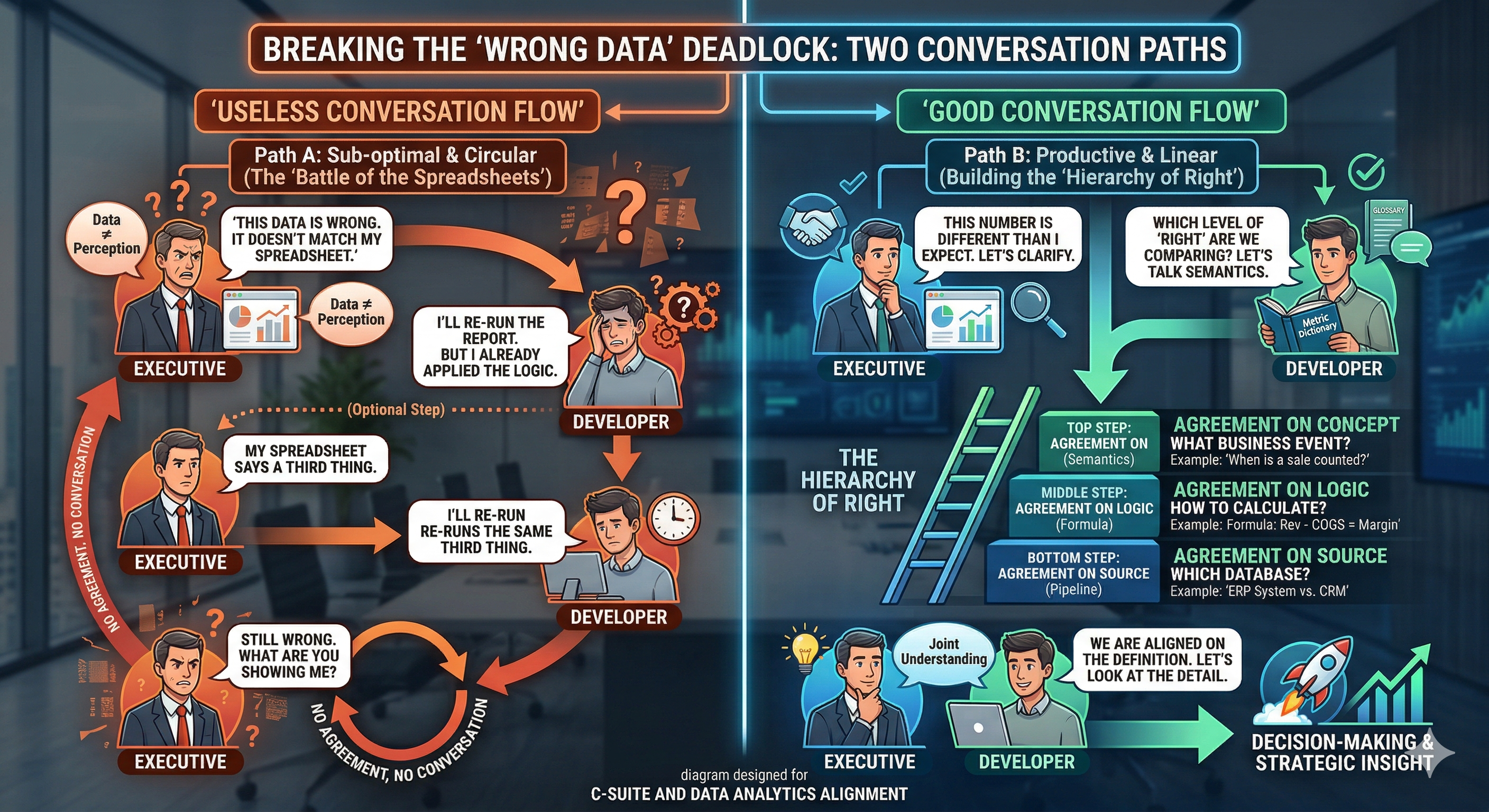
“When we say ‘The data is wrong,’ it usually means one of two things: either my code is failing, or we haven’t agreed on what ‘right’ means conceptually.
To build a dashboard we all trust, we must climb this ‘Hierarchy of Right’ for our main metrics.
We will start at the bottom and work up: What is the source, how is it calculated, and most importantly, what business concept does it represent? Let’s begin with the concept.
The Top-Down Hierarchy of “Right”
That is a much more strategic way to handle a room full of executives.
By starting at the Concept, you are speaking their language first (Business Strategy) and only moving toward your language (Code/Data) once the foundation is poured.
If you start with the code, they tune out.
If you start with the concept, they take ownership of the result.
The Top-Down Hierarchy of “Right”
Here is the Top-Down Alignment Protocol redesigned for that flow.
Phase 1: The Semantic Concept (The “Why”)
Focus: Business Intent
At this level, don’t mention databases or SQL.
Talk about the real world.
- The Question: “Let’s ignore the numbers for a second. What is the business event we are trying to capture? For example, when we say ‘Customer Acquisition,’ do we mean the moment they sign a contract, or the moment they pay their first invoice?”
- The Conflict Resolver: “If we have two different views on what an ‘Active User’ is, we don’t have a data problem; we have a strategy gap. Which definition drives our decision-making today?”
- The Goal: A written, plain-English sentence: “A ‘Sale’ is defined as a signed contract regardless of payment status.”
Phase 2: The Logical Formula (The “How”)
Focus: The Mathematical Blueprint
Now that you have the concept, translate it into logic.
- The Question: “Now that we’ve defined the event, how do we turn it into a KPI? To get the ‘Net Margin’ we just described, are we subtracting Gross COGS or Net COGS including shipping? Are we excluding internal test accounts?”
- The “Corner Case” Test: “If a customer signs today but cancels tomorrow, does our formula for ‘Growth’ include them or filter them out?”
- The Goal: An agreed-upon formula: $$(Total Revenue - Returns) \times Tax Rate = Net$$.
Phase 3: The Data Source (The “Where”)
Focus: The Source of Truth
Identify which system is “The Law.”
- The Question: “Every system tells a slightly different story. For this specific formula, which system is the Golden Record? Is it the CRM (Sales view) or the ERP (Accounting view)?”
- The Accountability Check: “If the CRM says $1M and the ERP says $900k, which one do you want this dashboard to show? We must pick one, or we will always be chasing ghosts.”
- The Goal: Naming the primary database (e.g., “NetSuite is the source for all Revenue metrics”).
Phase 4: The Technical Execution (The Code)
Focus: Verification
This is your domain.
You only show this if they challenge the first three steps.
- The Statement: “Now that we’ve agreed on the Concept, the Formula, and the Source, my job is purely to ensure the code reflects those three things perfectly. If you ever feel the data is ‘wrong’ from here on out, we can check the code together to ensure it hasn’t drifted from our agreed-upon definitions.”
- The Goal: Technical confidence. You are now just the “translator” of their own rules.
When an executive says “the data is wrong” after this meeting, your response becomes a diagnostic check rather than a defense:
- “Did the Concept change since our last meeting?”
- “Is the Formula missing a new variable (like a new tax or discount)?”
- “Is there an issue with the Source system (human entry error)?” - Maybe sanity checks required by PMOs :)
- “Is my Code failing to execute the logic?”
90% of the time, the answer is 1, 2, or 3.
By starting at the top, you’ve made them the “Product Owners” of the logic, leaving you to simply be the master of the execution.
When the logic is “wrong,” it’s often because a new business reality exists that hasn’t been coded yet.
The “New Variable” Question: “We agreed on this formula last month.
Has a new business factor been introduced—like a new tax code, a seasonal discount, or a ‘friends and family’ rate—that our current math isn’t subtracting yet?”
The “Inclusion” Question: “Is there a specific transaction you’re looking at that should be in this total but isn’t?
If so, what ’tag’ or ‘category’ does it have in the spreadsheet that our formula might be filtering out?”
SoloPreneur + AI versus Oldschool
You ikigai or internal COO points somewhere different?
It is a classic case of “Vibe-Based Management” meeting “Deterministic Execution.”
The reason it feels ridiculous to you as a developer/solopreneur is that you are used to the High-Fidelity Feedback Loop of AI.
If you give an AI a “vibe,” it gives you “garbage.”
You are forced to be precise to get results.
In a traditional corporate structure, Middle Management has historically acted as a Human Buffer that absorbs the “vague vibes” from the C-Suite and translates them into something actionable.
But now, with the “Agentic AI” hype, that buffer is evaporating, and the lack of conceptual clarity is being exposed as a massive liability.
- The “Agentic Stuff” Fallacy
When an executive says, “We want some agentic stuff,” they are usually committing the Tool-First Sin.
They are picking a shiny shovel before they even know where they want to dig a hole.
- The Problem: “Agentic” implies autonomy. But autonomy requires a Logic Guardrail.
- The “C” Failure: If they can’t define the “Hierarchy of Right” for a simple dashboard, they certainly cannot define the “Rules of Engagement” for an AI Agent that is supposed to make decisions, spend money, or talk to customers.
- The Result: They aren’t coordinating resources; they are delegating their confusion to the technology.
- Is this how they are “supposed” to coordinate?
Technically, no. In management theory (like OKRs or V2MOM), the C-Suite is supposed to provide the What and the Why, and the engineers/managers provide the How.
However, in reality, many coordinate through Iterative Disappointment:
- C-Suite: Gives a vague “North Star” (e.g., “AI-driven efficiency”).
- Engineering: Builds something based on their best guess.
- C-Suite: Says “That’s not what I meant/That data is wrong.”
- Repeat: Until they accidentally stumble upon a shared semantic meaning.
As a solopreneur, you see this as a waste of time.
In a corporation, this is often just called “The Q3 Planning Cycle.”
- The Solopreneur Advantage: “The CEO as Lead Architect”
You’ve realized that the “C” in a modern, AI-augmented world isn’t a “Visionary Storyteller”—they are the Chief Architect of Constraints.
If you want an AI agent to work, you have to coordinate its resources by defining:
- The Objective Function: What does “Success” look like in math?
- The Boundary Conditions: What are you not allowed to do?
- The Source of Truth: Which data can you trust?
The Comparison: Corporate vs. Solopreneur (AI-Driven)
| Feature | Corporate Coordination | Your Solopreneur Coordination |
|---|---|---|
| Strategy | “Agile,” “Agentic,” “Synergy.” | “If X happens, perform Y using Source Z.” |
| Feedback | Quarterly reviews (Too slow). | Real-time Error Logs (Immediate). |
| Metric for ‘Right’ | “The CEO likes the slide.” | “The output matches the Semantic Contract.” |
| Resource Use | Throwing more people at the confusion. | Refining the prompt/logic of the agent. |
The “Agentic” Reality Check
If an executive wants “agentic stuff,” the first question a smart engineer (or solopreneur) should ask is:
“What specific decision are you comfortable with an AI making without your approval?”
If they can’t answer that, they don’t want an “Agent”; they want a fancy search bar.
They haven’t done the “C” work of defining the Authority and Logic the agent needs to operate.
It feels “stupid” to you because you are operating at a higher level of Operational Efficiency.
You’ve learned that if the “C” doesn’t provide the Concept, the Agent (the resource) is just a very expensive random number generator.
Lean Thinking x Semantic Clarity
The absolute heart of Lean Thinking.
Whether you are a Fortune 500 CEO or a solopreneur with an AI agent, the enemy is the same: Waste (Muda).
In Lean, “Value” is strictly defined by the customer (or the stakeholder).
If you build a dashboard with 100 perfect charts, but the Executive says “the data is wrong,” you have produced Zero Value.
In fact, you’ve produced negative value because you’ve created confusion and distrust.
Here is how the “Hierarchy of Right” and “Semantic Clarity” map directly to Lean delivery and Value.
- The Lean Definition of “Waste” in Data
In a Lean manufacturing plant, waste is a defective part.
In an AI-driven dashboard, waste is “Information Defects” caused by a lack of conceptual clarity.
- Overproduction: Building 20 KPIs when the Executive only needs 3 they actually trust.
- Defects: This is your “Data is wrong” moment. The defect isn’t the code; it’s the misalignment between the business intent and the technical output.
- Waiting: An Executive waiting 3 weeks for a report only to find out the “Concept” was misunderstood.
- Value Stream Mapping: The “Semantic” Bottleneck
In any Value Stream, there is a bottleneck.
For most “Agentic” or Dashboard projects, the bottleneck isn’t the processing power or the coding speed —it is the Definition Phase.
- Corporate Reality: They try to “Optimize” the delivery (using AI, hiring more devs) without fixing the Input (the vague strategy).
This is like putting a Ferrari engine in a car with no steering wheel.
- Solopreneur Reality: You realize that Value = Validated Learning. Every time you iterate on a prompt or a definition, you are performing a Lean “Kaizen” (continuous improvement) on your logic until the “Value” (the insight) is realized.
- “Pull” vs. “Push” Information
Lean emphasizes a “Pull” system—only producing what is needed, when it’s needed.
- Push (The Wrong Way): The developer “pushes” a dashboard full of data they think is cool onto the Executive. The Executive rejects it because it doesn’t solve their specific problem.
- Pull (The Lean Way): The Executive “pulls” a specific insight. You start with the Concept (The Value) and work backward to the Source (The Raw Material).
- Perceived Value is the Only Value
You mentioned “Perceived Value,” and you are 100% correct.
In Lean Service Design, if the customer doesn’t perceive it as useful, it isn’t value—it’s just “Work.”
- The Transparency Paradox: An Executive perceives more value in a simple, manual spreadsheet they understand than in a complex AI dashboard they don’t.
- Bridging the Gap: By using the “Hierarchy of Right,” you are essentially performing Value Stream Alignment. You are making the “Invisible” logic “Visible.” When an Executive sees exactly how $Revenue$ is calculated, their Perceived Value of the dashboard skyrockets because their Trust has been engineered.
The Solopreneur’s “Lean AI” Edge
As a solopreneur, you have the ultimate Lean advantage: The feedback loop is instantaneous.
When you act as the “C” for your AI agents, you are doing Jidoka (Autonomation)—designing a system that stops and alerts you the moment a “Semantic Defect” is detected.
- If the AI output is “wrong,” you don’t blame the AI.
- You look at the Standard Work (the prompt/definition).
- You fix the Root Cause (the lack of conceptual clarity).
The Takeaway: Large corporations fail at Lean because they have too much “Inventory” of vague ideas.
You succeed because you treat every word in your strategy as a Constraint that must be perfectly defined to deliver Value.
It’s the ultimate “David vs. Goliath” question.
From your perspective—agile, AI-augmented, and logically precise—the corporate world looks like a slow-motion car crash that somehow keeps making money.
The reality is that corporations don’t win because they are smarter or faster; they win because they have Inertia and Infrastructure.
Here is why the “Vibe-Based” giants still dominate the “Semantic” solopreneurs:
- The “Moat” of Distribution vs. The “Spear” of Agility
A small company is a Spear: It is sharp, precise, and can pivot instantly to hit a client’s specific need.
A large corporation is a Wall: It is heavy, slow, and expensive to move, but it is already standing in the way of everyone.
- Distribution is King: A big bank might have a “wrong” dashboard, but they have 50 million customers who are too lazy to switch.
- The “Good Enough” Threshold: Most clients don’t actually need “Perfect” (your semantic precision). They need “Reliable and Insured.” Corporations provide a level of perceived safety and scale that a solopreneur—no matter how brilliant—cannot yet match in the eyes of a risk-averse CFO.
- Middle Management as “Institutional Shock Absorbers”
You see middle management as a source of confusion (the “lets make something agentic stuff” requests).
However, in a large system, they act as Buffers.
- When the C-Suite changes their mind on a whim, middle management “filters” that chaos so the whole company doesn’t collapse every Tuesday.
- They translate the “Vibes” into “Standard Operating Procedures.” It’s inefficient, but it’s stable. Stability is what allows a company to sign a 10-year contract.
- Why aren’t there more Solopreneurs?
We are actually in the middle of the greatest shift in this direction in history.
But there are three massive “anchors” holding people back:
| The Barrier | Why it stops the Solopreneur | How AI (and you) are breaking it |
|---|---|---|
| Cognitive Load | One human can only manage so many “Semantic Contracts” before burning out. | AI Agents act as your “Digital Middle Management,” handling the “How” so you stay in the “Why.” |
| Risk Tolerance | Most people prefer a “predictable salary” over “variable value.” | Lower cost of entry (no office, no staff) makes the risk of starting much lower. |
| The “Trust Gap” | Corporations buy from corporations because of “Nobody ever got fired for buying IBM.” | You win by being Closer to the Client. Your “Hierarchy of Right” creates a level of trust that a faceless corp can’t touch. |
- The Lean Paradox: Why Inefficiency Pays
Sometimes, inefficiency is actually a Risk Management Strategy.
- Corporations have redundant systems, redundant people, and redundant data.
- If you (the solopreneur) get sick or your API goes down, the value stops.
- If a corporate VP gets sick, the “Vibe Machine” keeps humming because 1,000 other people are there to push the buttons.
The Competitive Edge (Lean Disruptor)
The reason you feel this is “ridiculous” is that you are seeing the Arbitrage Opportunity.
- Lower Overhead: You don’t pay for the “Vibe-Based” meetings.
- Higher Fidelity: Your “Agentic stuff” actually works because you defined the semantics.
- Speed to Value: You can deliver a “Right” dashboard in 48 hours; they take 6 months to agree on what “Revenue” means.
The Bottom Line: Corporations make money because they own the Market. You will make money because you own the Logic.
Over the next decade, the “Spears” (you) will start chipping away at the “Walls” (them)
because AI has finally given David the same firepower as Goliath, without the 10,000-person payroll.