Batteries are a thing
TL;DR
From 3v to a car battery
Intro
Its been inspiring this post from Sean, with a framework that ill be copying in my intros:
- Why Im writting this post: bc i got a bluetti,it was time to put the wh to ah conversions and to know how to properly charge my x13
- What Ive learnt with it: Ive ended up learning sth about batteries like the SoC, thx to the FPV drones (LiPo vs Li-ion), electric car tests and a now…a portable bluetti for home project.
About Batteries
Dealing with three distinctly different types of lithium battery chemistries?
Each one is engineered for a completely different purpose: one values balanced driving performance, one is built for extreme safety and longevity, and the other is optimized for pure, lightweight power.
Car batteries
The EV I rented uses Lithium NMC chemistry.
- The Goal: Maximizing energy density (range) while keeping weight reasonable.
- How it compares: NMC batteries can pack a massive amount of energy into a heavy vehicle chassis. They offer incredible power delivery for acceleration and handle fast-charging stations well.
However, they are chemically more sensitive than a Bluetti — which is why EV manufacturers built in software buffers (the “zombie cells” we talked about) and recommend only charging them to 80% or 90% for daily use to prevent faster degradation.

The financial and energy breakdown for a trip in the Cupra EV:
- Inferred Battery Size: $62.60 \text{ kWh}$ (This aligns perfectly with Cupra’s standard $62 \text{ kWh}$ Gross / $58 \text{ kWh}$ Usable battery pack option found in the Cupra Born).
- Energy Consumption: $13.03 \text{ kWh}$ per $100 \text{ km}$ (or $0.13 \text{ kWh}$ per single km).
- Financial Running Cost: $0.05 \text{ USD}$ per km (which translates to $4.98 \text{ USD}$ per $100 \text{ km}$, or roughly $0.50 \text{ NOK}$ per km based on the total $811.40 \text{ NOK}$ spent over the $1630 \text{ km}$ trip).
Bluetti
This has been very useful for my automatic watering setup
Also learnt along the way about DC plugs anatomy
And that the bluetti can bring interesting MQTT data:
The portable power station utilizes LiFePO4 chemistry, LFP (Lithium Iron Phosphate)
- The Goal: Absolute longevity, safety, and stability.
- How it compares: This is the marathon runner of the group. LFP batteries can easily handle 3,000 to 3,500+ charge cycles before dropping to 80% health (compared to the ~1,000 to 1,500 typical of an automotive NMC battery).
They are highly resistant to thermal runaway (catching fire) and you can safely charge them to 100% regularly without heavily damaging their lifespan.
The trade-off?
They are significantly heavier and bulkier per kWh than NMC, which is fine for a power station sitting on the ground, but tougher for a nimble sports car.
To load my x13 from ~low to 100% took ~35% of the bluetti capacity
To charge back again the bluetti you do it at 200W, so expected ~
That “click” sound is 100% normal and expected.
You are hearing the sound of a physical, mechanical switch moving inside the Bluetti.
There is some engineering difference between why AC clicks and DC is silent
⚡ The AC Side: Physical Mechanical Relay
Because AC electricity runs at high voltage ($230\text{V}$), safety standards require physical separation between the inverter board and the outlets when the port is turned off.
- Inside the Elite 30 V2, there is an electromechanical relay (a physical switch operated by a tiny electromagnet).
- When you hit AC ON: The unit sends a current through a tiny coil, creating a magnetic field that physically slams a metal contact arm shut to complete the circuit. (CLICK!)
- When you hit AC OFF: The coil de-energizes, and an internal spring snaps the metal arm back open to isolate the outlets. (CLICK!)
🔋 The DC Side: Solid-State Semiconductors (MOSFETs)
Low-voltage DC power (like your 12V car outlet and USB-C ports) doesn’t need physical mechanical switches to be safe.
- Instead of mechanical arms, the DC circuit is controlled by MOSFETs (solid-state semiconductor transistors).
- These are digital chips with zero moving mechanical parts. Turning a DC port on or off is done purely by changing voltage on a silicon gate—making it completely instantaneous and dead silent.
Bottom Line: The click is actually a reassuring safety feature. It tells you the high-voltage relay just physically clamped shut and is ready to safely handle up to 600W of AC power!
Power vs Energy Density
- Capacity: 288 Wh (18 Ah)
Following our previous calculation logic ($\text{Wh} = \text{Ah} \times \text{Voltage}$):
$$\text{Voltage} = \frac{288 \text{ Wh}}{18 \text{ Ah}} = 16 \text{ Volts}$$
This indicates the power station uses a 4S LiFePO4 battery pack configuration (4 cells connected in series):
- Nominal voltage per LiFePO4 cell = $3.2 \text{ V}$
- Pack nominal voltage = $4 \times 3.2 \text{ V} = 12.8 \text{ V}$ to $16 \text{ V}$ (depending on whether it is calculated using nominal or full charge voltage)
- Weight vs. Chemistry: 4.3 kg with LiFePO4
LiFePO4 (Lithium Iron Phosphate) cells are heavier and slightly less energy-dense than standard Li-ion cells, but they offer 3,000+ charge cycles and superior thermal safety.
- A 4.3 kg (9.5 lbs) total weight for a 288 Wh rugged power station (including inverter, casing, internal copper wiring, screen, and cooling fans) is very light for LiFePO4.
- Ports & Output Design
The output specs line up with modern power delivery requirements:
- USB-C (100 W & 140 W): The inclusion of a 140 W USB-C port (Power Delivery 3.1 standard) allows it to fast-charge high-power devices like a 16-inch MacBook Pro directly without needing the AC wall adapter.
- DC Outputs (12V Car + 2x DC5521): Runs on standard 12 V DC bus power, which bypasses the AC inverter for higher efficiency when running 12 V mini-fridges or camping gear.
Realistic Expectations for Usage
With 288 Wh of total energy (accounting for typical 85% inverter conversion losses $\approx 245 \text{ Wh}$ of usable AC power):
| Device | Power Draw | Estimated Runtime / Charges |
|---|---|---|
| Smartphone | 15 W | $\approx 16 \text{ full charges}$ |
| Laptop | 60 W | $\approx 4 \text{ full charges}$ |
| CPAP Machine | 30 W | $\approx 8 \text{ hours}$ |
| Starlink Mini | 25 W | $\approx 9.5 \text{ hours}$ |
| Mini Camping Fridge | 40 W (50% duty cycle) | $\approx 12 \text{ hours}$ |
When evaluating power stations, it is important to distinguish between Power Density (watts of instantaneous output power per kg/L) and Energy Density (watt-hours of total stored energy per kg/L).
Here are the exact figures calculated for the BLUETTI Elite 30 V2 (4.3 kg | 7.45 Liters | 600 W Output | 288 Wh Capacity):
- Power Density (Speed of Power Delivery)
Measures how much power output the unit can deliver relative to its size and weight.
Per Kilogram (Gravimetric Power Density):
Continuous Output (600 W): $\approx 139.5\text{ W/kg}$
Peak Output (1,500 W Power Lifting): $\approx 348.8\text{ W/kg}$
Per Volume / Liter (Volumetric Power Density): (Dimensions: $25.0 \times 17.8 \times 16.75\text{ cm} = 7.45\text{ Liters}$)
Continuous Output (600 W): $\approx 80.5\text{ W/L}$
Peak Output (1,500 W Power Lifting): $\approx 201.3\text{ W/L}$
- Energy Density (Total Stored Energy)
Measures how much runtime storage is packed into the unit.
- Per Kilogram: $288\text{ Wh} \div 4.3\text{ kg} =$ $\approx 67\text{ Wh/kg}$
- Per Volume / Liter: $288\text{ Wh} \div 7.45\text{ L} =$ $\approx 38.6\text{ Wh/L}$
Why system density is lower than raw cell density
If you look up bare LiFePO4 battery cells alone, they typically offer $\approx 140\text{–}160\text{ Wh/kg}$ and $\approx 300\text{ Wh/L}$.
The unit as a whole yields lower overall density ($\approx 67\text{ Wh/kg}$) because the remaining weight and volume are occupied by:
- The Inverter & Electronics: Convert DC battery power to 110V/230V AC output.
- Cooling Systems: Internal fans and heatsinks to manage heat during high power discharge.
- Outer Casing & Structure: Ruggedized ABS plastic outer casing and internal fireproof insulation.
A 1S Drone
A tiny 1S drone battery uses LiPo Lithium Polymer or LiHV Lithium High Voltage chemistry.
- The Goal: Maximum power punch with absolute minimum weight.
- How it compares: Drones need to fight gravity, so weight is the enemy. LiPo batteries don’t use a heavy rigid metal casing like your car or Bluetti cells; instead, they use a soft polymer pouch.
They have a massive “C-rating,” meaning they can discharge almost their entire capacity in just 3 to 5 minutes of aggressive flying without melting.
The catch is that they are fragile, have a short lifespan (often showing degradation after just 100–200 cycles), and require strict care (like discharging them to a storage voltage of 3.8V when not in use) to prevent them from puffing up or becoming fire hazards.
- https://jalcocert.github.io/JAlcocerT/dji-tello-python-programming
- https://jalcocert.github.io/JAlcocerT/dji-tello-python-sdk/
Be careful with FPV bateries
Get a good charger
I got ahead with a ISDT 608AC chargerand so far no issues with the Li-Po
For Li-Ion the radiomaster can charge them, you can get a XTAR VC4SL or ISDT N8 / N16 in case that you want to charge 18650 separately
Laptops and Phones
Both the Lenovo ThinkPad X13 and the Google Pixel 8 belong to the same core chemical family as your Cupra EV and your 1S drone—they use variations of Lithium-ion technology.
However, they share a very specific structural and packaging style that matches your drone battery more than anything else:
Li-Polymer (Lithium-ion Polymer)
Instead of using a rigid metal cylinder (like your 18650 cells) or a massive heavy metal block (like your Bluetti), portable everyday electronics like thin laptops and smartphones use Lithium Polymer pouch cells.
The Chemistry: Chemically, they are nearly identical to standard Lithium-ion (often using a Lithium Cobalt Oxide or NMC variant as the base).
The Difference: The big change is the electrolyte container. Instead of a liquid electrolyte held inside a rigid metal tube, a polymer pouch uses a gel-like or porous polymer matrix inside a flexible, laminated aluminum foil pouch.
Why they are used here:
Space & Shape: Manufacturers can press these pouches into incredibly thin, flat rectangles or specific shapes. This allows Lenovo to fit a flat 41Wh or 54.7Wh battery flush under your laptop keyboard, and lets Google cram a thin 4,575 mAh battery right behind the Pixel 8 screen.
Weight: Removing the heavy steel or aluminum cylindrical walls saves a massive amount of weight, keeping your phone and laptop highly portable.
How they behave compared to your other batteries:
- Compared to your 1S Drone: Your drone also uses soft LiPo pouches for pure weight savings, but your drone battery is optimized for explosive discharge (high C-rate) to fight gravity, meaning it degrades within 150–200 cycles.
Your laptop and Pixel 8 batteries are optimized for slow, steady endurance (low C-rate).
They are built to cycle about 800 to 1,000 times before dropping to 80% health.
- Compared to your 18650: While an 18650 is rugged and tough to puncture because of its steel armor shell, a laptop or phone battery is physically vulnerable.
If you bend, puncture, or crush a Li-Polymer pouch cell, it can easily short-circuit internally.
- Compared to your Bluetti (LFP): Your laptop and phone will degrade much faster than your Bluetti.
While your Bluetti can sit at 100% charge with very little stress, keeping your laptop plugged into the wall at 100% all day, or letting your Pixel 8 fast-charge to 100% in a hot environment overnight, accelerates degradation.
Others
The RadioMaster Pocket takes two 18650s: Because your transmitter needs to broadcast a rock-solid, high-frequency signal (especially running an ELRS module) and power a backlit operating system for hours, it skips old-school AA batteries entirely and opts for the punchier 3.7V Lithium-ion 18650s.
Your mouse uses standard AA (NiMH): Computer mice draw a tiny, slow trickle of current.
A 1.2V NiMH AA is the perfect fit—extremely safe, cheap, and capable of keeping a mouse awake for months before needing a charge.
So, in your current setup, you’ve got an incredibly diverse, high-tech battery ecosystem running everything from your desk to the sky!
The Flat 3V Battery: Lithium Coin Cell (CR2032, CR2016, etc.)
If your “flat 3V” is a shiny, button-shaped battery like a CR2032 (often found in PC motherboards, car key fobs, or small smart home sensors), it is a Lithium Manganese Dioxide ($\text{Li-MnO}_2$) disposable cell.
- The Chemistry: Unlike your rechargeable phone or drone, this is a primary (non-rechargeable) lithium chemistry.
It uses lithium metal as the anode and manganese dioxide as the cathode.
The Voltage: It sits perfectly at $3.0\text{V}$ nominal when fresh (often reading around $3.2\text{V}$ or $3.3\text{V}$ on a multimeter).
The Design Intent: It is engineered for ultra-low, steady power drain over an incredibly long time (sometimes lasting 5 to 10 years in a device that sleeps most of the time).
It cannot dump massive current like an 18650 or your drone battery; if you try to draw a lot of power out of it quickly, the voltage will collapse instantly.
- The Multimeter Battery: 9V Rectangular Block
Here is the little mix-up: your multimeter almost certainly uses a 9V battery (the rectangular block with two snaps on top), rather than a 5V one.
Traditional standalone 5V batteries don’t really exist in consumer electronics, but 9V Alkaline or Carbon-Zinc blocks are the global standard for multimeters.
The Chemistry: If it’s a standard supermarket battery, it’s Alkaline (Zinc/Manganese Dioxide). Inside that rectangular 9V shell, there are actually six tiny 1.5V cells stacked in a row (series) to add up to $9\text{V}$.
Why it’s in your multimeter: Multimeters need to measure high resistance and test things like diodes or LEDs. To do that, the meter needs to push a small “sensing voltage” out of its probes into the component you are testing.
A 1.2V AA or a 1.5V cell isn’t high enough voltage to illuminate or read many types of diodes, but a 9V source gives the multimeter plenty of headroom to do its job.
- The Behavior: These are also non-rechargeable primary cells. They have very low self-discharge, which is why your multimeter can sit in a drawer for two years and still turn on perfectly when you need it.
Traditional Car Battery: Lead-Acid (Flooded or AGM)
Whether it is a classic “flooded” wet cell or a modern sealed AGM (Absorbent Glass Mat) battery, the chemistry is fundamentally the same: lead plates submerged in sulfuric acid.
Despite all the incredible breakthroughs in lithium technology, almost every internal combustion car on the planet still uses a variant of the same chemistry invented all the way back in 1859.
- The Goal: Massive, explosive cranking power to turn over a heavy engine, even in freezing temperatures, paired with dirt-cheap manufacturing costs.
- The Performance: These are 12V batteries built for a single job: dumping 500 to 1,000 Amps of current for just 2 seconds to start your car, and then immediately getting recharged by the alternator while you drive.
- How it compares to your setup:
- Weight: They are ridiculously heavy for how little energy they actually hold (poor energy density). Your $62\text{ kWh}$ Cupra pack weighs roughly $350\text{ kg}$. If you tried to build a $62\text{ kWh}$ pack out of traditional car batteries, it would weigh well over 1.5 tons!
- Discharge Abuse: They absolutely hate being drained. If you accidentally leave your headlights on and drain a lead-acid battery to 0% just a few times, permanent chemical damage (sulfation) occurs, and the battery dies. Your Bluetti or phone can handle deep discharges much more gracefully.
Old Power Tools or Cordless Home Phones: NiCd (Nickel-Cadmium)
If you have an older cordless drill or a landline cordless phone from the 2000s sitting in a drawer, it might use NiCd cells.
- The Reality: This chemistry is largely being phased out because cadmium is highly toxic. These were the infamous batteries that suffered from the “memory effect”—if you didn’t fully empty them before recharging, they would “forget” their full capacity and lose their runtime drastically. Lithium completely solved this issue.
Testing the Bluetti v2
Bluetti x MQTT x BLE
Here’s my take: NimBLE is a lightweight, open-source Bluetooth Low Energy (BLE) software stack designed specifically for microcontrollers.
Originally developed under the Apache Mynewt project, it is the engine that lets low-power chips (like your ESP32) talk to Bluetooth devices.
In the context of your ESP32 project, NimBLE (specifically the NimBLE-Arduino library) is the software tool you use to scan, connect to, and read data from your Bluetti power station over Bluetooth.
Why Engineers Use NimBLE Over Standard Bluetooth
The ESP32 comes by default with a built-in Bluetooth library called Bluedroid.
However, Bluedroid has a major downside: it was built to handle both old-school Bluetooth Classic (like wireless audio) and Bluetooth Low Energy at the same time.
Because of that, Bluedroid is huge, slow to boot up, and consumes a massive chunk of your ESP32’s RAM and flash memory.
NimBLE was created to fix this:
- Massive Memory Savings: NimBLE drops all legacy Bluetooth Classic features. It uses ~50% less RAM and significantly less flash storage on your ESP32.
- More Room for Code: Because NimBLE is so light, your ESP32 has plenty of leftover RAM to run Wi-Fi, MQTT connections, and handle sensor readings from your DHT22 simultaneously without running out of memory.
- Faster Connections: It initializes rapidly, meaning your ESP32 can connect to the Bluetti, grab the battery/solar numbers, and send them to your Raspberry Pi in milliseconds.
- Multiple Devices: NimBLE can comfortably maintain connections to multiple BLE sensors at the same time.
How it Fits into Your Setup
[ Bluetti Elite 30 V2 ]
         │ (BLE Radio Signal)
         ▼
 [ ESP32 Microcontroller ]  ◄── ( NimBLE Library handles the BLE connection )
         │ (Wi-Fi / MQTT)
         ▼
 [ Raspberry Pi Homelab ]
When you write your C++ sketch in the Arduino IDE, calling #include <NimBLEDevice.h> tells the ESP32 to use this lightweight engine to pair with your Bluetti.
Conclusions
You have these all over your home:
And maybe in your car:
| Metric | Cupra EV (NMC) | Your Bluetti (LiFePO4) | Your 1S Drone (LiPo) |
|---|---|---|---|
| Priority | High range + power density | Longevity + safety | Featherweight + explosive power |
| Lifespan | Moderate (~1,000–1,500 cycles) | Extremely High (3,500+ cycles) | Low (~150–200 cycles) |
| Daily 100% Charge | Not recommended (prefer 80%) | Perfectly fine | Yes, but don’t store them full |
| Structure | Rigid, heavily cooled pack | Heavy, protected block | Soft, exposed pouch |
- Heavy-Duty Energy Storage: Bluetti (LiFePO4 — Safe, long-lasting, heavy)
- High-Range Vehicles: Cupra EV (Lithium NMC — Energy-dense, fast-charging)
- Portable Tech: Laptop & Pixel 8 (Lithium Polymer — Paper-thin, molded pouches)
- Extreme Flight Performance: 1S Drone (LiPo / LiHV — Featherweight, explosive power, fragile)
- RC Control & Household: RadioMaster & Mouse (18650 Li-ion or AA NiMH — Steady, reusable)
- Legacy Engine Starters: Gas/Diesel Car (Lead-Acid — Cheap, heavy, massive cold-cranking power)
What is this for?
An experiment with a 18650 x ESP32
Upcoming offgrid experiment for crops/tomatoes x bluetti
ESP32 x 18650
Ive been doing one more experiment around battery duration
Checking it with a multimeter is completely safe and a great way to double-check that your DIY setup is working exactly as intended.
📊 The Voltage Scale for a Samsung 18650:
- $4.20\text{ V}$(or very close, like $4.15\text{ V} - $4.19\text{ V}$): This means the battery is 100% fully charged and the AZDelivery board did its job and cut off the power perfectly.
- $3.6\text{ V} - 3.7\text{ V}$: This is the nominal/halfway voltage.
- $3.0\text{ V}$: The battery is empty.
When we talk about “battery life,” there are two different ways to look at it: how long the drone/ESP32 will run if the sun completely disappears (Autonomy), and how many years the physical battery will last before it degrades and needs to be thrown away (Lifespan).
- Running Time with Zero Sun (Autonomy): just in case you are in a cabin between mountains and snow covering your panels during winter
cd ./poc/iot-rpi-dht-insulation/ingester #http://192.168.1.2:3011/
#configure the mqtt host properly and
docker compose up -d && docker compose logs --tail 10
#mosquitto_sub -h 127.0.0.1 -p 1883 -t 'esp32/temperature/dht11' -v
If there is a massive storm and your solar panel gets absolutely zero light for days, how long will your project stay powered on a single full charge?
Precisely: 11 days @ 60 seconds!
sqlite3 /home/jalcocert/poc/iot-rpi-dht-insulation/ingester/data/readings.sqlite "SELECT date(received_at) AS day, COUNT(*) AS rows, AVG(value) AS avg_value
  FROM readings WHERE metric = 'temperature' GROUP BY day ORDER BY day;"
The battery stopped with xyz V
I tried again with bigger
@ 10 mindeep sleep and got xyz days
Assuming you are using a standard, high-quality $3000\text{ mAh}$ 18650 battery:
- At constant $100\text{ mA}$ draw (ESP32 fully awake 24/7):
$$\text{Running Time} = \frac{3000\text{ mAh}}{100\text{ mA}} = \mathbf{30\text{ hours}}$$
Verdict: Your project will survive for exactly 1.2 days of total darkness.
Using Deep Sleep (Average draw of $5\text{ mA}$):
$$\text{Running Time} = \frac{3000\text{ mAh}}{5\text{ mA}} = 600\text{ hours} = \mathbf{25\text{ days}}$$
- Verdict: Your project will easily survive almost a full month of complete darkness!
- Physical Lifespan: How many years before replacing it
Standard 18650 Lithium-Ion chemistry is incredibly durable, but it does degrade slowly over time as you charge and discharge it.
The Cycle Count
A typical quality 18650 cell (like a Samsung, LG, or Sony/Murata) is rated for 300 to 500 full charge/discharge cycles before its maximum capacity drops to 80% of its original state.
Since your solar setup will cycle once per day (discharging at night, charging during the day), 500 cycles theoretically equals about 1.5 years of daily use.
The “Shallow Discharge” Cheat Code (Why it will actually last longer!)
Batteries only degrade quickly if you drain them down to 0% and charge them up to 100% every time.
Because your ESP32 only uses about $1400\text{ mAh}$ during the night (which is only about 45% of a $3000\text{ mAh}$ battery’s total capacity), you are doing what is called shallow cycling.
- Discharging a battery only halfway and recharging it is incredibly gentle on the chemistry.
- Because of this, your battery’s lifespan will easily double, lasting 1,000 to 1,500 partial cycles.
📅 Real-World Lifespan: You can realistically expect your single 18650 cell to run your solar ESP32 station for 2 to 3 years of continuous daily outdoor operation before you need to swap it out for a fresh one!
TP4056 x DW01A
The TP4056 chip itself does not protect against over-discharge!
That is one of the biggest misconceptions with these boards.
The TP4056 is strictly a charging chip—it only controls power going into the battery from the USB port.
The component that stops your 18650 from dropping below a safe voltage (around $2.4\text{V} - 2.8\text{V}$) is a separate protection circuit built onto that black AZDelivery board.
The Two Chips Working Together:
If you look closely at the little black board, you’ll see two tiny 8-pin chips near the USB ports:
TP4056 (The Charger): Handles incoming power, limits current to ~$600\text{ mA}$, and cuts power off when the battery reaches $4.2\text{ V}$.
DW01A + FS8205A MOSFET (The Guard Dogs): This is the protection circuit.
DW01A: Constantly measures the battery voltage. The moment the voltage drops below about $2.4\text{V}$, it commands the MOSFET to instantly cut the connection between the battery and your ESP32.
This completely shuts down the circuit so the battery doesn’t drain into the “dead zone” where lithium chemistry gets permanently ruined.
TP4056 = Stops it from going above $4.2\text{V}$ (Overcharge Protection).
DW01A Circuit = Stops it from dropping below ~$2.4\text{V}$ (Over-discharge Protection).
Because my
AZDelivery boardhas both, the Samsung 35E battery is 100% safe in both directions!
Tomatoes x Bluetti
Coming from this section for the tomatoes.
They already gave me x2 harvests, say ~1kg total (the first one was bigger)
FAQ
Rigid, standard Lithium-Ion (Li-ion) batteries store slightly more energy per kilogram (gravimetric energy density) than Lithium Polymer (LiPo) batteries.
- Li-ion (Standard Rigid Cells): $\approx 150 \text{ to } 250 \text{ Wh/kg}$
- LiPo (Flexible Soft-Pouch Cells): $\approx 100 \text{ to } 200 \text{ Wh/kg}$
Why Standard Li-ion Holds More Energy per kg
Electrolyte Composition: Traditional Li-ion uses a liquid organic electrolyte, which allows lithium ions to move very quickly and efficient chemical packing. LiPo uses a gel-like or polymer matrix electrolyte, which is slightly bulkier and less energy-dense at a chemical level.
Active Material Ratio: Standard cylindrical cells (like 18650 or 21070 cells) can compress active chemistry inside a rigid metal shell very tightly, packing more energy into the internal material relative to its weight.
The Trade-off: System vs. Cell Level
While pure Li-ion chemistry wins on raw energy density (Wh/kg), LiPo often wins on usable design efficiency depending on the application:
- Packaging & Casing: Standard Li-ion requires heavy metal cans (steel/aluminum) for individual cells. LiPo uses a lightweight aluminum-laminate foil pouch.
- Dead Space: Cylindrical Li-ion cells leave gaps when packed together. LiPo pouches lie flat, making them easier to fit into thin spaces (like smartphones, laptops, and custom drone frames) without wasting volume.
- Power Output (C-Rating): LiPo batteries deliver massive spikes of instant current (high burst power), making them preferred for RC drones and racing applications despite their slightly lower total Wh/kg capacity.
Standard Li-ion is optimal when aiming for maximum total energy capacity per kilogram (such as in long-range drones, power tools, or electric vehicles).
More Car batteries
These have been interesting to watch:
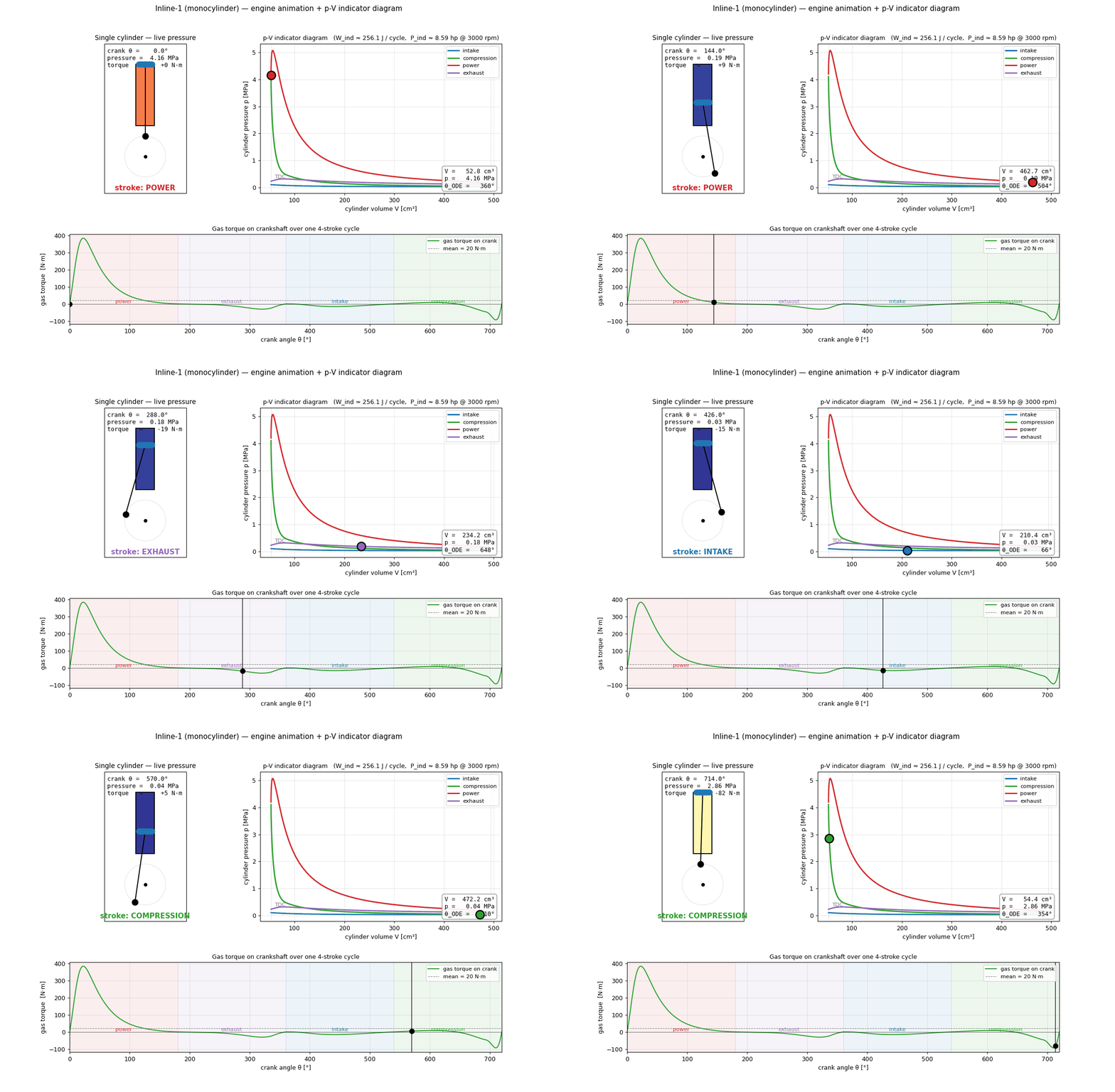
W Engine simulation
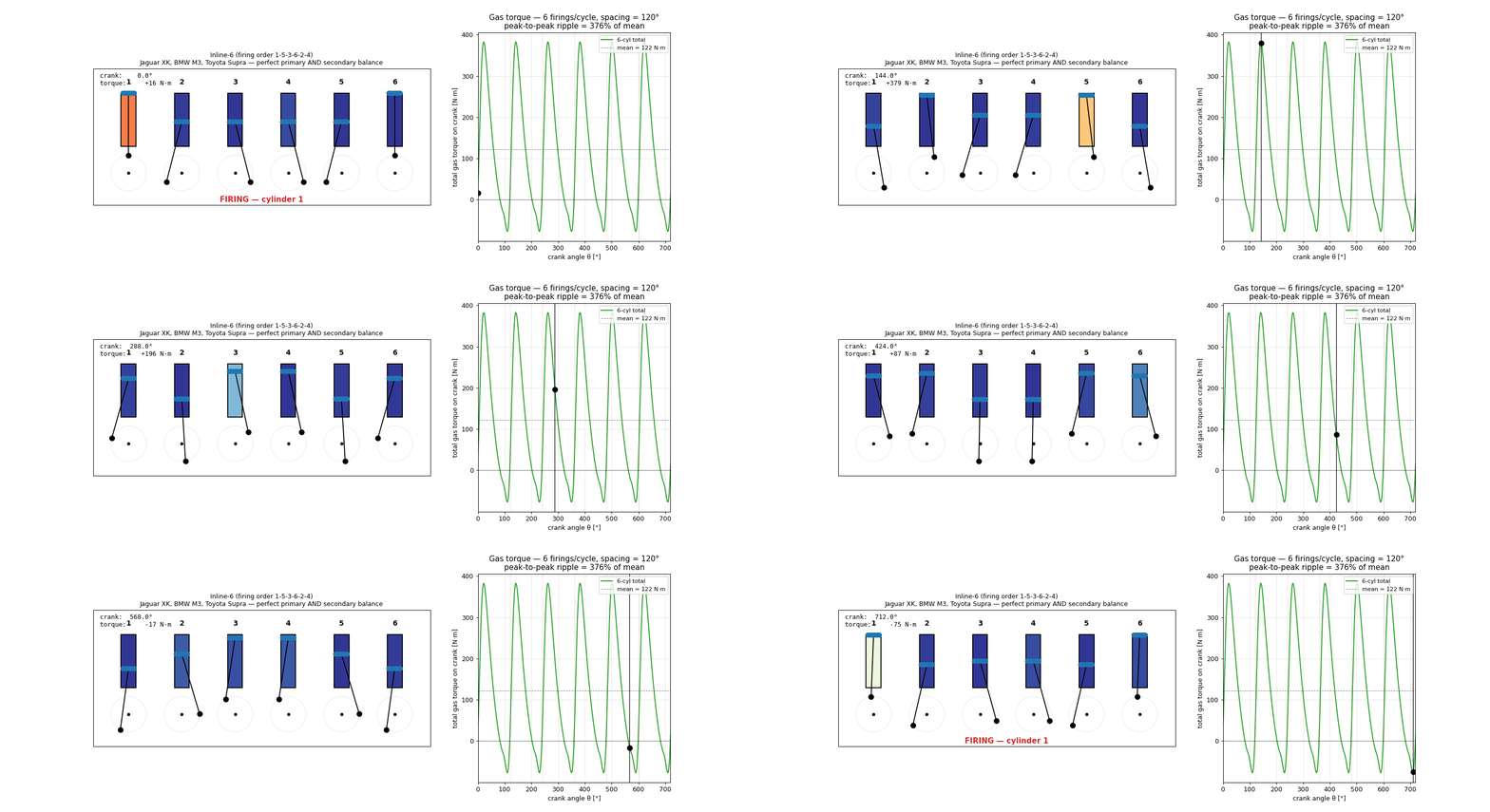
Recently I got to know that the W engine inside m4a’s was 5xI6 with 20L
Thats x30 of these:
Or x5 of these:
This is the W30 in action:
Those had a 24V battery system for the startup, which required ~500-1000A
meaning… ~24KW or ~30hp!
All of that to get started a ~300-400 hp @ 2400 rpm engine
Its crazy how much more compact and efficient engines had got along the way
Example: a laguna 1.9 td has 110cv and is fine with a 660Ah 12V battery
But, im telling this just to give you the simulation of the W engine, following the previous Inline and V posts:
Battery vs Gasoline
Gasoline completely dwarfs batteries in energy density—it is in an entirely different order of magnitude.
- Stored Energy Density (Raw Fuel vs. Power Station)
| Metric | Gasoline (Raw Fuel) | BLUETTI Power Station | Difference |
|---|---|---|---|
| Gravimetric (Energy per kg) | $\approx 12,200 \text{ Wh/kg}$ | $\approx 67 \text{ Wh/kg}$ | Gasoline is $\approx 180\times$ denser |
| Volumetric (Energy per Liter) | $\approx 9,700 \text{ Wh/L}$ | $\approx 38.6 \text{ Wh/L}$ | Gasoline is $\approx 250\times$ denser |
- Real-World Usable Energy (Accounting for Efficiency)
Gasoline must be burned in an internal combustion engine (like a portable gas generator) to generate electricity.
- Small portable gas generators convert heat into electricity at $\approx 15%\text{–}20%$ thermal efficiency (the remaining $80%\text{–}85%$ is lost as waste heat, noise, and friction).
- Battery power stations (like the BLUETTI) output electricity through an electronic inverter at $\approx 85%\text{–}90%$ electrical efficiency.
Practical Comparison: 1 Litre of Gasoline vs. the BLUETTI
- 1 Litre of Gasoline ($\approx 0.75 \text{ kg}$):
$$\text{Raw Energy} = 9,700 \text{ Wh} \xrightarrow{20% \text{ generator efficiency}} \mathbf{1,940 \text{ Wh usable electricity}}$$
- BLUETTI Power Station ($4.3 \text{ kg}$ total weight):
$$\text{Raw Stored Energy} = 288 \text{ Wh} \xrightarrow{85% \text{ inverter efficiency}} \mathbf{245 \text{ Wh usable electricity}}$$
Even after losing 80% of its energy as waste heat, 1 liter of gasoline (weighing under 1 kg) delivers roughly 8 times more usable electricity than this entire 4.3 kg power station.
- If Gasoline is So Dense, Why Use Portable Power Stations?
Gasoline wins on energy density, but batteries win on operational advantages:
- Zero Emissions & Quiet: Can be safely run indoors, inside tents, or in enclosed living spaces without carbon monoxide poisoning or engine noise.
- Instant Power Delivery: No pull cords, choke settings, or warming up.
- No Consumables / Zero Maintenance: No oil changes, spark plugs, carburetors cleaning, or fuel stabilization.
- Rechargability: Can be recharged directly from solar panels for off-grid sustainability.
Conversions
A 770 mAh capacity matches 5.5 Wh because the battery operates at a nominal voltage of 7.2 V (commonly used in 2-cell / 2S lithium-ion battery packs, such as camera batteries like the Panasonic DMW-BLG10).
The Formula
$$\text{Energy (Wh)} = \frac{\text{Capacity (mAh)} \times \text{Voltage (V)}}{1000}$$
The Calculation
- Convert mAh to Ah:
$$770 \text{ mAh} \div 1000 = 0.77 \text{ Ah}$$
- Multiply by Nominal Voltage (7.2 V):
$$0.77 \text{ Ah} \times 7.2 \text{ V} = 5.544 \text{ Wh} \approx 5.5 \text{ Wh}$$
- mAh (milliamp-hours) measures electric charge (how many current units the battery can release over time).
- Wh (watt-hours) measures total energy (taking into account the electrical force, or voltage, pushing that current).
Batteries use mAh and Wh instead of Joules because they align directly with how electrical devices are measured, used, and rated in real-world engineering and everyday life.
While Joules ($J$) is the SI unit for energy ($1 \text{ Wh} = 3,600 \text{ Joules}$), converting to Joules creates three major practical problems:
- The Numbers Get Unmanageably Large
A standard, small phone battery (e.g., 4,000 mAh at 3.85 V) holds 55,440 Joules.
- Joules: “This battery holds 55,440 Joules.”
- Wh: “This battery holds 15.4 Watt-hours.”
Watt-hours keep numbers in clean, human-friendly ranges (usually between 5 and 100 Wh for consumer electronics).
- Direct Math with Device Power Ratings
Electrical devices are rated in Watts ($W$), not Joules per second, in consumer markets.
Having the battery capacity in Watt-hours ($Wh$) makes calculating runtime instant:
$$\text{Runtime (Hours)} = \frac{\text{Battery Energy (Wh)}}{\text{Device Power Draw (W)}}$$
- Example: A laptop draws 15 W. If its battery is 60 Wh, it runs for $60 \div 15 = 4 \text{ hours}$.
- If capacity were given as $216,000 \text{ Joules}$, you would have to divide by $3,600$ every single time to calculate simple runtime.
- Current (mA) and Time (h) are What We Measure
Batteries deliver current over time.
- mAh (milliamp-hours) tells an electrical engineer how many milliamps of current the battery can output for how many hours at a given voltage.
- Since circuit components, LED displays, and chips draw specific amounts of current (e.g., a chip drawing 50 mA), knowing the mAh rating instantly tells you how many hours the system will run.
Unit Conversion Summary
| Unit | What it Measures | Formula | Best Used For |
|---|---|---|---|
| Joule (J) | Raw Energy | $1 \text{ J} = 1 \text{ Watt-second}$ | Physics, thermodynamics, fundamental science |
| Watt-hour (Wh) | Practical Energy | $1 \text{ Wh} = 3,600 \text{ J}$ | Battery capacity, airline travel limits, electricity bills |
| Milliamp-hour (mAh) | Electric Charge | $\text{Current (mA)} \times \text{Time (h)}$ | Single-cell battery sizing, device current draw |
Generally, yes. Rigid, standard Lithium-Ion (Li-ion) batteries store slightly more energy per kilogram (gravimetric energy density) than Lithium Polymer (LiPo) batteries.
- Li-ion (Standard Rigid Cells): $\approx 150 \text{ to } 250 \text{ Wh/kg}$
- LiPo (Flexible Soft-Pouch Cells): $\approx 100 \text{ to } 200 \text{ Wh/kg}$
Why Standard Li-ion Holds More Energy per kg
Electrolyte Composition: Traditional Li-ion uses a liquid organic electrolyte, which allows lithium ions to move very quickly and efficient chemical packing. LiPo uses a gel-like or polymer matrix electrolyte, which is slightly bulkier and less energy-dense at a chemical level.
Active Material Ratio: Standard cylindrical cells (like 18650 or 21070 cells) can compress active chemistry inside a rigid metal shell very tightly, packing more energy into the internal material relative to its weight.
The Trade-off: System vs. Cell Level
While pure Li-ion chemistry wins on raw energy density (Wh/kg), LiPo often wins on usable design efficiency depending on the application:
- Packaging & Casing: Standard Li-ion requires heavy metal cans (steel/aluminum) for individual cells. LiPo uses a lightweight aluminum-laminate foil pouch.
- Dead Space: Cylindrical Li-ion cells leave gaps when packed together. LiPo pouches lie flat, making them easier to fit into thin spaces (like smartphones, laptops, and custom drone frames) without wasting volume.
- Power Output (C-Rating): LiPo batteries deliver massive spikes of instant current (high burst power), making them preferred for RC drones and racing applications despite their slightly lower total Wh/kg capacity.
Standard Li-ion is optimal when aiming for maximum total energy capacity per kilogram (such as in long-range drones, power tools, or electric vehicles).